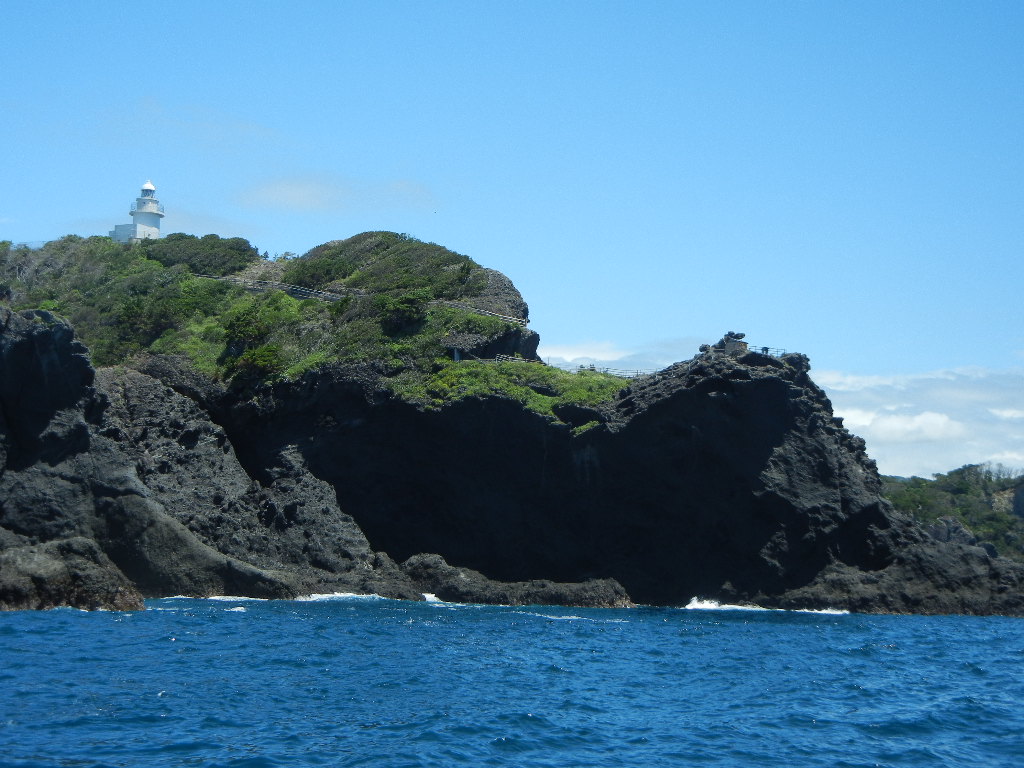
Irozaki Lighthouse
A 26-year-old Scottish railway engineer named Richard Henry Brunton arrived in Japan in 1868 with a crash course in lighthouse design from the famous Stevenson engineers of Edinburgh and a mandate from the new Meiji government to light up the most dangerous coastline in the Pacific. Within three years, he had built ten western-style lighthouses across the archipelago. The tenth, completed on October 5, 1871, was planted on the wind-scoured tip of Cape Irozaki, the southernmost point of the Izu Peninsula, where Sagami Bay meets Suruga Bay and the currents conspire to wreck ships on rocky reefs. That lighthouse still stands, rebuilt in concrete after the original wooden tower fell to a storm, its beam sweeping across waters that have claimed vessels for centuries.
The Father of Japanese Lighthouses
Japan's modernization in the Meiji era required, among many things, safe passage for the foreign ships now trading in its harbors. The Anglo-Japanese Treaty of Amity and Commerce of 1858 had specifically stipulated the construction of eight lighthouses, but the Meiji government recognized that far more were needed. They hired Richard Henry Brunton, born in Muchalls, Kincardineshire, Scotland, who would go on to design and supervise the construction of 26 lighthouses across Japan over seven and a half years. Brunton was more than a lighthouse builder; he surveyed and drew the first detailed maps of Yokohama, planned its sewage system and gas lighting, and helped found Japan's first school of civil engineering. But it was his lighthouses that earned him the title 'Father of Japanese Lighthouses.' The Irozaki light was not among the eight mandated by treaty, but the Meiji government gave it priority because of the sheer frequency of marine accidents off the Izu Peninsula, where submerged reefs and colliding currents made navigation treacherous.
Wood, Wind, and Concrete
Brunton designed the original Irozaki Lighthouse as an octagonal wooden structure, perched on a hill at the outermost extremity of Cape Irozaki. Construction began in July 1871 and was completed by October of the same year, a remarkably fast build even by Brunton's efficient standards. For sixty-one years, that wooden tower endured the typhoons and salt-laden gales that rake the cape. On November 14, 1932, a particularly violent windstorm finally brought it down. The replacement was built without sentiment: a reinforced concrete tower completed on March 31, 1933, designed to outlast any weather the Pacific could hurl at it. The lens was upgraded and the structure repaired again in 1993, but the essential form has endured. What stands today at Irozaki is a functional monument to the tension between nature's power and human stubbornness.
Where Two Bays Collide
Cape Irozaki is a place of dramatic geography. The Izu Peninsula juts south from the main body of Honshu like a crooked finger pointing into the Philippine Sea, and Irozaki is its final knuckle. To the west lies Suruga Bay, one of the deepest bays in Japan, with the snow-capped cone of Mount Fuji rising behind it. To the east lies Sagami Bay, opening toward the metropolis of Tokyo. The waters around the cape are where these two bodies of water exchange currents, creating unpredictable conditions that have always made this one of the most difficult stretches of Japanese coastline to navigate. The lighthouse sits within the borders of the Fuji-Hakone-Izu National Park, one of Japan's most visited protected areas, and on clear days the view from the cape extends across open ocean to the volcanic peaks of the Izu Islands strung out to the south.
Honored Among Fifty
The Japan Lighthouse Association has designated Irozaki as one of the '50 Lighthouses of Japan,' a recognition that considers not only the light's navigational importance but its historical and scenic significance. Operated by the Japan Coast Guard, the lighthouse continues its original mission of guiding vessels through dangerous waters, even as the cape has become a destination for travelers drawn by the rugged coastal scenery and the sense of standing at land's end. The walking path to the lighthouse passes through subtropical vegetation, and the hilltop platform where the tower stands offers a panoramic sweep of ocean and sky. Brunton could not have imagined, as he oversaw the raising of his wooden octagon in 1871, that his creation would still be serving the same purpose more than 150 years later, a beam of Scottish engineering persisting on a Japanese headland, one of the earliest symbols of a nation racing to remake itself.
From the Air
Irozaki Lighthouse sits at 34.603N, 138.845E at the southernmost tip of the Izu Peninsula. From the air, Cape Irozaki is unmistakable as the pointed terminus of the peninsula, with rocky coastline and the white lighthouse tower visible on the hilltop. The cape marks the boundary between Suruga Bay to the west and Sagami Bay to the east. Mount Fuji is visible to the north-northwest on clear days. The Izu Islands chain extends to the south. Nearest airport is Shimojishima Airport or approach from Shizuoka Airport (RJNS) to the west. Best viewed at 2,000-4,000 feet to appreciate the dramatic cape geography and surrounding national park coastline.