Ira F. Brilliant Center for Beethoven Studies
On the fifth floor of the Dr. Martin Luther King Jr. Library in downtown San Jose, past the stacks and study carrels of a working university library, sits a lock of hair cut from Ludwig van Beethoven's head the day after he died. The hair arrived here by way of Vienna, a Danish fishing village, a Sotheby's auction house in London, and an Arizona real estate developer with a passion for a composer who had been dead for more than 150 years. The Ira F. Brilliant Center for Beethoven Studies is the only institution of its kind in North America -- and its collection traveled a path almost as improbable as Beethoven's music.
A Real Estate Man's Obsession
Ira F. Brilliant was an Arizona real estate developer who collected Beethoven memorabilia the way other men collected cars or baseball cards -- methodically, passionately, and with an eye for the rare. In 1983, he donated his collection to San Jose State University with one condition: the university had to establish a center devoted entirely to Beethoven's life and works. The university agreed, and the center opened to the public in 1985. It was an unlikely marriage -- a Silicon Valley commuter university and an 18th-century Viennese composer -- but Brilliant's collection gave it credibility. In 1987, the center expanded significantly by acquiring the collection of William S. Newman, a Beethoven scholar and musicologist at the University of North Carolina at Chapel Hill, adding depth and academic rigor to what had begun as one man's passion project.
The Journey of the Guevara Lock
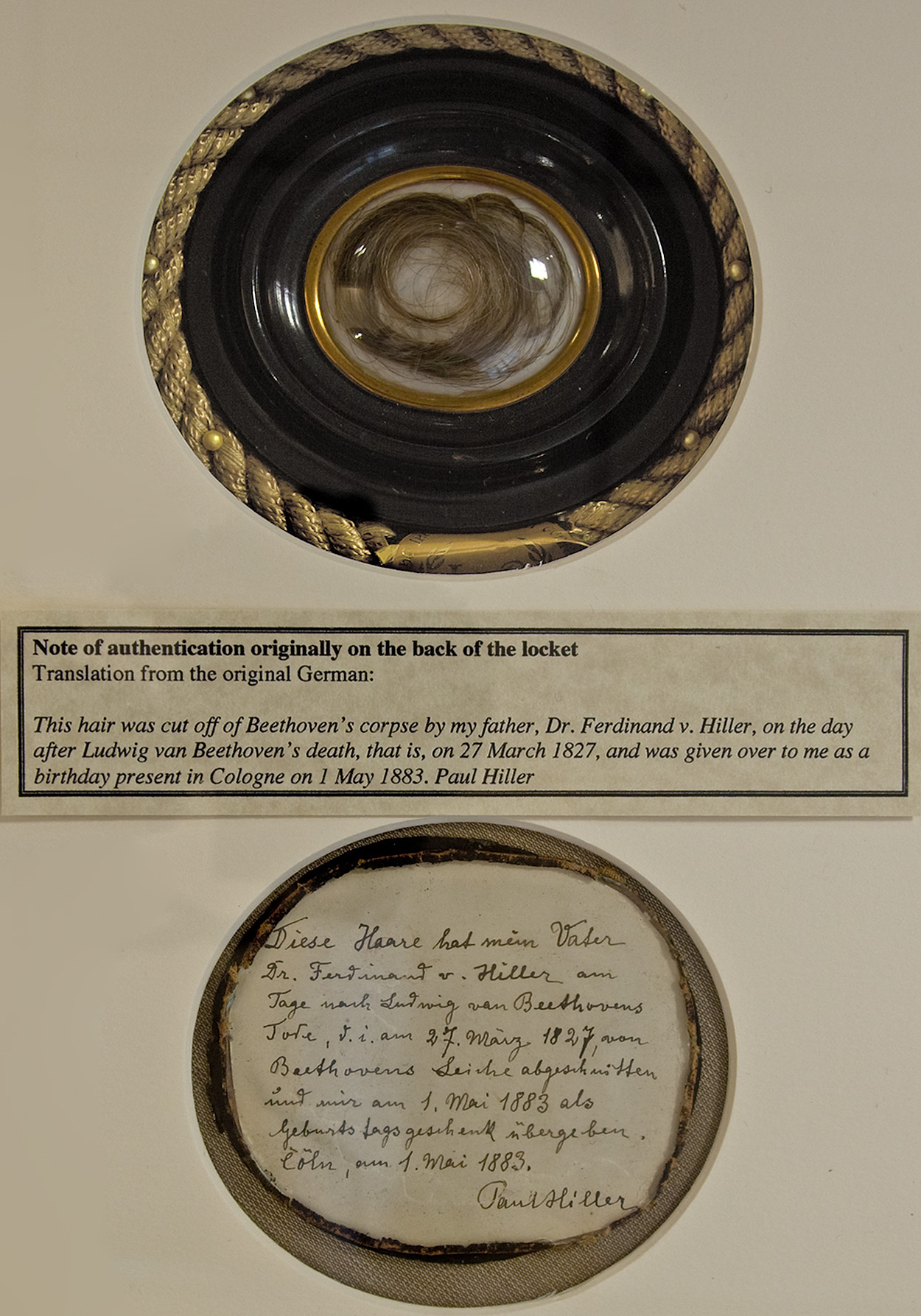
The center's most famous artifact is a lock of Beethoven's hair known as the Guevara Lock. On March 27, 1827 -- one day after Beethoven died -- a young German composer named Ferdinand Hiller cut the lock in Vienna and kept it in a locket, which he later gave to his son Paul. Paul Hiller inscribed the lock's history on the back of the locket, and then the trail goes cold. The hair resurfaced in 1943 in Nazi-occupied Denmark, given as payment to a doctor named Kay Alexander Fremming for treating Jewish refugees escaping the Holocaust. For half a century, the Fremming family kept it. In 1994, the estate put it up for auction at Sotheby's in London, where four members of the American Beethoven Society -- Dr. Alfredo Guevara, Ira Brilliant, Dr. Thomas Wendel, and Caroline Crummey -- purchased it for 3,600 pounds. The original lock contained 582 brown, white, and grey hairs, three to six inches long. The center now holds 422 of them, along with Hiller's original locket.
Four Thousand Books and a First Mention
Beyond the famous lock of hair, the center holds over 4,000 books and publications about Beethoven, including a rare 1783 issue of Cramer's Magazin der Musik -- the first time Beethoven's name appeared in print. He was twelve years old. The collection also includes photocopies of more than 8,000 articles and a microfiche archive of every Beethoven manuscript held by the Berlin State Library. For researchers, this is one of the richest Beethoven archives outside of Europe, a place where a scholar can trace the evolution of a sonata from manuscript sketch to published score without leaving a single building. Russell Martin chronicled the Guevara Lock's odyssey in his nonfiction book Beethoven's Hair, which brought the center unexpected public attention and cemented its reputation beyond academic circles.
Instruments You Can Play
The center displays several keyboard instruments from Beethoven's era: an original 1827 Viennese fortepiano, a reproduction of a 1795 Dulcken fortepiano, a clavichord, and a harpsichord. The Dulcken, clavichord, and harpsichord are not behind glass. Visitors can sit down and play them, pressing the same style of keys that Beethoven's fingers struck when he composed the Moonlight Sonata or the Emperor Concerto. A modern piano's hammers hit the strings with felt-covered heads; a fortepiano's hammers are covered in leather, producing a sound that is brighter, thinner, and more transparent. Playing one changes how you hear Beethoven. The fortissimo passages that thunder on a Steinway become something more intimate on the instrument the composer actually knew -- and in a library on the fifth floor, surrounded by his manuscripts and his hair, the intimacy feels earned.
From the Air
Located at 37.34N, 121.89W in downtown San Jose, California, inside the Dr. Martin Luther King Jr. Library on the San Jose State University campus. The library is a tall, modern building visible among the university's structures near the intersection of E San Fernando Street and S 4th Street. Nearest airports: Reid-Hillview (KRHV, 4nm E), San Jose International (KSJC, 4nm NW), Moffett Federal Airfield (KNUQ, 8nm NW). Best viewed at 2,000-3,000 feet AGL to identify the SJSU campus amid downtown San Jose's grid.