Iranian National Jewels
Somewhere beneath Ferdowsi Street in central Tehran, inside the vaults of the Central Bank of Iran, sits a collection of gemstones so valuable that it literally backs the country's currency. The Iranian National Jewels are not merely decorative relics of monarchy. They are a functioning financial reserve -- crowns, thrones, tiaras, and loose diamonds that successive governments, including the Islamic Republic, have deemed too economically essential to sell, too historically significant to hide, and too politically charged to ignore.
Plunder and Reclamation
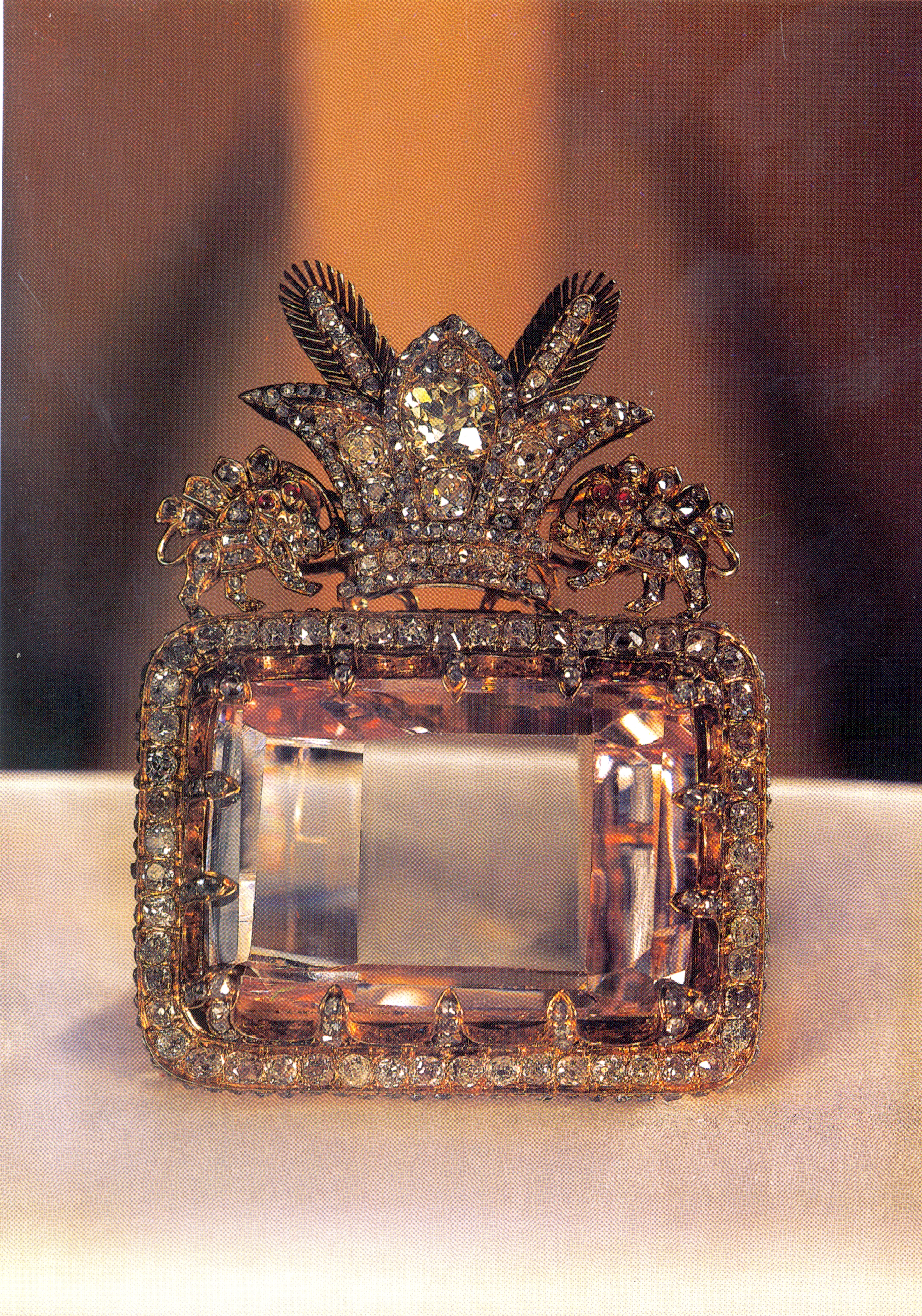
The collection traces its origins to the Safavid dynasty, which ruled Iran from 1502 to 1736 and amassed an extraordinary treasury of gemstones. When Afghan invaders sacked the Safavid capital of Isfahan in 1719, they carried the crown jewels away as plunder. It took a decade of internal war before Nader Shah drove the Afghans out of Iran. He did not stop there. In 1738, he launched his campaign into Afghanistan and northern India, ultimately sacking Delhi in 1739. Nader Shah returned to Iran with the recovered jewels and spectacular new acquisitions: the Koh-i-Noor diamond, the Darya-ye Noor ("Sea of Light"), the Peacock Throne, and the Samarian Spinel -- among the largest and most famous gemstones in the world. The Koh-i-Noor eventually passed to the British Crown, but the Darya-ye Noor, a pale pink diamond weighing an estimated 182 carats, remains the centerpiece of the Iranian collection.
A Kingdom's Vanity Table
The scale of the collection defies easy description. Thirty tiaras. A dozen jewel-encrusted swords and shields. Dining services cast in gold and studded with gems. The Royal Mace, a favorite of Fath-Ali Shah Qajar, stretches 73 centimeters and is encrusted from end to end with spinels and diamonds -- the largest diamond alone weighing 17 carats, with six spinels of 40 carats each ringing the top. Perhaps the most unusual item is a large golden globe with the continents rendered in rubies, sapphires, and diamonds while the oceans are made entirely of emeralds. Each piece tells a story of power projected through spectacle, of rulers who understood that visible wealth was itself a form of authority.
From Royal Vault to National Reserve
In 1937, Reza Shah Pahlavi made a decision that would inadvertently save the collection from revolutionary destruction. He transferred ownership of the jewels from the royal family to the Iranian state and deposited them in the vaults of Bank Melli Iran, where they served as collateral to strengthen the national monetary system. When his son, Mohammad Reza Shah, was crowned alongside Empress Farah in 1967, the coronation regalia came out of the bank vault and went back in afterward. The jewels were the state's, not the king's. This distinction proved critical when the Islamic Revolution swept away the Pahlavi dynasty in 1979.
Revolution and Survival
When revolutionaries toppled the monarchy, fears spread that the crown jewels had been looted or smuggled abroad in the chaos. Some smaller items did disappear across Iran's borders. But the bulk of the collection survived intact, protected less by ideology than by economics -- the Islamic Republic needed the gems as currency backing just as the Shah had. The revolutionary government kept the jewels locked away for years. It was not until the presidency of Hashemi Rafsanjani in the 1990s that the permanent exhibition reopened to the public inside the Central Bank. Visitors today descend into a heavily guarded vault on Ferdowsi Street to view crowns that once sat on the heads of shahs, displayed behind glass in a republic that abolished the institution of monarchy but could not afford to abolish its most glittering assets.
The Weight of Brilliance
The Treasury of National Jewels remains one of the most concentrated displays of gemstones anywhere on Earth. The Noor-ol-Ain tiara, set with a 60-carat pink diamond surrounded by smaller diamonds and emeralds, was crafted for Empress Farah's wedding in 1958. The Naderi Throne, built for Fath-Ali Shah in the early nineteenth century, is inlaid with 26,733 gemstones. The Pahlavi Crown, created for Reza Shah's 1926 coronation, holds 3,380 diamonds, 369 pearls, and five emeralds. These numbers begin to blur together, which is perhaps the point: the collection exists at a scale where individual gems cease to be remarkable and the sheer accumulation becomes the statement. That this statement now serves an Islamic republic rather than a monarchy is one of history's stranger ironies.
From the Air
The Treasury of National Jewels is located at 35.689°N, 51.420°E inside the Central Bank of Iran on Ferdowsi Street in central Tehran. The building sits in the dense commercial heart of the city, south of the Alborz mountain range. Mehrabad International Airport (OIII) is approximately 9 km to the west. Imam Khomeini International Airport (OIKB) is 50 km to the south. Tehran's elevation is roughly 1,200 meters on the Iranian Plateau. Best viewed at 3,000-5,000 feet AGL for city context.