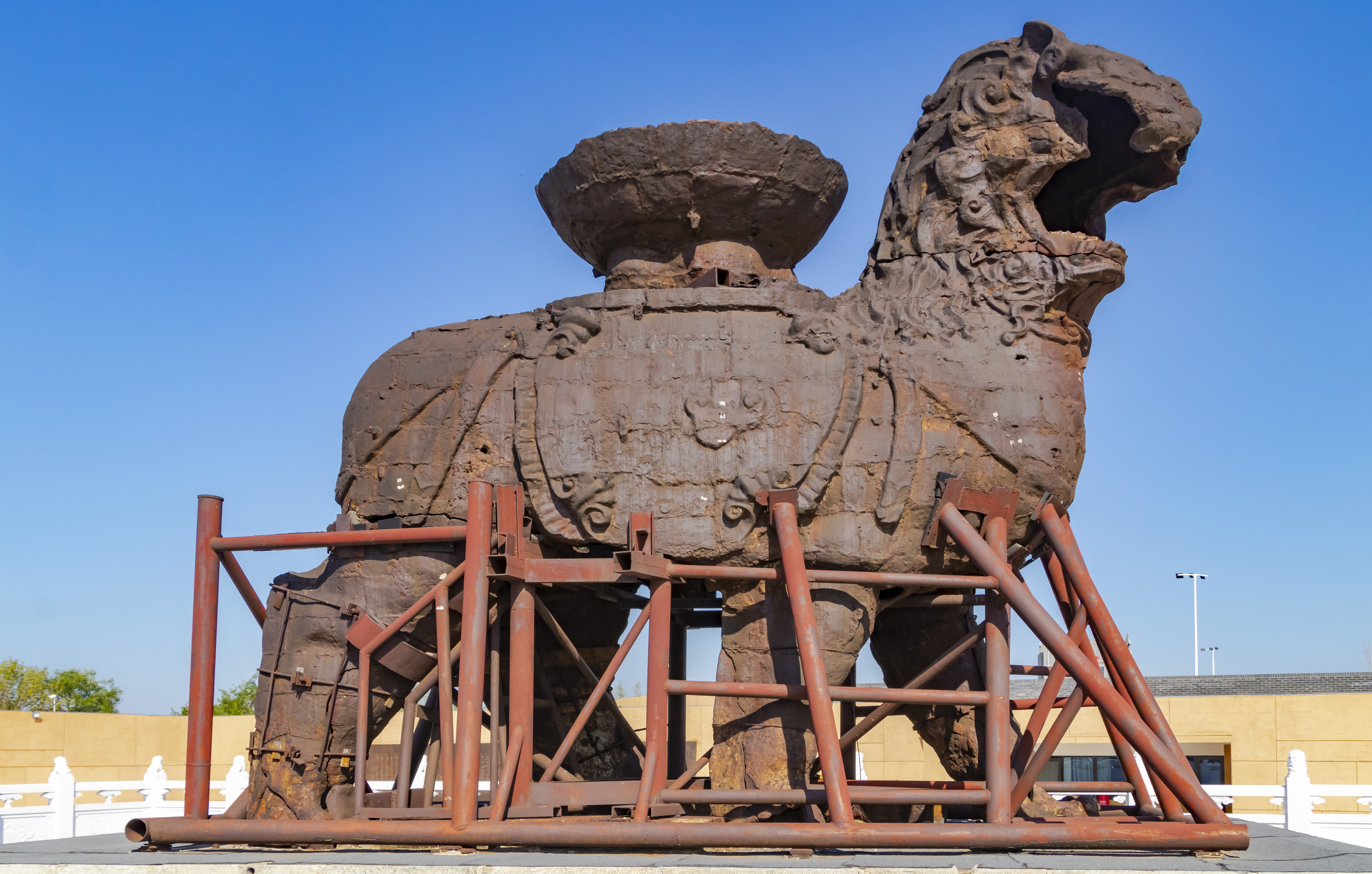
Iron Lion of Cangzhou
They called it the Sea-suppressing Howler. According to legend, the lion appeared from heaven and roared at an evil dragon that had been causing floods, ending the devastation with the force of its voice alone. The reality behind the Iron Lion of Cangzhou is no less extraordinary than the myth: cast in 953 AD during the Later Zhou dynasty, this 40-tonne sculpture is the largest known and oldest surviving iron-cast artwork in China. Standing 5.78 meters high and 6.5 meters long, it has endured for more than a thousand years in the open air of Hebei Province, a monument to metallurgical ambition that modern engineers still study with respect.
A Buddha's Missing Rider
On the lion's back sits a basin-shaped lotus throne, roughly two meters in diameter and 70 centimeters high. The throne was not decorative. It was designed to hold a bronze statue of Manjusri, the bodhisattva of wisdom, suggesting the iron lion was originally displayed inside a Buddhist temple as a sacred mount for the enlightened figure. At some point, the bronze Manjusri disappeared. Some scholars believe it was removed during the anti-Buddhist campaigns of Emperor Shizong of the Later Zhou dynasty; others suggest it was taken later, its high-value bronze too tempting to leave unguarded. Whatever the timing, the lion has stood riderless for centuries, the empty lotus throne a reminder of the sculpture's original sacred purpose and of the vulnerability of precious objects across political upheavals.
The Art of Molten Iron
The casting technique used to create the lion reveals a level of metallurgical sophistication that astounded scholars when it was first carefully studied. The sculpture was made using a piece-molding method in a single mold. Craftsmen first built a clay model of the lion, covered it with an outer layer of clay, then cut this outer shell into sections and removed it before it dried completely. They then shaved material from the inner model to create space for pouring molten iron between the core and the reassembled outer mold. The visible seams on the sculpture are not joints between separate iron pieces but impressions left by the seams between sections of the outer mold. Casting proceeded in stages, with each pour cooling before the next was added. To bridge the fault lines between pours, workers plunged pieces of wrought iron into the solidifying surface, then covered them with the next pour -- an ingenious solution whose traces can still be found in the sculpture today.
One of Hebei's Four Treasures
The Iron Lion is counted among the Four Treasures of Hebei, a designation that reflects its status as one of the province's most culturally significant artifacts. The local poet Ji Ruiqi celebrated the sculpture during the Qing period, and the lion has been a cultural icon of Cangzhou for centuries. The city has embraced the lion as a symbol -- a full-size recreation stands in a public square, and the original's image appears throughout the area. For a city located 180 kilometers southwest of Beijing, the Iron Lion provides a point of identity that reaches back more than a millennium, connecting modern Cangzhou to the industrial and artistic achievements of the Later Zhou dynasty.
Shelter After a Thousand Years
For most of its existence, the Iron Lion stood exposed to rain, wind, and the freeze-thaw cycles of northern China's continental climate. The toll of those centuries is visible in the sculpture's surface, which has weathered and corroded over time. In 2021, a massive roof was finally built over the statue to protect it from further deterioration, part of a new archaeological park constructed around the lion. The shelter came late -- more than a thousand years of exposure had already left its mark -- but the investment signals a recognition that some objects are worth extraordinary effort to preserve. The Iron Lion of Cangzhou now stands as it perhaps should always have: a centerpiece, protected, still roaring silently at whatever dragons remain.
From the Air
Located at 38.21°N, 117.02°E in Cangzhou City, Hebei Province, approximately 180 km south-southwest of Beijing. The Iron Lion archaeological park includes a large protective roof structure that may be visible from lower altitudes. Nearest airports include Cangzhou Airport and Tianjin Binhai International Airport (ZBTJ), approximately 100 km to the north. Recommend viewing at 2,000-4,000 ft to spot the park complex within the urban area of Cangzhou.