Iron Mountain Mine
Deep inside a fractured mountain nine miles northwest of Redding, California, water flows that defies what most people think possible: a pH of negative 3.6, making it the most acidic water naturally occurring anywhere on Earth. Iron Mountain Mine spent a century yielding iron, gold, silver, copper, and zinc before closing in 1963, but the chemistry set loose by those operations continues its work underground. The mountain bleeds acid into creeks that feed the Sacramento River, threatening endangered Chinook salmon and the drinking water of 70,000 people. Listed as a Superfund site since 1983, this scarred peak in the Klamath Mountains stands as one of America's most toxic legacies.
A Century of Extraction
Thomas Jefferson Harrison, Robert Lyon, and Stephan Alozo Meek discovered valuable mineral deposits at Iron Mountain in 1852, during California's gold rush fever. What they found was a massive sulfide ore deposit, a geological formation packed with iron, silver, gold, copper, zinc, quartz, and pyrite. The Mountain Copper Company eventually took over operations, attacking the ore from above and below: open-pit and sidehill mining scarred the surface while underground crews carved out chambers using open stope techniques. At the operation's peak, more than two hundred stamp mills pounded away, crushing ore into manageable pieces. The mountain's structure never recovered. When mining ceased in 1963, the fractured rock remained exposed to oxygen, rainwater, and something no one anticipated: hungry bacteria.
Chemistry of Destruction
The abandoned mine workings, waste rock dumps, and tailings piles left behind created a slow-motion environmental catastrophe. When pyrite meets moisture and oxygen, sulfuric acid forms. That acid seeps through the fractured mountain, dissolving copper, cadmium, zinc, and other heavy metals as it goes. The toxic soup emerges from seeps and portals, finding its way into Boulder Creek, Slickrock Creek, and Spring Creek before reaching the Sacramento River system. Water temperatures underground reach 117 degrees Fahrenheit. Samples collected in 1990 and 1991 recorded pH values of negative 3.6, numbers so extreme they challenge chemical intuition. To put that in perspective: battery acid typically registers around pH 1. The drainage has effectively eliminated aquatic life in the creeks immediately downstream of the mine.
Life in the Extreme
The hostile environment inside Iron Mountain has attracted attention from scientists studying life at its limits. A pink biofilm, several millimeters thick, floats on pools of hot water with a pH of 0.8. This living mat consists of bacteria like Leptospirillum and archaea like Ferroplasma, organisms that thrive in conditions that would dissolve most organic matter. These microbes cannot be isolated and cultured using traditional methods, so researchers performed community sequencing, reading the DNA of five dominant species simultaneously and assembling their genomes afterward. In 2004, scientists identified four entirely new species this way. A year later, they catalogued 2,033 proteins produced by the biofilm community, 572 of which were unique to this extreme ecosystem. The bacteria survive by oxidizing iron dissolved from the rock, producing more sulfuric acid in the process.
Managing the Unmanageable
The Environmental Protection Agency designated Iron Mountain Mine a Superfund site in 1983, recognizing the scale of contamination threatening Northern California's water supply. A treatment plant went online in 1994 to intercept acid drainage before it could reach the Sacramento River. In 2000, the federal government reached a settlement with Aventis CropScience, now part of Bayer, to fund long-term cleanup efforts. The Bureau of Reclamation coordinates releases from Spring Creek Reservoir, timing discharges to coincide with diluting flows from Shasta Dam. When the system works, heavy metal concentrations stay within tolerable limits. When Spring Creek Reservoir reaches capacity, as it has during wet years, uncontrolled spills release harmful quantities of copper, zinc, and cadmium into the Sacramento River.
Salmon and Stalactites
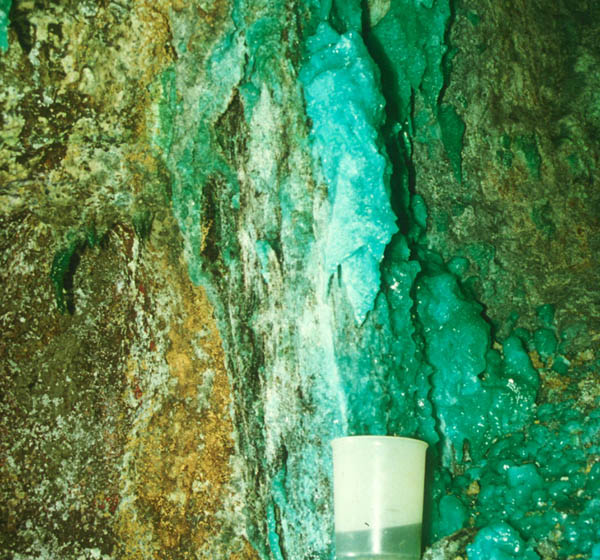
The stakes of managing Iron Mountain's drainage include the survival of winter-run Chinook salmon, a federally listed endangered species that spawns in the Sacramento River downstream. Fish kills linked to the mine have been documented since 1899. The drainage poses a constant threat to approximately 70,000 people who draw drinking water from surface sources within three miles of the contaminated creeks. Yet the mine also harbors strange beauty. Huge stalactite and stalagmite formations span from floor to ceiling inside the mine openings, built not from calcium carbonate like limestone caves but from rhomboclase and other iron sulfate minerals. These structures grow in a world of acid and heat, monuments to chemistry running wild in a mountain humans broke open over a century ago.
From the Air
Iron Mountain Mine sits at 40.67N, 122.53W in the Klamath Mountains of Shasta County, approximately 9 miles northwest of Redding. From 6,000 feet, the scarred terrain is visible, with exposed rock and waste piles marking the former mining operations. Spring Creek Reservoir and Keswick Reservoir are visible to the south, where the acid drainage ultimately flows. Redding Municipal Airport (KRDD) lies 10 nautical miles to the southeast. Shasta Dam and Lake Shasta dominate the northern view. The area receives heavy precipitation from October through March; summer months offer clearest visibility.