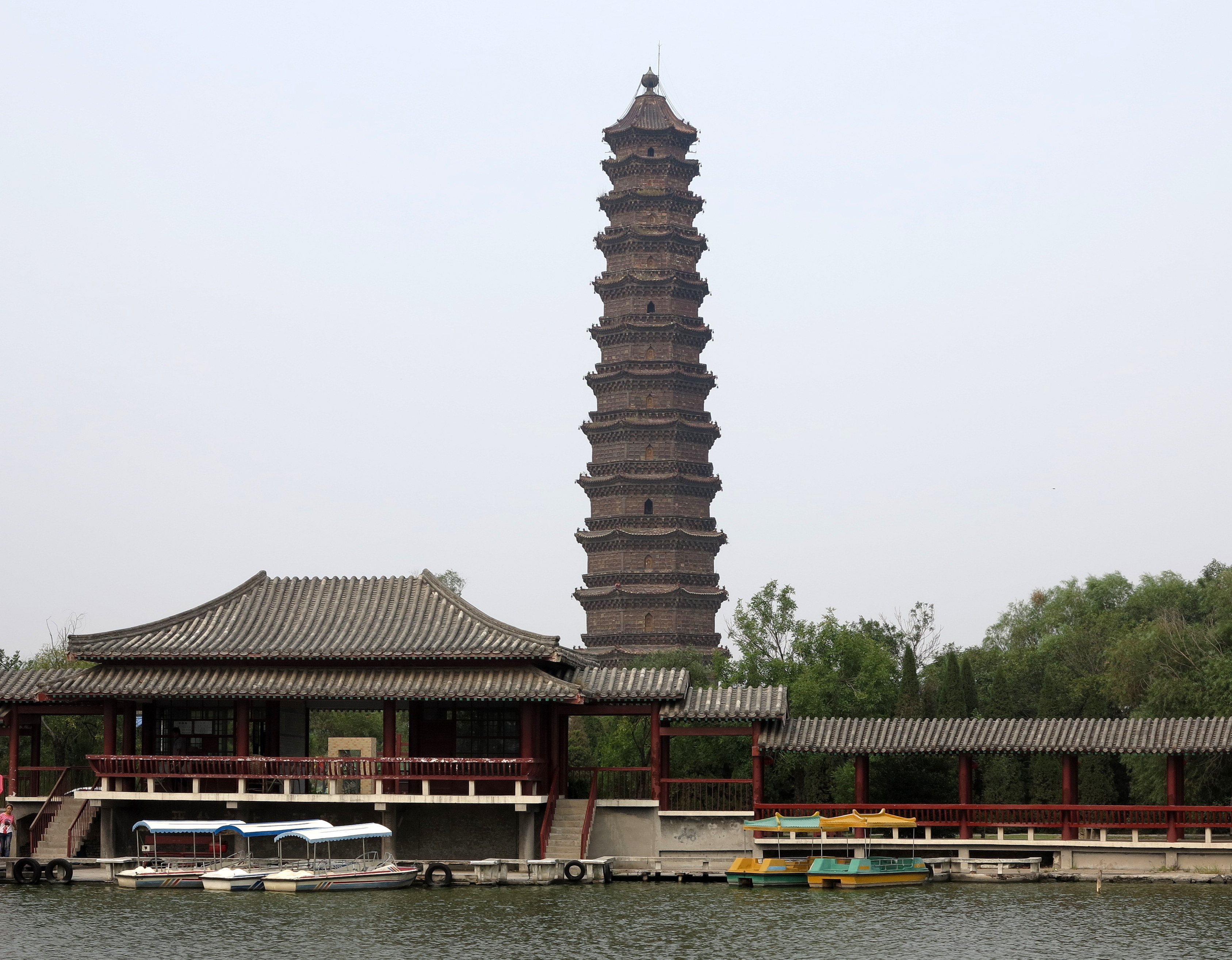
Iron Pagoda
The name is a trick of the eye. Kaifeng's Iron Pagoda contains no iron. Its bricks are faced with glazed tiles of such a deep, dark brown that from a distance the entire structure appears to be cast metal, and the name stuck. Built in 1049 during the Northern Song dynasty, the pagoda has stood for nearly a thousand years on the spot where a magnificent wooden predecessor, designed by the celebrated architect Yu Hao, burned to the ground after a lightning strike in 1044. The replacement was built to last, and it has -- through floods, earthquakes, wars, and the slow grind of centuries that has toppled almost everything else from Kaifeng's imperial age.
A Phoenix from Ashes
Yu Hao's original wooden pagoda, built as part of Youguo Temple between 965 and 995 CE, was considered one of the great architectural marvels of its time. Its destruction by lightning fire in 1044 was a significant cultural loss for the Song capital. The brick replacement, completed five years later, borrowed nothing from its predecessor's material but inherited its ambitions. Rising from an octagonal base to a height of 56.88 meters across thirteen stories, the Iron Pagoda is a solid-core tower with an inner spiral stone staircase and exterior openings that admit both light and ventilation. Its architectural style combines the densely positioned dougong bracket sets of the miyan (closely-spaced eave) tradition with the vertical drama of multi-story louge construction.
Tile by Tile
The pagoda's distinctive appearance comes from its cladding -- thousands of individually molded and glazed tiles covering the brick structure beneath. Each tile was fired to produce the iron-dark brown that gives the tower its misleading name. The craftsmanship required to produce, fire, and assemble these tiles at scale was extraordinary for the eleventh century, and the result has proved remarkably durable. Inside the pagoda, frescoes depict scenes from classical Chinese tales, including The Journey to the West. Along with the Liuhe, Lingxiao, Liaodi, Pizhi, and Beisi pagodas, the Iron Pagoda is considered one of the masterpieces of Song dynasty architectural achievement -- a group of structures that collectively demonstrate the period's advances in engineering, materials science, and aesthetic refinement.
Still Standing in a Drowned City
Kaifeng sits on one of the most flood-prone stretches of the Yellow River. Over the centuries, the river has repeatedly buried the city under layers of silt, raising the ground level so dramatically that entire previous versions of Kaifeng lie meters below the modern surface. The Iron Pagoda survived where almost nothing else from the Song era did, in part because of its solid brick construction and in part because of the slight elevation of its temple grounds. In 1994, it was honored with a place on a two-yuan Chinese postage stamp -- a small recognition for a structure whose real distinction is simply that it remains. In a city where the river has swallowed palaces, walls, and entire neighborhoods, the Iron Pagoda persists as Kaifeng's most tangible connection to the dynasty that made it great.
From the Air
Located at 34.82N, 114.36E in northeastern Kaifeng, Henan province. The pagoda stands 56.88 meters tall and is one of the tallest structures in the old city area, potentially visible from moderate altitude. Nearest major airport is Zhengzhou Xinzheng International (ZHCC/CGO), approximately 75 km west. The flat Yellow River plain surrounds the city.