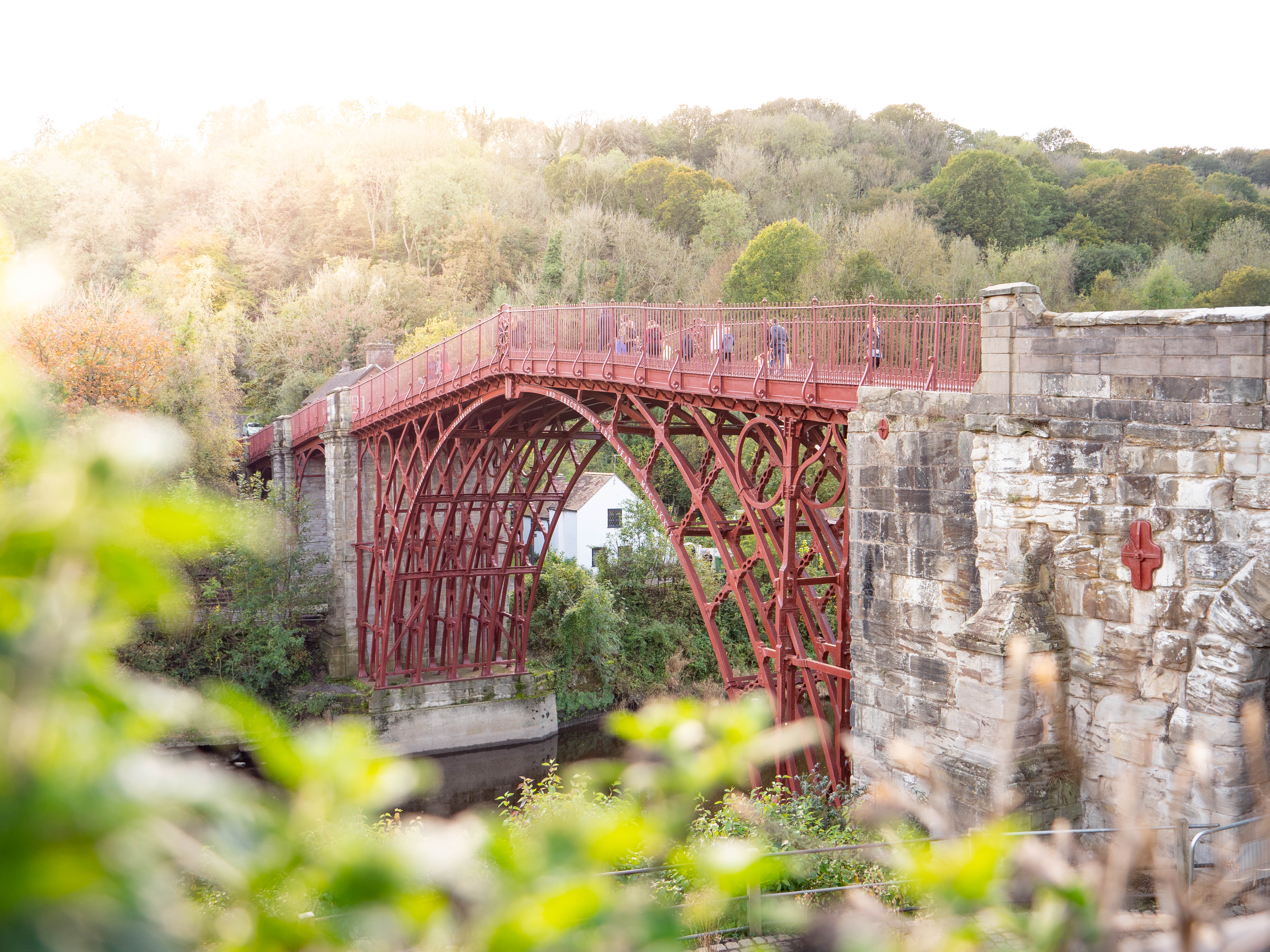
Ironbridge
Before 1781, this place had no name of its own. It was Madeley Wood, a scattered settlement on the north bank of the River Severn, tucked into the steep walls of the gorge. Then Abraham Darby III opened his revolutionary cast iron bridge on New Year's Day 1781, and almost overnight the settlement found its identity. A new market square replaced the ancient one at Madeley. The Tontine Hotel rose to accommodate the visitors who came specifically to marvel at the bridge. The village of Ironbridge -- named for the structure that made it -- became the commercial and administrative center of the Coalbrookdale coalfield, a place that existed because a bridge proved iron could do what stone and timber had always done before.
Born from a Bridge
The bridge that gave Ironbridge its name was designed by Thomas Farnolls Pritchard and built by Abraham Darby III to link the industrial town of Broseley with Madeley and the growing center of Coalbrookdale. Construction began in 1779, and the 100-foot cast iron span opened to traffic on January 1, 1781. The bridge's proprietors immediately understood they had created something worth seeing: they built the Tontine Hotel facing a new square to accommodate curious visitors. Across that square stands a bronze war memorial erected in 1924, a First World War soldier in marching order sculpted by Arthur George Walker. The village grew uphill from the river, its architecture tracking the decades: a 16th-century hunting lodge on Lincoln Hill, 17th- and 18th-century workers' cottages, Georgian houses built by ironmasters and mine owners, and Victorian villas constructed from the colorful local bricks and tiles.
A Church Built Backward
St Luke's Church, built in 1837 in Commissioners' Gothic style by Samuel Smith of Madeley, is one of Ironbridge's quiet oddities. Walk inside and you discover the sanctuary is at the west end and the tower at the east -- the reverse of nearly every other church in England. The reason is entirely practical: the land at the west end was unstable, unable to bear the weight of a tower, so the architect simply flipped the traditional plan. The stained glass, by David Evans of Shrewsbury, fills windows that look out over the gorge. The church bells were installed in 1920 as a memorial to parishioners who died in the First World War, and the external clock was later illuminated in memory of those lost in the Second. Even the most functional buildings in Ironbridge carry layers of history.
The River's Revenge
Living beside the Severn has always meant living with floods. Ironbridge's Wharfage -- the riverside street that accommodates pubs, homes, and shops -- floods with grim regularity. Since 2004, portable flood barriers have been erected during high water, but these are not always enough. In February 2020, storms Ciara and Dennis sent such volumes of rainfall that the barriers were overwhelmed, forcing a full evacuation of Wharfage residents. The river rose again in February 2022, flooding the museums for a third consecutive year. This recurring struggle between settlement and river is older than the bridge itself: the Severn's tendency to flood is the reason the gorge exists at all, carved by glacial meltwater that found no other outlet.
Unlikely Fame
Ironbridge has produced a surprisingly eclectic roster of notable residents for a village of its size. Billy Wright, born here in 1924, played 490 games for Wolverhampton Wanderers and became the first footballer in the world to earn 100 international caps. Roger Squires, who lived in Ironbridge, held the Guinness record as the world's most prolific crossword compiler. Thomas Parker, the electrical engineer and inventor, spent his final years at Severn House from 1908. The Rogers family built and used coracles on the Severn for generations, from 1778 to 2003, and an annual Coracle Regatta still takes place each August. Today the Ironbridge Gorge Museum Trust operates ten museums across the World Heritage Site, collectively telling the story of the Industrial Revolution through the places where it happened.
From the Air
Located at 52.63N, 2.49W on the north bank of the River Severn in the Ironbridge Gorge, Shropshire. The village clusters around the iconic Iron Bridge, visible at low altitude as a distinctive arch spanning the river. Nearest airports: EGBO (Wolverhampton Halfpenny Green, 12nm SW), EGBJ (Gloucestershire, 40nm S). Best viewed at 1,000-2,000 ft AGL following the river.