Ironbridge Gorge
An ice age made this place possible. When glacial waters burst from the vanished Lake Lapworth and carved a deep channel through the Shropshire hills, they exposed seams of coal, iron ore, limestone, and fireclay in the gorge walls -- materials that would not normally sit so conveniently together, so close to the surface, beside a navigable river. The River Severn flowed through this accidental treasury, offering a highway to the Bristol Channel and the wider world. By the time Abraham Darby first smelted iron with coke in nearby Coalbrookdale in 1709, the gorge had already been giving up its riches for centuries. What followed would earn it a title no landscape expects: UNESCO World Heritage Site, birthplace of the Industrial Revolution.
Geology Written in Ice
The Ironbridge Gorge was not always here. Before the last ice age, the River Severn flowed northward. When the Irish Sea ice sheet advanced, it dammed the river and created Lake Lapworth, a vast body of meltwater that grew until it found the lowest point in the surrounding hills and poured through. That catastrophic overflow carved the gorge, permanently redirecting the Severn southward toward the Bristol Channel. The violence of that erosion did something remarkable: it sliced through geological layers like a knife through cake, laying bare commercial deposits of coal, ironstone, limestone, and clay on both banks. What took geological ages to deposit, glacial force made accessible in a geological instant. The gorge is roughly half a mile deep in places, its steep wooded sides still bearing the scars of that ancient flood.
The Forge of Industry
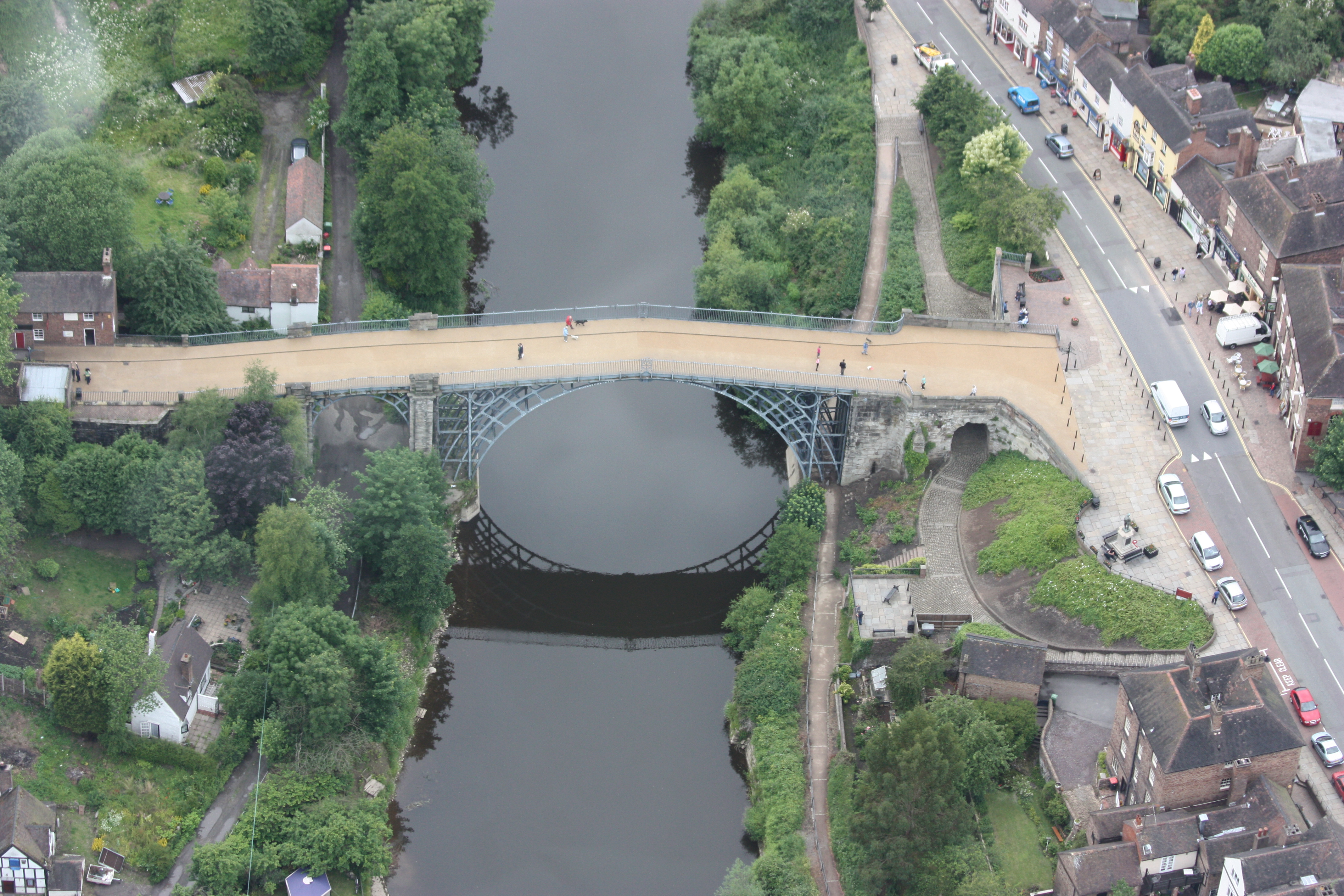
Two factors made the Ironbridge Gorge irresistible to early industrialists. First, the raw materials for manufacturing iron, tiles, and porcelain lay exposed or easily mined in the gorge walls. Second, the River Severn -- deep and wide -- carried finished goods downriver to the sea. In 1709, Abraham Darby I perfected the technique of smelting iron ore with coke rather than charcoal at his furnace in Coalbrookdale, dramatically reducing costs. His grandson, Abraham Darby III, would later build the famous Iron Bridge in 1779, linking the industrial towns of Broseley and Madeley across the gorge. The settlements that grew along the valley -- Coalbrookdale, Coalport, Jackfield, Ironbridge itself -- each specialized in different trades: iron at Coalbrookdale, porcelain at Coalport, decorative tiles at Jackfield. Together they formed an industrial ecosystem unlike anything the world had seen.
A Living Museum
Today ten museums operated by the Ironbridge Gorge Museum Trust preserve the memory of those industries across the World Heritage Site. Blists Hill Victorian Town recreates a working community from the late 1800s, complete with costumed staff and functioning shops. The Coalbrookdale Museum of Iron stands beside the very furnace where Darby first used coke. The Jackfield Tile Museum occupies a former tileworks, and the Tar Tunnel -- a natural bitumen seep discovered during mining in 1787 -- remains one of the gorge's stranger attractions. The Severn Gorge Countryside Trust manages roughly 260 hectares of woodland and grassland within the heritage site, preserving the landscape that industry once stripped bare. Green Wood Centre has spent over two decades training new coppice workers, reviving ancient woodland crafts in the valley that pioneered mechanized ones.
The Gorge Today
About 3,275 people live in the Gorge civil parish, within the borough of Telford and Wrekin. It is a quiet place now, the furnaces long cold, the river traffic replaced by canoeists and coracle enthusiasts. The steep wooded hillsides that once rang with hammers and bellows have returned to birdsong. Walking the gorge's paths, you pass 16th-century hunting lodges, Georgian ironmasters' houses, and Victorian workers' cottages built from the colored bricks and tiles of local manufacture. The contrast between past intensity and present calm gives the gorge its particular atmosphere -- a landscape that changed the world, then stepped back to let the trees reclaim it.
From the Air
Located at 52.63N, 2.47W along the River Severn in Shropshire. The gorge is visible as a distinctive wooded valley cutting through rolling farmland. The Iron Bridge is identifiable at low altitude. Nearest airports: EGBO (Wolverhampton Halfpenny Green, 12nm SW), EGBJ (Gloucestershire, 40nm S). Best viewed at 1,500-2,500 ft AGL for the full gorge profile.