Ironwood Theatre
The first film ever screened at the Ironwood Theatre was Wings, the 1927 World War I epic starring Clara Bow and Gary Cooper that would go on to win the first Academy Award for Best Picture. Eighty-two years later, when volunteers finished restoring the theatre's original 1928 Barton pipe organ, they chose the same film for the rededication ceremony. That act of symmetry says everything about this place. The Historic Ironwood Theatre, designed in Italian Renaissance style by self-taught Ironwood architect Albert Nelson, was built in 1928 at a cost of $160,000. It seated 1,000 people, showed first-run films and vaudeville acts, and served as the cultural heart of a remote mining city in Michigan's Upper Peninsula. Then it nearly disappeared.
Vaudeville, Hollywood, and Collapse
Under the direction of A.L. Pikar, the Ironwood Theatre flourished through Hollywood's Golden Age. Through the 1930s, 40s, and 50s, it was one of three movie houses in town, presenting first-run films alongside live vaudeville shows. The Italian Renaissance interior -- hand-sculpted faux pillars, an arched proscenium stage, and a three-piece canvas mural by artist William Hasenberg painted during the final stages of construction in 1927 -- made the theatre feel grander than a small mining town might suggest. But as Ironwood's mines closed and its population shrank, the economics of running a thousand-seat movie palace became impossible. Financial difficulties mounted through the 1970s, and in the spring of 1982, the Ironwood Theatre closed its doors. Owner Thomas Renn donated the building to the City of Ironwood through the Downtown Ironwood Development Authority. For six years, the theatre sat dark.
The Grand Old Lady on Her Pedestal
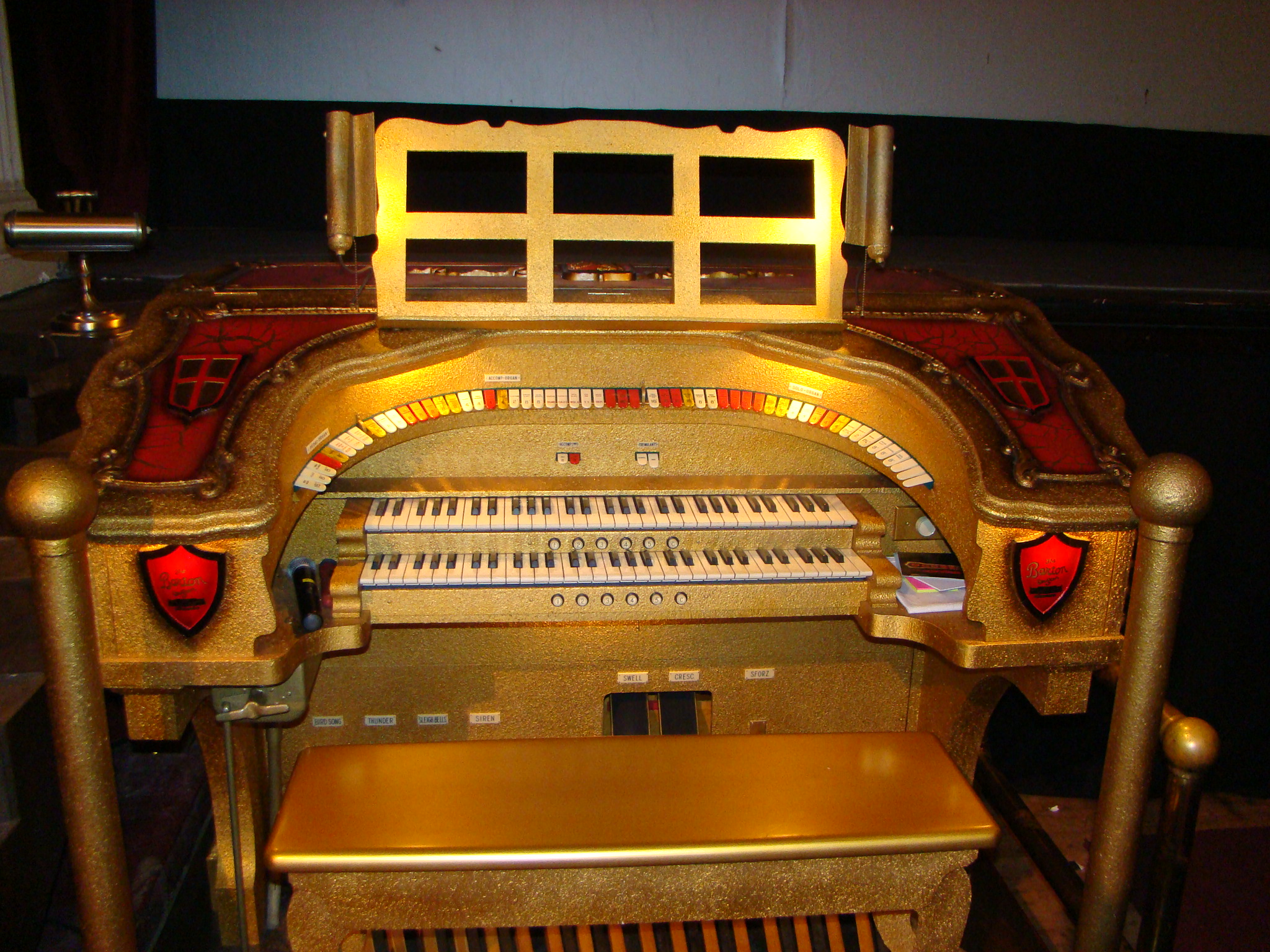
Through all those years of closure, the Barton pipe organ never left. Nicknamed "The Grand Old Lady," the 2-manual, 7-rank, 499-pipe instrument sat on its original 1928 pedestal while the theatre around it went silent. Restoration began in 2000 under Dr. Tom Peacock's direction. Volunteers -- taught by experts -- inspected and repaired the console, pipes, valves, and wiring. Every leather component was replaced. Over 700 solder connections on the back of the console were redone. The console itself was sent to the Carlton Smith Pipe Organ Restoration company and returned in June 2010, completing a decade of painstaking work funded by grants and donations. Of the roughly 250 pipe organs the Barton Organ Company ever built, the Ironwood Theatre's instrument is one of an estimated 40 still in their original homes, and one of only six documented Bartons that remain playable. As of 2010, it was the most recently restored Barton in existence.
A Mural Beneath the Paint
During a 1973 renovation, workers painted the theatre's proscenium mural and surrounding ceiling with dark blue and white paint. The three-piece canvas painting by William Hasenberg -- created to give the theatre its finishing grandeur -- was assumed destroyed. Two decades later, muralist David Strickland proved otherwise. Through careful restoration work in 1994, Strickland successfully removed the overpaint without damaging the original artwork beneath. The mural emerged intact, returned to its 1927 appearance, and now catches the eye of every visitor who steps into the auditorium. The rescue of the Hasenberg mural mirrors the theatre's own story: something valuable, buried under layers of expedient decisions, waiting for someone patient enough to bring it back.
Volunteers Keep the Lights On
The Ironwood Theatre reopened in 1988 as a nonprofit cultural organization, operated by Ironwood Theatre Inc. and a volunteer board of directors. In 2010, the city purchased the adjacent Seaman building, renamed it City Centre, and expanded the theatre's footprint with a concourse, elevator, new restrooms, offices, and a catering kitchen. The auditorium now seats 732 -- 480 on the main floor and 252 in the balcony -- with replica chairs matching the 1928 originals. The stage has hosted Jeff Daniels, the Detroit Symphony Orchestra, American Idol finalist Matt Giraud, productions of South Pacific and Chicago, and the Lake Superior Big Top Chautauqua. The American Theatre Organ Society announced plans to open an Upper Peninsula chapter anchored at the Ironwood Theatre. In a town of just over five thousand people, this volunteer-run venue consistently punches above its weight -- proof that a community that refuses to let a building die can turn stubbornness into art.
From the Air
Located at 46.454N, 90.169W in downtown Ironwood, Michigan, in the Upper Peninsula. The theatre is in the city center, not individually visible from altitude but located within the downtown grid visible along US Highway 2. Gogebic-Iron County Airport (IWD/KIWD) is approximately 7 nm northeast with a 6,502-foot runway. The Montreal River forming the Michigan-Wisconsin border is visible immediately west. Lake Superior's shoreline lies to the north. Best appreciated as part of the broader Ironwood cityscape from 2,000-4,000 feet.