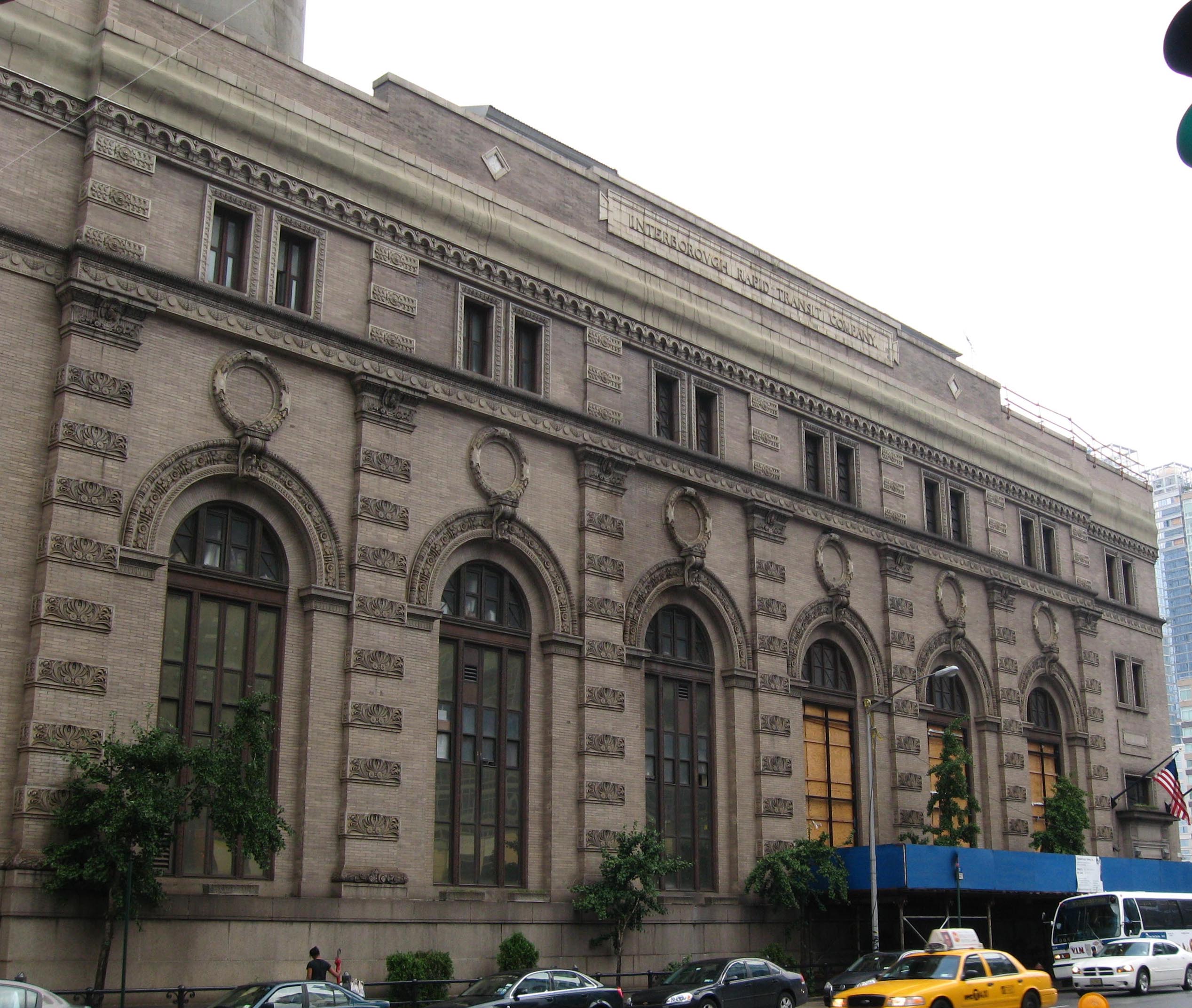
IRT Powerhouse
Stanford White designed palaces. That one of them was a power plant says everything about the ambitions of New York at the turn of the twentieth century. The IRT Powerhouse, stretching 694 feet along 59th Street between Eleventh and Twelfth Avenues, was built to do one thing: generate the electricity that would drive the first subway beneath Manhattan's streets. It opened on October 27, 1904, the same day the subway itself began carrying passengers. A New York Times writer later called it a "thoroughly classical colossus of a building," and the description holds. The powerhouse is a temple to industrial power dressed in the language of the Italian Renaissance, its brick facade articulated with pilasters and arched windows that make the building look less like a generating station and more like something Palladio might have sketched if he had been asked to house steam turbines.
Power for the Underground
The Interborough Rapid Transit Company needed something unprecedented: a single generating station powerful enough to electrify an entire subway network. White, of the firm McKim, Mead & White, drew up elevations for the plant by February 1902. The building was originally planned in concrete, but bricklayers threatened to strike, so the IRT switched to brick in March of that year. The powerhouse was initially designed at 586 feet long, but the signing of Contract 2 -- which expanded the subway system -- forced an extension to 694 feet. Construction proceeded through multiple labor disputes, with over four hundred workers on site by April 1904. The Real Estate Record and Guide called it "the largest project in the city actually under construction." When the six boiler-and-engine combinations came online that October, they powered not just a transit system but a transformation of how New Yorkers moved through their city.
Upgrades and Expansions
The subway grew, and the powerhouse grew with it. Between 1909 and 1910, the IRT installed five 7,500-kilowatt vertical turbo-generators made by General Electric, adding 15,000 kilowatts of capacity in preparation for the Dual Contracts expansion. By 1917, the company had added three 35,000-kilowatt horizontal turbines and fitted superheaters to thirty boilers. A central control service activated in 1915 at the 59th Street plant managed operations across multiple power stations and substations on the IRT network. In 1940, the New York City Board of Transportation acquired the IRT, merging it with the Brooklyn-Manhattan Transit Corporation and the Independent Subway System. The board enlarged the plant westward to Twelfth Avenue in the late 1940s, completing an annex in 1950 that added 62,500 kilowatts from a single boiler requiring only one-third the coal of the originals.
From Transit Power to City Steam
By the mid-1950s, much of the original equipment had never been replaced. A 1954 report described the plant as "an engineering museum piece," and the pollution it generated drew increasing complaints. In May 1959, Consolidated Edison purchased the IRT Powerhouse and two other transit power stations at auction for approximately $126 million -- a deal that freed the New York City Transit Authority to buy additional subway cars with the maintenance savings. Con Ed overhauled the plant completely, converting it from a transit power station to a node in Manhattan's district steam network. Low-pressure boilers gave way to modern high-pressure units. By 1968, the plant had switched entirely from coal to oil and natural gas. Though no longer generating electricity, the 59th Street station provided about 12 percent of the steam network's capacity, feeding heat to some 1,500 buildings across Manhattan.
The Long Fight for Landmark Status
Preserving a working power plant proved far more difficult than preserving a church or a theater. The Landmarks Preservation Commission first considered designating the IRT Powerhouse in 1979, but Consolidated Edison opposed the move, arguing that only the Eleventh Avenue facade could be attributed to Stanford White's firm. The question resurfaced in 2007, when urban planners Jimmy Finn and Paul Kelterborn founded the Hudson River Powerhouse Group to advocate for the building. The LPC reconsidered in 2009, receiving hundreds of letters of support from architects, historians, and artists -- including Robert A. M. Stern, Barry Bergdoll, and Chuck Close -- but again declined, bowing to Con Ed's opposition. The issue was finally resolved on December 5, 2017, when the LPC designated the IRT Powerhouse a city landmark. A restoration plan was approved the following month. The building that powered New York's first subway had finally received the recognition its architect would have expected all along.
From the Air
Located at 40.7719N, 73.9922W on Manhattan's far West Side, stretching 694 feet along 59th Street between Eleventh and Twelfth Avenues. The massive Renaissance Revival building with its tall chimney stacks is visible from altitude as one of the largest structures in the Hell's Kitchen area. Look for the long brick facade with arched windows running parallel to the Hudson River. Nearby landmarks include the Jacob Javits Convention Center to the south and Columbus Circle to the east. Nearby airports: KEWR (Newark Liberty, 10 nm W), KLGA (LaGuardia, 6 nm NE), KJFK (John F. Kennedy International, 14 nm SE). Best viewed at 2,000-3,000 ft AGL.