Iruma Air Base
Lieutenant Colonel Gerald R. Johnson gave away his parachute to save a crewman, then tried to fly a crippled B-25 through a typhoon. He did not survive. The airfield where he died on approach in October 1945 was later named in his honor -- Johnson Air Base, the former Imperial Japanese Army academy at Irumagawa, thirty kilometers north of central Tokyo in Saitama Prefecture. That act of sacrifice set the tone for a base that would witness some of the most consequential aviation of the twentieth century, from kamikaze launches to Cold War jet combat to the peacetime aerobatics that now draw hundreds of thousands of spectators each November.
Orange Biplanes and One-Way Missions
The Imperial Japanese Army Air Force established Irumagawa Airfield in 1937, opening it in December 1938 as the training ground for its air academy. In those early years, the runway hosted Kawasaki Ki-10 biplanes painted bright orange -- training aircraft that stood in vivid contrast to what would follow. As the Pacific War intensified, the 14th Sentai operated Mitsubishi Ki-67 medium bombers from the field. American B-29 Superfortresses bombed Irumagawa multiple times. By war's end, the base's final missions were its darkest: launches of Yokosuka MXY-7 Ohka rocket-powered kamikaze aircraft, purpose-built for one-way strikes against American ships off the coast. The base that began with training biplanes ended its Imperial service sending pilots on missions from which no one was meant to return.
Cold War Launchpad
The U.S. Fifth Air Force relocated from Okinawa to Irumagawa on September 25, 1945, and renamed it Johnson Air Base. For the next decade and a half, the field served as a critical American staging point in East Asia. When the Korean War erupted in June 1950, the 3rd Bombardment Wing scrambled B-26 Invaders from Johnson's runway to strike North Korean forces pushing south. The first Americans killed in that conflict -- First Lieutenant Remer L. Harding and Staff Sergeant William Goodwin of the 13th Bombardment Squadron -- were returning to Johnson from a sortie over the Korean Peninsula on June 28, 1950. Captain John S. Walmsley Jr. earned a posthumous Medal of Honor for a night mission in a B-26 from Johnson on September 14, 1951, pressing his attack until his aircraft was destroyed. Meanwhile, the 4th Fighter Wing brought F-86 Sabres to Johnson aboard aircraft carriers in December 1950, engaging Soviet-built MiG-15s over Korea from this suburban Tokyo base.
A Slow Handover
The transition from American to Japanese control unfolded over two decades of careful negotiation. In August 1958, the Japan Air Self-Defense Force established its Central Air Defense Force headquarters on the base, even as USAF operations continued. The Americans re-designated their facilities as Johnson Air Station in 1960, then converted the buildings to family housing in 1963. The JASDF formally assumed management in November 1963, but the last American communications equipment -- telecommunications centers, telephone exchanges, HF antenna arrays -- did not transfer until September 1978, a full thirty-three years after the U.S. first occupied the field. Few military handovers in Cold War Asia moved so gradually, and the drawn-out timeline speaks to both the base's strategic value and the complexity of the U.S.-Japan alliance.
Blue Impulse and 200,000 Faces
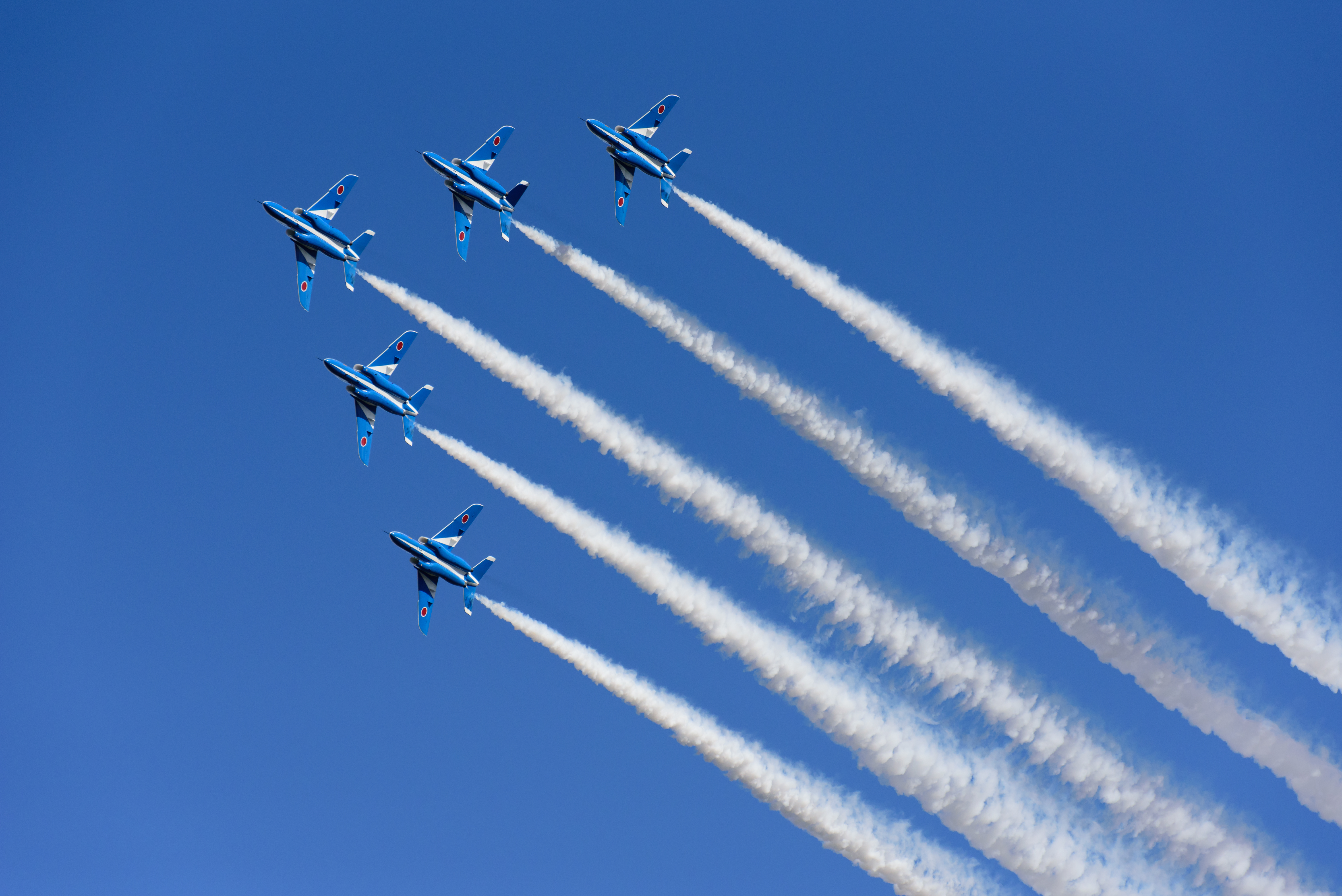
Every November 3rd, Japan's Culture Day holiday, Iruma Air Base transforms into one of the country's largest outdoor gatherings. The annual air show draws staggering crowds -- approximately 200,000 in 2015, 130,000 in 2016, and around 210,000 in 2017. The star attraction is Blue Impulse, the JASDF's aerobatics team, flying Kawasaki T-4 trainers through routines under what organizers note are typically clear autumn skies. Ground displays feature aircraft from all three branches of the Japan Self-Defense Forces, along with police helicopters. The base's proximity to Tokyo's population center makes it uniquely accessible; no other major military air show in the world sits so close to a metropolitan area of this scale. Today, Iruma hosts an eclectic mix of squadrons: electronic warfare aircraft, flight check planes, CH-47J Chinook helicopters, and Kawasaki C-1 transports -- a far cry from the orange biplanes that first taxied here in 1938.
From the Air
Iruma Air Base (ICAO: RJTJ) sits at 35.84N, 139.41E in Sayama, Saitama Prefecture, roughly 30 km northwest of central Tokyo. The single runway is oriented approximately 17/35. Yokota Air Base (RJTY) lies about 15 km to the west-northwest. Approach from the south offers views of the dense Kanto Plain sprawl giving way to the base's distinctive footprint. Best observed at 3,000-5,000 feet. Tokyo's Haneda (RJTT) and Narita (RJAA) are the nearest major commercial airports. Expect complex airspace; this area falls under the Tokyo Terminal Control Area.