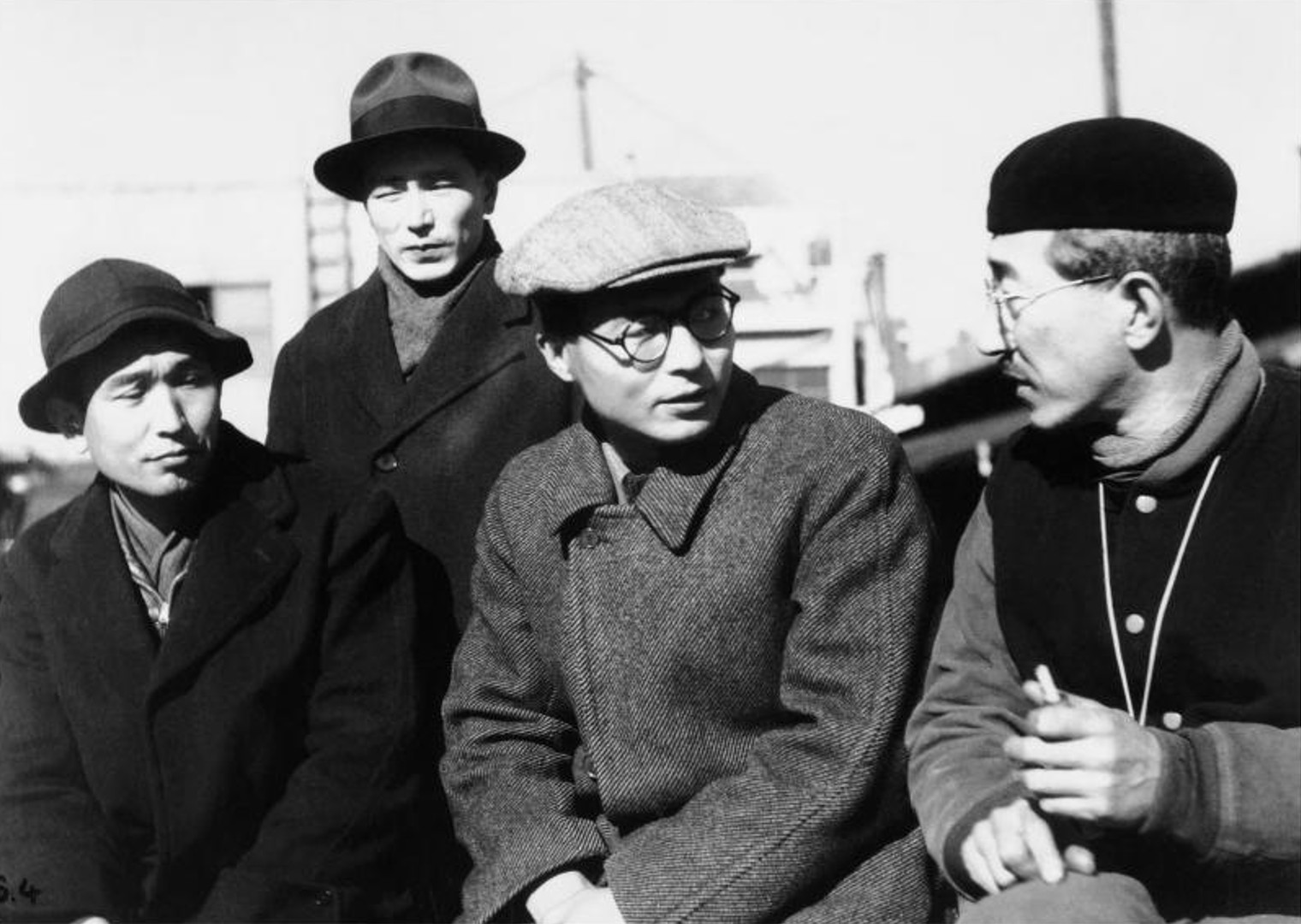
Ishiro Honda
On his desk in Seijo, in a quiet residential corner of Tokyo's Setagaya ward, Ishiro Honda kept a mortar shell. It had landed at his feet near Hankou during the war and failed to detonate. He brought it home to Japan in 1946 as a reminder of what he had survived -- six years on the front lines across three tours in China, imprisonment by the Chinese National Revolutionary Army, and nightmares that would jolt him awake two or three times a year for the rest of his life. Within eight years of returning from that war, Honda would channel the atomic terror of his generation into a film about a giant monster rising from the sea, irradiated and furious. He called it Godzilla. The franchise it spawned is recognized by Guinness World Records as the longest-running in cinema history.
The Temple Boy Who Loved Movies
Honda was born on May 7, 1911, in Asahi, Yamagata Prefecture -- now part of the city of Tsuruoka -- the fifth and youngest child of a Buddhist monk. His father and grandfather both served at Churen-ji, a temple on Mount Yudono, where the family grew rice, potatoes, and daikon, made their own miso and soy sauce, and supplemented their income with a silk moth farm. His given name encoded his identity: 'I' for inoshishi, the boar of his birth year; 'shi' for four, the fourth son; 'ro' marking a boy. While his brothers received religious instruction, Honda devoured the scientific magazines his eldest brother Takamoto sent him. When the family moved to Tokyo in 1921, Honda discovered cinema. He was mesmerized not by the silent films themselves but by the benshi -- live narrators who stood beside the screen and performed the story. Against his brother's wish that he become a dentist, Honda enrolled in Nihon University's experimental film program in 1931. When professors cancelled classes, he went to the theaters and took notes.
Six Years in the Shadow of War
Drafted at twenty-three in 1934, Honda had barely begun his career as an assistant director at the studio that would become Toho. The February 26 Incident of 1936 -- a failed military coup by his former commanding officer -- swept Honda into its aftermath. Though he had no involvement, the association made him suspect, and his regiment was shipped to Manchukuo. He would be recalled to duty again and again. He married Kimi Yamazaki in 1939 with no ceremony -- just signed papers at city hall, a bow at Meiji Shrine, and home. A week before his daughter Takako was due, he was called back to China. In total, Honda served three tours across six years at the front. He was captured by Chinese forces and held between Beijing and Shanghai. The locals and temple monks treated him kindly and even offered to let him stay permanently, but Honda refused -- he needed to find his wife and children. When he finally returned to Japan in March 1946, the film industry he had left behind had been transformed into a propaganda machine modeled on Nazi cinema policies.
A Monster Born from the Mushroom Cloud
Honda's path to Godzilla wound through documentaries and dramas. His directorial debut, the 1949 documentary Ise-Shima, became the first Japanese film to successfully use underwater photography. He served as chief assistant director to his friend Akira Kurosawa on Stray Dog, capturing the post-war Tokyo atmosphere that Kurosawa credited him for. His first feature, The Blue Pearl, arrived in 1951, when Honda was forty years old. Then came the catalyst: in 1954, a Japanese fishing boat, the Daigo Fukuryu Maru, was exposed to nuclear fallout from a Pacific test. Producer Tomoyuki Tanaka saw an opportunity. Honda and screenwriter Takeo Murata secluded themselves for three weeks at an inn in Tokyo's Shibuya ward to write the screenplay. Principal photography took 51 days. Godzilla -- a giant monster that rises near Odo Island and destroys Tokyo -- was a metaphor for nuclear holocaust, drawn directly from Honda's wartime experience. It lost the Japanese Movie Association's best picture award to Kurosawa's Seven Samurai but won for special effects, and its success launched a franchise that now spans seven decades.
The Man Behind the Monsters
Honda directed 46 feature films across five decades, but his legacy extends far beyond Godzilla. He directed Rodan in 1956 -- his first color film -- Mothra, Matango, King Kong vs. Godzilla (his biggest commercial hit), and a string of science fiction works that defined the tokusatsu genre. Yet his producer Tanaka once observed that had he not steered Honda toward science fiction, Honda would have become 'a director like Mikio Naruse' -- a master of intimate human drama. Kurosawa himself once planned for Honda to direct Throne of Blood before ultimately directing it himself. After his eighth and final Godzilla film, Terror of Mechagodzilla, in 1975, Honda retired. But Kurosawa pulled him back, and Honda served as directorial advisor and creative consultant on Kurosawa's last five films, from Kagemusha in 1980 through Madadayo in 1993. Filmmakers from Quentin Tarantino to Martin Scorsese cite Honda as an influence. Guillermo del Toro dedicated Pacific Rim to Honda and Ray Harryhausen. Takashi Yamazaki's 2023 film Godzilla Minus One paid direct homage to Honda's original vision.
The Last Screening
In mid-February 1993, Honda attended a screening of Satyajit Ray's final film, Agantuk, with Kurosawa. Afterward, Kurosawa invited him home for dinner, but Honda felt sick and declined. His cough had been worsening for weeks, dismissed as a common cold. When X-rays and blood tests finally came back, Honda already had his bags packed. He was admitted to Kono Medical Clinic, a nineteen-bed facility in Soshigaya, because the major hospitals were full. He died of respiratory failure at 11:30 pm on February 28, 1993. At his memorial service at Joshoji Kaikan in Setagaya, two of Japan's greatest cultural figures -- Akira Kurosawa and Toshiro Mifune, estranged for years -- saw each other across the room. The Nikkei reported what happened next: they made eye contact and embraced in tears over the body of their mutual friend.
From the Air
The article's coordinates (35.37N, 138.91E) place it in the foothills southwest of Mount Fuji, near the border of Shizuoka and Yamanashi prefectures. Honda's birthplace was in Tsuruoka, Yamagata Prefecture, far to the north, but his life was centered in Tokyo's Setagaya ward where he lived and worked at Toho Studios. Nearest airports: Tokyo Haneda (RJTT) approximately 50nm east, Mt. Fuji Shizuoka Airport (RJNS) approximately 30nm southwest. The surrounding terrain includes the Tanzawa Mountains to the east and Mount Fuji dominating the western horizon. Best viewed at 3,000-5,000 feet AGL for context of the greater Tokyo-Fuji corridor.