Ishiyama-dera
On a full moon night in August 1004, a court lady named Murasaki Shikibu sat in a room at Ishiyama-dera, gazing at the moonlight reflected on Lake Biwa. That evening, according to temple tradition, she began writing The Tale of Genji, the sweeping narrative of court life and romantic entanglement that many scholars consider the world's first novel. The temple still maintains a Genji room with a life-size figure of Lady Murasaki, commemorating a creative moment that changed Japanese literature forever. But Ishiyama-dera's story runs far deeper than a single night of literary inspiration. This temple, perched on massive outcroppings of wollastonite rock along the Seta River in Otsu, Shiga Prefecture, has accumulated thirteen centuries of legend, political intrigue, and cultural treasure.
The Statue That Would Not Move
The founding legend of Ishiyama-dera involves a prayer for gold, a prophetic dream, and a statue that refused to leave its rock. In 747, at the request of Emperor Shomu, the monk Roben brought a small gilt bronze statue of Nyoirin Kannon to this site. The emperor desperately needed gold to gild the Great Buddha being constructed at Todai-ji in Nara, and Roben had been ordered to pray for it. A deity named Zao Gongen appeared in a dream and directed him south of Lake Biwa, to a place where Kannon Bodhisattva was said to manifest. Guided by an old man who was actually the deity Hira Myojin in disguise, Roben placed the Kannon statue on a massive boulder and built a hut for prayer. Two years later, gold was discovered in distant Mutsu Province. The prayers had worked. But when Roben tried to remove the statue from the rock, it would not budge. It had fused to the stone. A hall was built to shelter the immovable image, and that structure became the origin of Ishiyama-dera, the Stone Mountain Temple.
A Temple Woven Into the Imperial Court
From its earliest years, Ishiyama-dera was a national project. Documents from the Shosoin Repository reveal that beginning in 761, Buddhist sculptors were dispatched from Todai-ji to expand the temple, with construction carried out under imperial sponsorship. The Hora Palace of Emperor Junnin and Empress Koken stood nearby. A new principal image, a full-sized clay statue of Nyoirin Kannon, was completed between 761 and 762, with the original small bronze figure placed inside. By the Heian period, the temple had shifted from the Kegon sect to Shingon Buddhism and became affiliated with Daigo-ji. Pilgrimages to Ishiyama grew fashionable among court ladies, documented in literary diaries like the Kagero Nikki and the Sarashina Nikki. The third abbot, Jun'yu Naigu, grandson of the great scholar Sugawara no Michizane, left behind a vast body of handwritten manuscripts now collectively designated a National Treasure. His physical disability prevented him from sitting in the formal posture, so he poured himself entirely into scholarship.
Surviving Warlords and Wildfire
Ishiyama-dera's survival through Japan's most violent centuries is remarkable. On January 2, 1078, lightning struck the main hall, partially burning it and damaging the clay Kannon statue. The present main hall, now designated a National Treasure, was rebuilt in 1096. In the early Kamakura period, the shogun Minamoto no Yoritomo donated funds for the East Gate, the distinctive Tahoto double-ring pagoda, and the Bishamon-do Hall. Then came the Sengoku period's chaos. In February 1573, the temple made the dangerous political choice to side with Ashikaga Yoshiaki, the fifteenth and last Muromachi shogun, in rebellion against Oda Nobunaga. The consequences were severe: buildings were damaged in battle and Nobunaga confiscated the temple's estates. After Nobunaga's assassination, Toyotomi Hideyoshi restored some land in 1596, and Tokugawa Ieyasu later granted 579 koku of estates for the temple's upkeep. Yodo-dono, Hideyoshi's consort, funded further restoration. Through it all, fires that ravaged the surrounding mountain somehow spared Ishiyama-dera's core, preserving an extraordinary collection of buildings, sculptures, scriptures, and documents.
A Mountain of National Treasures
Few temples in Japan hold as many designated cultural properties as Ishiyama-dera. The main hall and the Tahoto pagoda are both National Treasures, the pagoda dating to 1194 and considered one of the oldest of its type in Japan. The temple's collection of National Treasure documents spans from the Nara period through the Heian period, including ancient Chinese texts from the Tang Dynasty and 73 scrolls of sacred writings by the abbot Jun'yu. Among the Important Cultural Properties are sculptures by the master Kaikei, paintings attributed to Tosa Mitsuoki, and archaeological artifacts reaching back to the Yayoi period. One statue from the Nara period was stolen in 1947; only the headless torso was later recovered, the severed head still missing. The temple also holds thousands of volumes of sutras spanning from the Nara to Muromachi periods, a paper library of devotion accumulated over more than a millennium.
The Autumn Moon at Ishiyama
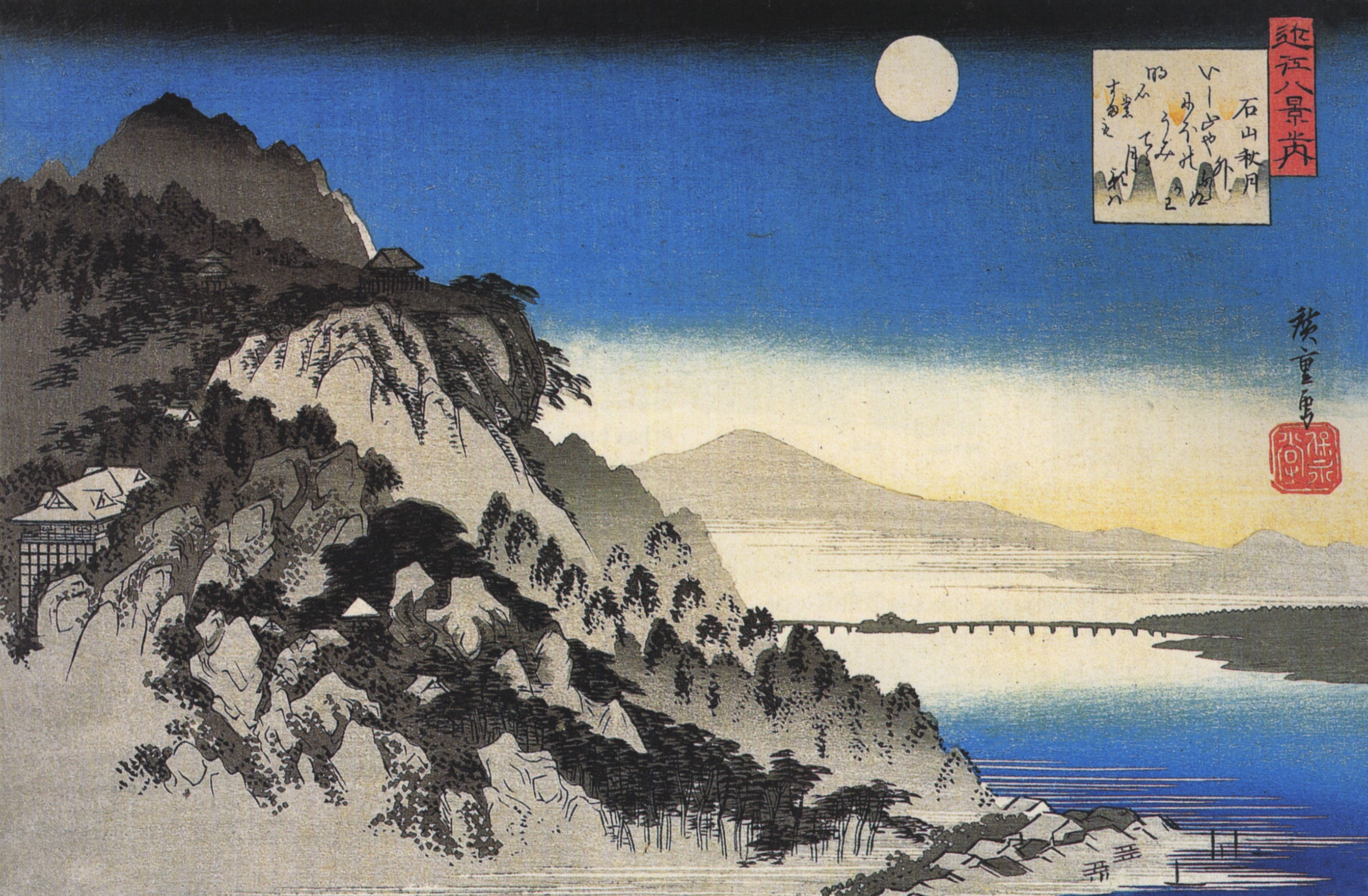
Ishiyama-dera occupies a cherished place in Japanese art as one of the Eight Views of Omi, the celebrated scenic vistas around Lake Biwa that have inspired painters and poets for centuries. Its designated scene is The Autumn Moon at Ishiyama, capturing moonlight over the temple's rocky bluffs. Ukiyo-e masters Suzuki Harunobu in the eighteenth century and Hiroshige in the nineteenth century both rendered this view, fixing the temple in the popular imagination as a place where stone, water, and moonlight converge. Today visitors reach the temple on a ten-minute walk from Ishiyamadera Station on the Keihan Railway's Ishiyama Sakamoto Line. The grounds reveal the wollastonite rock formations that give the temple its name, pale stone jutting from the hillside between ancient buildings. As the thirteenth stop on the Saigoku Kannon Pilgrimage, Ishiyama-dera draws both art lovers and pilgrims, united by the same impulse that brought Murasaki Shikibu here on that moonlit summer night a thousand years ago.
From the Air
Located at 34.9604N, 135.9056E on the south bank of the Seta River where it exits Lake Biwa, in Otsu, Shiga Prefecture. Best viewed at 2,000-3,000 feet AGL, where the temple complex is visible against the forested hillside along the river. Lake Biwa, Japan's largest freshwater lake, dominates the landscape to the north and serves as the primary visual landmark. Nearest airports: RJOO (Osaka Itami, 25 nm southwest), RJOT (Omi-Hachiman, 20 nm northeast). The distinctive Tahoto pagoda is a potential visual reference point in good visibility.