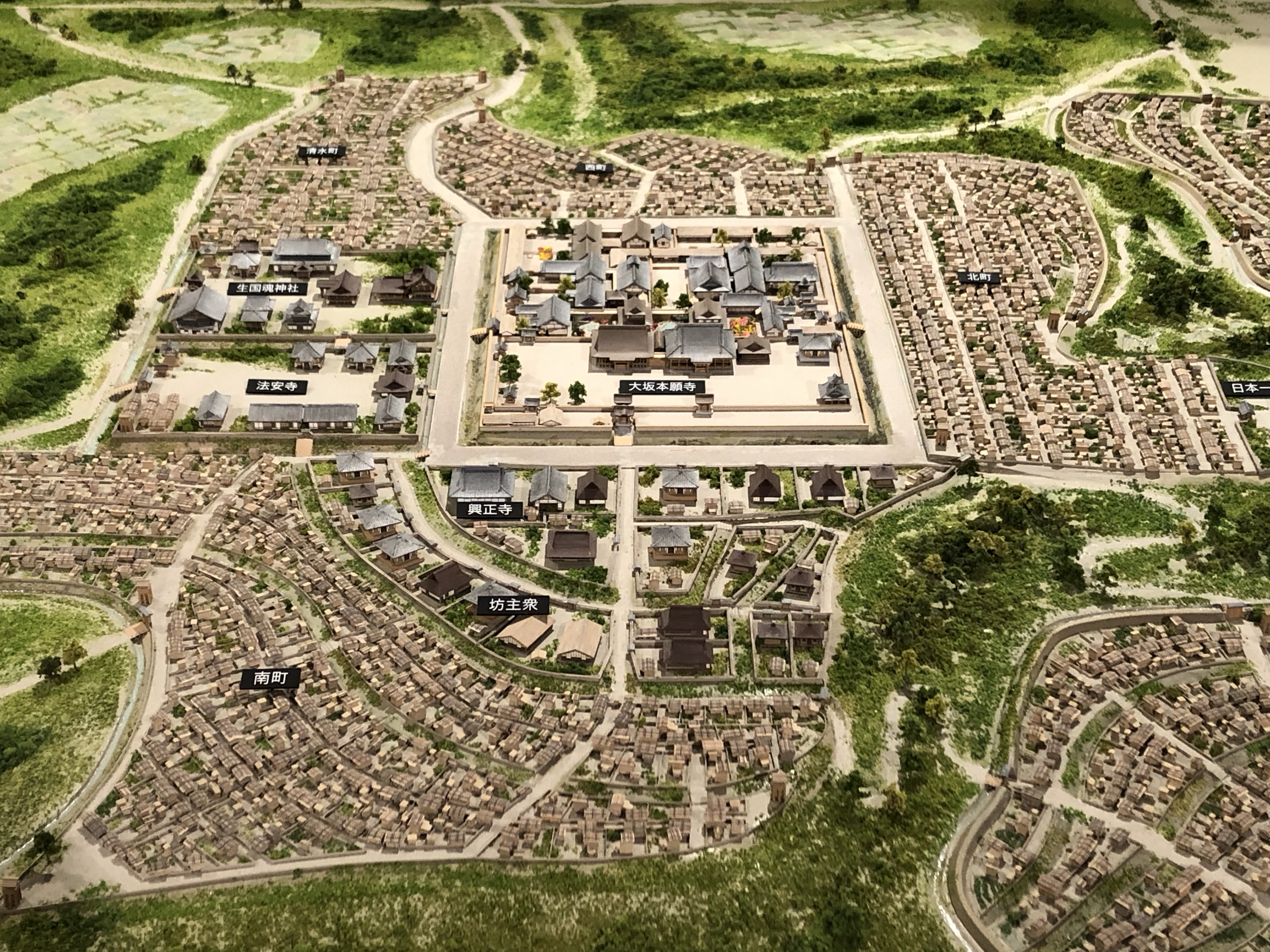
Ishiyama Hongan-ji: The Warrior Temple That Became Osaka Castle
Ten thousand warrior monks could be summoned to battle by the ringing of a single bell. That was the defensive strength of Ishiyama Hongan-ji, a temple-fortress that stood at the mouth of the Yodo River on the coast of the Seto Inland Sea, where Osaka Castle stands today. It began in 1496 as nothing more than a retired priest's private chapel. Rennyo, the great revivalist abbot of Jodo Shinshu Buddhism, sought isolation on a rocky hill he called Ishiyama -- 'stone mountain' -- just outside the ruins of the ancient capital of Naniwa. Recent archaeological research has confirmed that the temple was built directly atop the ruins of the old Naniwa imperial palace. Rennyo wanted solitude. What he got was a city.
A Retirement That Built a Metropolis
Rennyo's retreat attracted followers almost immediately. The tiny temple he built for personal devotion expanded as devotees arrived, erected homes, and established the infrastructure of a growing settlement. By the time of Rennyo's death three years later in 1499, the general shape and size of the Ishiyama Hongan-ji was already established. Contemporary documents describing his retirement site as being on an 'Ozaka' are the earliest known use of that name -- a word that changed only slightly over the centuries to become Osaka, now Japan's second-largest city. The temple became the primary seat of the Ikko sect after the destruction of Yamashina Mido in Kyoto in 1532, drawing contributions from devotees funneled through a network of brokers based primarily in nearby Sakai, in Izumi Province.
A Fortress That Rang Its Own Alarm
The Ishiyama Hongan-ji was considered impenetrable. Its coastal position at the river mouth made approach difficult, and roughly a hundred priests patrolled the grounds at all times. The bell that could summon ten thousand defenders to the walls was no metaphor -- the Ikko-ikki, leagues of warrior monks and armed commoners who opposed samurai rule, had turned religious devotion into military discipline. The fortress drew its priest-soldiers not only from the Osaka area but from the Ikko sect's strongholds in the distant provinces of Kaga and Echizen. When siege came, the Mori clan supplied the fortress by sea. Even the great rivals of Oda Nobunaga -- Uesugi Kenshin and Takeda Shingen -- served the Ikki's cause simply by keeping Nobunaga occupied on other fronts.
Eleven Years of Fire
Oda Nobunaga's forces laid siege to the Hongan-ji in 1570, determined to break the last great center of Ikko-ikki resistance. The fortress held. Year after year, the coastal position that Rennyo had chosen for its quiet beauty proved strategically devastating, allowing resupply by sea even as Nobunaga's armies controlled the land approaches. The siege stretched into the longest in Japanese history -- eleven years of intermittent warfare, blockade, and negotiation. Finally, in August 1580, Abbot Kosa (also known as Kennyo) was persuaded to surrender. As the defenders yielded the fortress, the entire temple complex was set ablaze. Some sources say the fires were lit from within, deliberately denying Nobunaga any material gain from his hard-won victory. A few holdouts fled to Kaga Province for a final stand, but the burning of Ishiyama Hongan-ji effectively ended the Ikko-ikki as a militant force.
From Ashes to Castle
Three years after the temple burned, Toyotomi Hideyoshi began construction of Osaka Castle on the same site. It was no accident. The position that made the Hongan-ji nearly impregnable -- commanding the river mouth, backed by the sea, elevated on its rocky hill -- was precisely what Hideyoshi wanted for his own seat of power. The ancient ruins of the Naniwa palace lay beneath both structures, creating a layered archaeology of power: imperial palace, warrior temple, warlord's castle, one built upon the bones of the last. Today, Osaka Castle's massive stone walls and iconic tower dominate the site where Rennyo once sought solitude and where ten thousand monks once answered the bell. Nothing remains of the Hongan-ji above ground, but the city it accidentally founded stretches in every direction, home to nearly three million people who live on the 'stone mountain' Rennyo named.
From the Air
Located at 34.68N, 135.52E in central Osaka, Japan -- the site now occupied by Osaka Castle. The castle's massive stone walls and tower are the dominant landmark; the original Hongan-ji temple was destroyed in 1580 and lies beneath. From the air, Osaka Castle Park is a large green rectangle in the urban grid, bordered by the Okawa River to the north. The Yodo River system flows west to Osaka Bay. Osaka Itami Airport (RJOO) lies approximately 8 nautical miles to the north-northwest; Kansai International Airport (RJBB) is approximately 26 nautical miles to the south-southwest. Best viewed at 3,000-5,000 feet AGL to appreciate the castle's relationship to the river mouth and bay.