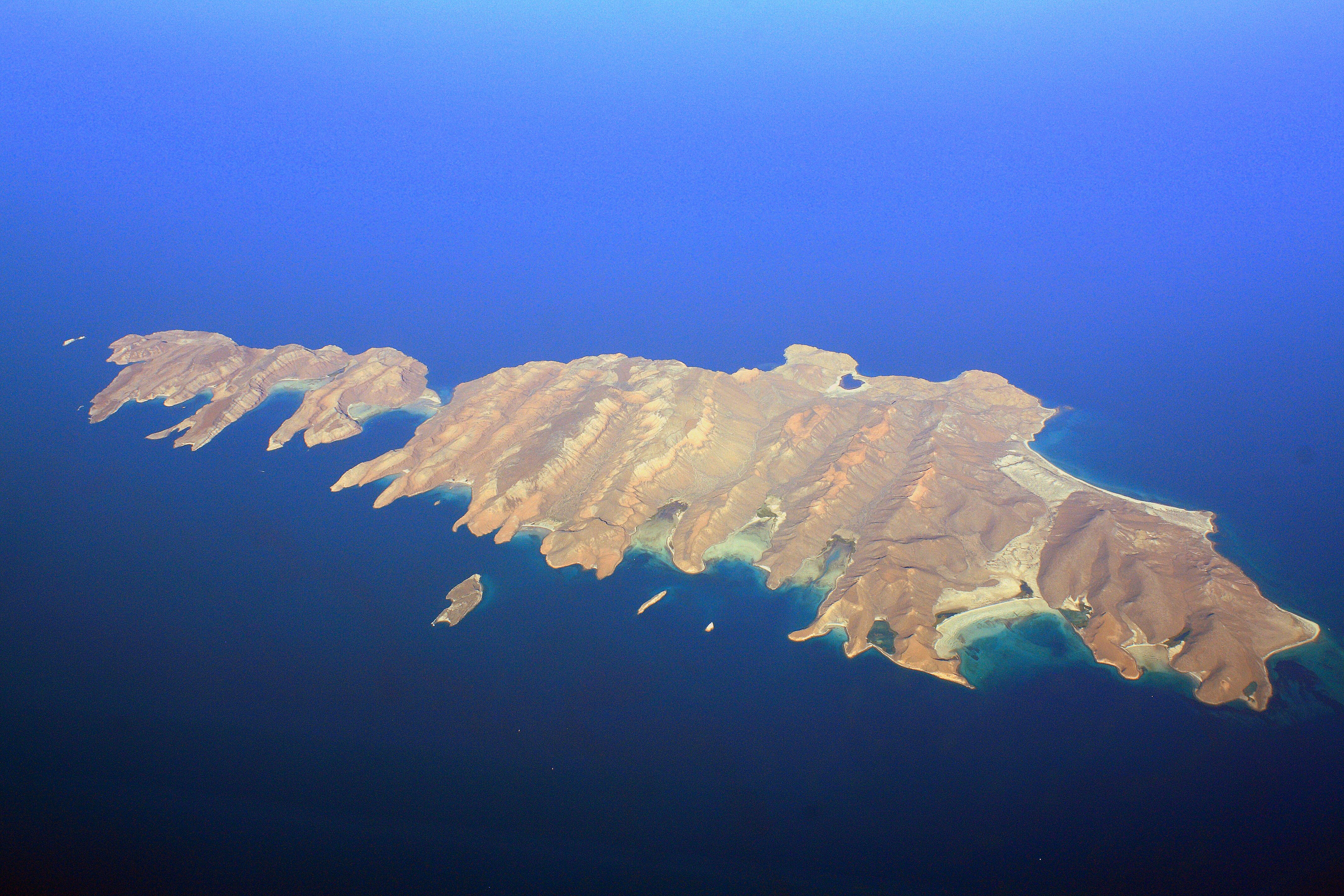
Isla Espiritu Santo
Nine thousand years ago, someone sat in a rock shelter on this island and carved a fishhook from a pearl oyster shell. The hook, discovered at Covacha Babisuri on Isla Espiritu Santo, is among the oldest shell fishhooks ever found anywhere in the world -- similar in design to specimens unearthed in Australia and along the Arabian Sea. The island itself, a volcanic remnant rising from the turquoise waters of the Sea of Cortez just 26 kilometers from the port city of La Paz, has been uninhabited for centuries. But it has never been empty of purpose. From ancient fishing camps to a modern fight against casino developers, Espiritu Santo -- "Holy Spirit" -- has drawn people to its shores for millennia.
Born of Fire and Fracture
Isla Espiritu Santo exists because the earth broke apart. The island and its sister, Isla Partida, are rock formations created by violent earthquakes and volcanic activity along the tectonically restless Gulf of California. Volcanic ash and lava compose the bulk of their geology, giving the landscape an austere palette of ochre, rust, and pale gray that shifts with the light. High ridges alternate with low valleys in a pattern that, from above, resembles a corrugated rainbow rendered in earth tones. Espiritu Santo covers 80.7 square kilometers, rising to 562 meters at its highest point -- the twelfth-largest island in Mexico. Partida, smaller at 15.5 square kilometers, sits at the northern edge, separated from its larger neighbor by a strait so narrow that at certain tides you can wade across it. Four named islets -- Lobos, Ballena, Gallo, and Gallina -- cluster around the two main islands, along with white-sand beaches framed by sheer bluffs and aquamarine water.
Life Found Nowhere Else
Isolation breeds uniqueness, and Espiritu Santo harbors species that exist nowhere else on earth. The black jackrabbit, Lepus insularis, and the Espiritu Santo antelope squirrel, Ammospermophilus insularis, are both endemic to this island alone. Beneath the waterline, the surrounding reefs teem with parrotfish, angelfish, trumpetfish, Moorish idols, and rainbow wrasse. Sharks, rays, sea turtles, dolphins, and whales pass through the deeper channels. Brown pelicans and great blue herons patrol the shoreline while turkey vultures circle overhead. At Los Islotes, a rocky outcrop off the islands' northern tip, a large colony of sea lions draws snorkelers who swim alongside the curious females and pups. Ensenada Grande beach, on Isla Partida, was voted the most beautiful beach in Mexico by The Travel Magazine and ranked among the top twelve beaches in the world.
Saving the Island from the Casino
By the 1990s, Espiritu Santo's beauty had attracted attention of a less welcome kind. A real estate developer proposed building a resort casino on the island. Tim Means, founder of Baja Expeditions and a leading conservationist based in La Paz since 1974, organized a coalition of activists to stop the project. They managed to purchase part of the island from the ejido that was selling it to the developer, funding the acquisition with money from Mexican donors, American funders working through the Nature Conservancy, and an anonymous gift to the World Wildlife Fund, each contributing roughly a third. The coalition then donated the island to the Mexican nation. A sculpture of a dove on the boardwalk in La Paz commemorates the gift. It was a grassroots conservation victory that required crossing national boundaries, bridging languages and legal systems, and convincing people that an uninhabited island was worth more as a protected wilderness than as a gambling destination.
Layers of Protection
Today, Espiritu Santo carries more protective designations than almost any comparable piece of land in Mexico. In 1994, the island and the other Gulf of California islands were declared a UNESCO Biosphere Reserve. The Mexican government designated them a Flora and Fauna Protection Area in 2000. UNESCO added the Gulf of California Islands to its World Heritage Site list in 2005. In 2007, the marine waters surrounding Espiritu Santo and Partida were declared a national park, creating the Archipelago Espiritu Santo National Park across 479.9 square kilometers of protected sea. Sea kayaking has become the signature way to experience the islands, paddling along the sculpted volcanic coastline where 9,000 years of human history meet one of the most biodiverse marine environments in the eastern Pacific.
From the Air
Located at 24.47N, 110.33W in the Gulf of California (Sea of Cortez), approximately 26 km north of La Paz. Best viewed at 3,000-6,000 feet AGL. The island is clearly visible as a distinct elongated landmass with dramatic volcanic ridges. Isla Partida lies immediately to the north, separated by a narrow strait. Nearest airport is La Paz International (MMLP/LAP). The Baja California Peninsula coastline is visible to the west, and the open Gulf stretches to the east.