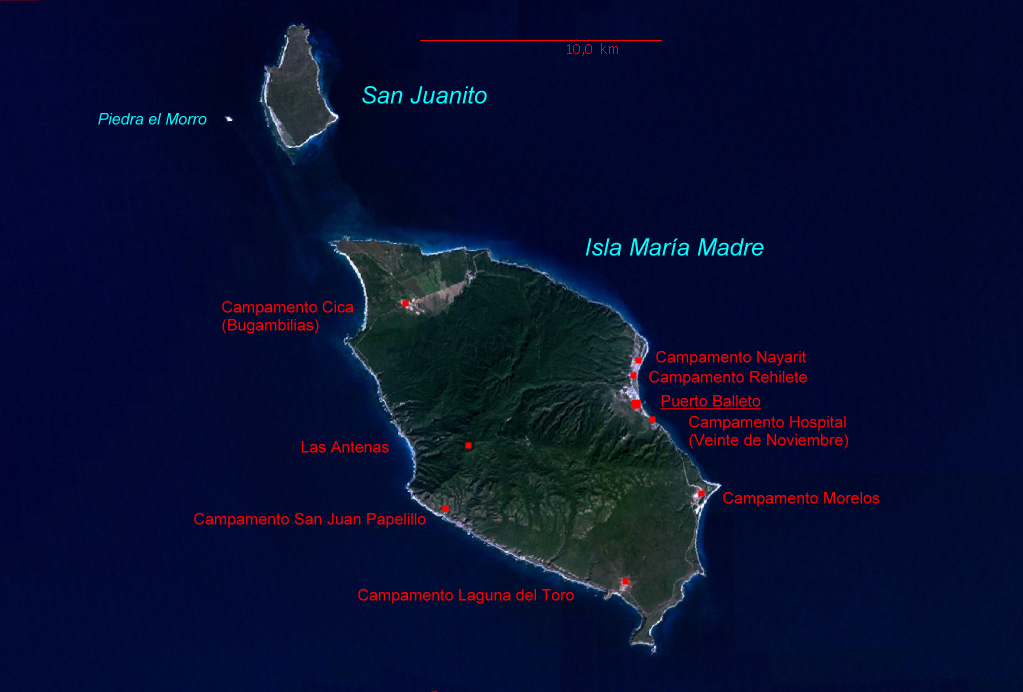
Islas Marías
For more than a hundred years, the name Islas Marias meant one thing in Mexico: prison. Four islands sitting a hundred kilometers off the Nayarit coast, surrounded by open Pacific, served as the country's most isolated penal colony from 1905 until 2019. The Mexican writer Jose Revueltas, imprisoned there for his political activism, titled his first novel Los Muros de Agua -- The Walls of Water -- because that is exactly what the ocean was. No walls of stone were necessary when the Pacific itself stood guard. On February 18, 2019, President Andres Manuel Lopez Obrador ordered the prison closed. The last inmates were transferred to the mainland. Now, the archipelago that generations of Mexicans associated with punishment is being reimagined as something entirely different: a UNESCO biosphere reserve and eco-tourism destination where the endemic wildlife has outlasted the inmates.
A Porfirista Solution to an Old Problem
The idea of turning the Islas Marias into a penal colony predated its execution by decades. Both Benito Juarez and Maximilian of Habsburg had considered it. But it was Porfirio Diaz who made it happen, purchasing the archipelago in 1902 as part of a broader penal reform designed to maintain social control, guarantee a supply of labor, and protect foreign investment. In 1905, the islands were officially declared a penal colony and the "penalty of descent" -- relegation to the islands -- became a formal punishment under Mexican law. The 1908 addition to the Penal Code spelled out the terms. Two camps were established: Balleto and Salinas. An administrative apparatus took shape, overseen by colony director Arturo G. Cubillas. Inmates who demonstrated good behavior could earn pre-release; some who completed their sentences chose to stay. The colony became a self-contained world, governed by a state official who served simultaneously as governor and chief judge, while the Mexican Navy maintained an independent military command.
Geology Written in Deep Time
The Islas Marias are continental shelf islands, a linear chain sitting in shallow sea eighty to a hundred and ten kilometers from the nearest mainland. Their geological story reaches far deeper than their human one. During the Miocene, this region was connected to the southern tip of the Baja California peninsula and the Nayarit coast. The islands remained attached to the mainland until about three million years ago, in the Late Pliocene, when tectonic rifting finally severed the connection. Significant uplift -- amounting to hundreds of meters -- raised them above the waterline. Throughout the Pleistocene, sea levels rose and fell cyclically, dropping as much as a hundred and twenty meters below present levels during glacial maxima. Each cycle reshaped the islands' relationship with the mainland, alternately connecting and isolating them, driving the evolution of species found nowhere else on Earth.
Species That Exist Nowhere Else
That long isolation produced a remarkable collection of endemic wildlife. The Tres Marias amazon, a green parrot with a distinctive red forehead, lives only on these islands. The Tres Marias hummingbird flashes through the seasonally dry tropical forest that covers most of the archipelago -- a forest strikingly similar to undisturbed vegetation on the adjacent mainland, evidence of the islands' recent geological separation. The Tres Marias island mouse and the Tres Marias raccoon, a subspecies of the common raccoon, round out a fauna shaped by millions of years of isolation in a hundred-kilometer moat of open Pacific. In 2010, UNESCO recognized the archipelago's biological significance by designating it the Islas Marias Biosphere Reserve. The dry tropical forest, the endemic species, and the surrounding marine environment were all deemed worthy of international protection -- a striking reversal for islands whose primary function for the previous century had been human confinement.
From Walls of Water to Open Doors
The transformation from penal colony to tourist destination has been neither quick nor simple. Isla Maria Madre, the largest island, still bears the physical imprint of its carceral past -- the camps, the administrative buildings, the lighthouse above Puerto Balleto with its red-and-white tower standing sixty-two meters tall. The first European to encounter the islands was Diego Hurtado de Mendoza, a cousin of Hernan Cortes, in 1532. He named them Islas Magdalenas and found no evidence of prior habitation. Nearly five centuries later, the government hopes to write a new chapter. In October 2024, a regional tourism board launched weekly flights between Tepic and the islands, serviced by a single aircraft. The goal is bio-tourism -- visitors drawn not by beaches and nightlife but by the chance to walk through dry tropical forest listening for the call of the Tres Marias amazon, knowing that this parrot's ancestors evolved here while the island held prisoners, and before that held no one at all.
From the Air
Located at 21.53°N, 106.47°W in the Pacific Ocean, approximately 100 km off the coast of Nayarit, Mexico. The archipelago of four islands is clearly visible from cruise altitude as a distinct landmass in open water. Isla Maria Madre is the largest and has a small airfield near Puerto Balleto. No ICAO code for the island airfield; nearest major airport is Tepic International Airport (ICAO: MMEP) on the mainland. Approach from the east for dramatic views of the islands rising from open Pacific. Best viewed at 5,000-8,000 ft AGL.