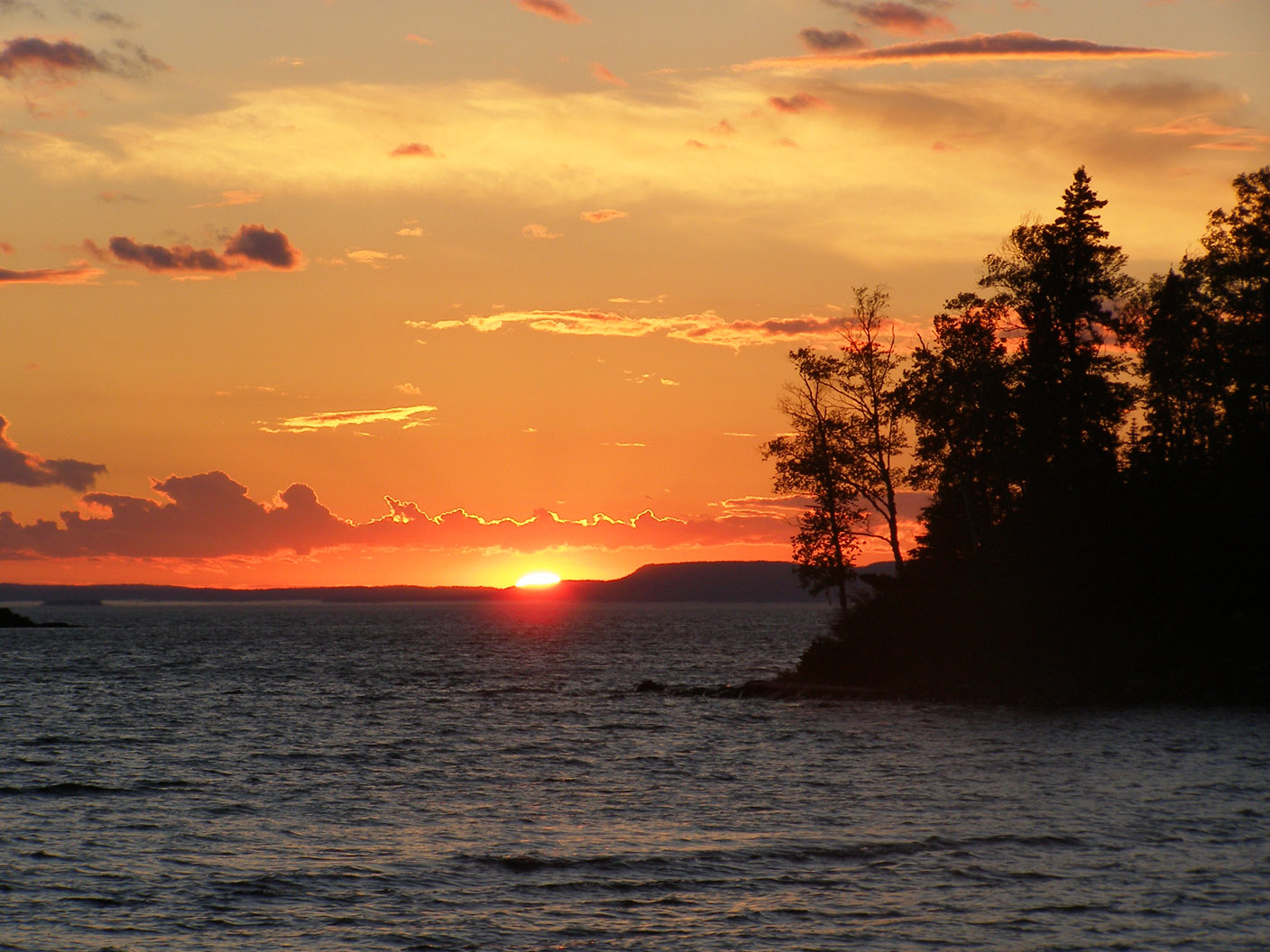
Isle Royale National Park
Look at a map of Lake Superior. The lake's outline resembles the profile of a snarling wolf. Isle Royale is the eye. That geographic coincidence feels less accidental the more you learn about this place. The 45-mile-long archipelago in the lake's northwest corner is home to the longest continuous predator-prey study in the world - wolves hunting moose on an island with no exit for either species. It is the only U.S. national park that closes entirely for winter. It receives fewer visitors in a year than Yellowstone sees in a single day. And those who do make the journey by ferry or floatplane stay an average of four to five days, the longest average visit of any national park - and still leave wanting more. Isle Royale holds the National Park Service's highest return-visit rate. The island earns that loyalty the hard way: by offering almost nothing except wilderness itself.
Copper, Sugar, and Four Thousand Years
Native Americans began visiting Isle Royale more than four millennia ago. They came to dig copper from surface deposits, tap maple trees for sugar, and fish the surrounding waters. The copper they extracted entered trade networks that carried it across much of the continent. When Europeans arrived, the island cycled through a series of economic identities - whitefish fisheries, copper mining ventures that never quite turned a profit, and around 1900, a resort community that catered to wealthy visitors seeking clean air and escape from hay fever. In the 1920s, Detroit News journalist Albert Stoll Jr. arrived and saw the damage that commercial development was inflicting on the island's wild character. His campaign for protection led to the park's establishment by Congress in 1931. The last private land was absorbed by 1940, with a few holdout owners granted lifetime leases. The archipelago was designated a Wilderness Area in 1976 and named an International Biosphere Reserve in 1980.
The Wolves Walked Across Ice
Around 1900, moose arrived on Isle Royale. The most likely explanation is that they swam from Ontario - a distance that would challenge most creatures but not a moose. For nearly half a century, the moose population had the island to themselves, booming and crashing with the food supply. Then, in the winter of 1949, wolves crossed an ice bridge from the mainland. A second wolf followed in 1967. Since then, wolves and moose have been locked in a relationship studied continuously by researchers since 1958 - the longest-running predator-prey study on Earth. The island's isolation makes it a natural laboratory. There are no bears, no deer, no other large predators or competitors. The wolf population, descended from those two founding packs, has also demonstrated the genetic consequences of inbreeding on a small, closed population. Both species have swung through dramatic booms and busts. By 2018, the wolf population had crashed to just two individuals. The National Park Service relocated wolves from the mainland, and by 2024 the population had recovered to approximately 30 animals - the target for the island's recovery plan.
A Wilderness That Means It
Isle Royale is a wilderness preserve first, a visitor destination second. The park enforces that priority. Away from the small ports at Rock Harbor and Windigo, running water means a creek and the only toilets are outhouses. There are no roads. Mountain bikes are prohibited. A 165-mile network of unpaved trails connects the island's campgrounds, marked by stone cairns across exposed rock and plank walkways through marshes. Cell phone coverage is essentially nonexistent. The island sits at 48 degrees north latitude, moderated by the cold of Lake Superior. Summer afternoons reach shorts weather on the ridges, but nights can drop below 50 degrees Fahrenheit even in August. Rain is almost guaranteed on any visit of more than a few days. The park headquarters relocate to Houghton, Michigan, for the winter - even the rangers leave.
Thieves With Fur and No Fingerprints
The island's wildlife has adapted to human visitors in ways both charming and inconvenient. Red foxes fill the scavenger niche and have learned that campgrounds mean opportunity. They will steal boots, socks, and cameras left unattended. Squirrels are more brazen still, chewing through backpacks to reach food and biting fingers that hold trail mix too loosely. Moose use the hiking trails as travel corridors and leave plentiful evidence of their passage. Loons nest on inland lakes, their calls echoing across water on still evenings. Wolf sightings are rare enough to feel electric - a glimpse of gray through the trees, fresh tracks pressed into ridge-top mud, or a howl that carries across a cold lake at night. On clear evenings, the absence of light pollution opens the sky to the aurora borealis and star fields that remind visitors just how far they are from everything else.
The Eye of Superior
Isle Royale itself is 45 miles long and 9 miles at its widest, covering about 205 square miles. The Greenstone Ridge runs the island's length, with Mount Desor rising to 1,394 feet above sea level - roughly 800 feet above the lake surface. The archipelago is the exposed edge of a geologic fault, pushed up from the lake floor and scoured by ice-age glaciers into a series of parallel ridges. Lakes and inlets fill the low points between them. The south slopes are gentle; the north sides drop steeply. Around the island's perimeter, shipwrecks litter the rocky shallows - the sunken cruise ship America sits in Washington Harbor with its bow breaking the surface and its stern resting at 84 feet, still remarkably intact. Lighthouses mark the approaches. Abandoned copper mines dot the interior. The island is a compressed anthology of Lake Superior's history: Indigenous, industrial, and wild, all layered onto a single long ridge of ancient stone surrounded by the coldest, deepest, most unforgiving of the Great Lakes.
From the Air
Located at 48.03N, 88.82W in northwest Lake Superior. The island is 45 miles long oriented roughly WSW-to-ENE, easily identifiable from altitude as the largest island in the lake. The Greenstone Ridge runs its full length. Rock Harbor at the east end and Windigo at the west end are the only developed areas. Nearest airports: Thunder Bay International Airport (CYQT) in Ontario to the north, Houghton County Memorial Airport (KCMX) in Michigan to the southeast. Floatplane service operates from Houghton. Elevation at Mount Desor: 1,394 feet MSL. The island sits roughly 15 miles from the Ontario mainland and 56 miles from Michigan's Keweenaw Peninsula. In clear conditions the Greenstone Ridge is visible from high altitude as a long dark spine against Superior's blue.