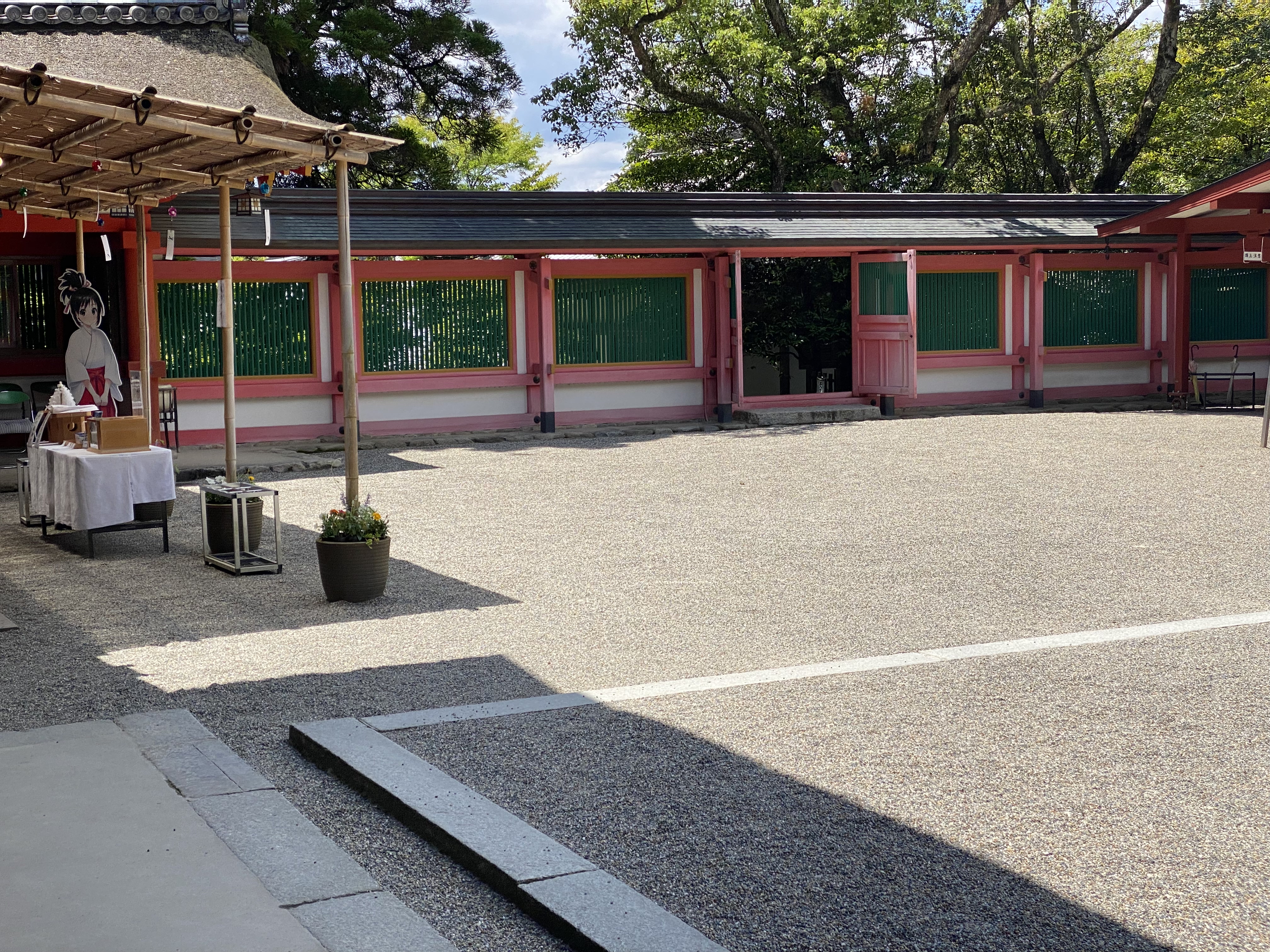
Isonokami Shrine
Somewhere inside Isonokami Shrine, behind walls that priests have guarded for centuries, rests the Totsuka-no-Tsurugi -- the sword the god Susanoo allegedly used to slay an eight-headed serpent. No one alive has seen it. Nearby, sealed away from public view, lies the Nanatsusaya-no-Tachi, a seven-branched sword gifted by the crown prince of the Korean kingdom of Baekje, its gold-inlaid inscription a rare firsthand record linking ancient Japan and Korea. These are not museum pieces behind glass. They are sacred objects held in active religious custody at one of the oldest Shinto shrines in Japan, nestled in the cedar-covered hills of Tenri in Nara Prefecture, at the northern end of the Yamanobe no Michi -- the oldest road in the country.
Arsenal of the Gods
Isonokami was never a shrine of tranquil contemplation. From its earliest days, it functioned as a spiritual armory. When Yamato kings rose to power in the 4th century, they stored the state's iron weaponry in the shrine's storehouses, blurring the line between sacred site and military depot. The Nihon Shoki records that Emperor Suinin's eldest son ordered a thousand swords made and took charge of Isonokami's treasures, founding the Mononobe clan as its hereditary guardians. The Mononobe patronized the shrine for generations, and their martial identity became inseparable from it. Archaeological excavations have turned up iron shields from the Kofun period, breastplate armor, and ring-pommel sabers -- not offerings to the gods, but weapons held in trust for the state. Even the shrine's primary deity reflects this martial character: the enshrined kami is the spirit of a legendary sword, the futsu-no-mitama-no-tsurugi, said to have been given to Emperor Jimmu, Japan's mythical first emperor.
The Seven-Branched Blade
In 1873, a priest at Isonokami made a discovery that would reshape understanding of ancient East Asian diplomacy. Hidden within the shrine was the Nanatsusaya-no-Tachi, a ceremonial sword with six branch-like protrusions extending from a central blade -- seven points in total. Gold-inlaid characters on the blade recorded that it was forged and presented by the crown prince of Baekje, a kingdom on the Korean Peninsula that maintained close ties with Yamato Japan. The inscription dates the sword to the 4th century, making it one of the earliest written records of diplomatic exchange between Japan and Korea. The sword had likely been held at Isonokami since the century of its creation, passed from guardian to guardian without anyone fully grasping its historical significance. Today it is designated a National Treasure of Japan. It is not available for public viewing.
Cedars and Ancient Poetry
The approach to Isonokami leads through groves of towering cryptomeria -- the Japanese cedar called sugi -- that have defined the shrine's landscape for centuries. A waka poem from the Man'yoshu, Japan's oldest surviving anthology of poetry compiled in the 8th century, describes the shrine surrounded by these holy cedar trees. The main hall, or honden, is built in the nagare-zukuri style, with its distinctive asymmetric gabled roof sweeping forward over the entrance. The haiden, or hall of worship, dates to the Kamakura period and features elegant irimoya-style roofing; it too holds National Treasure status. An intriguing architectural mystery lingers: a secondary shrine to Izumo-takeo sits on higher ground than the main structure. Since Shinto custom dictates that secondary shrines are never built above the principal shrine, some scholars believe this was actually an older religious site -- possibly connected to the great Izumo-taisha -- that predated the current Isonokami.
Power Shifts and Imperial Favor
The shrine's fortunes tracked the rise and fall of its patrons. When the Mononobe clan collapsed in a power struggle with the Buddhist-leaning Soga clan in the late 6th century, the clan reformed as the Isonokami clan, and the shrine persisted. By the Heian period, Isonokami had become a recipient of direct imperial patronage. In 965, Emperor Murakami established a system of sending imperial messengers to report important events to the guardian kami of Japan; Isonokami was among the 16 shrines chosen. It was later elevated to the prestigious Twenty-Two Shrines system. From 1871 to 1946, during the modern era of state-supported Shinto, it held the highest government shrine rank. Even today, the shrine maintains a calendar packed with ceremonies -- from the Denden Festival on June 30 to the Hokura-matsuri on New Year's Eve -- marking it as a living institution rather than a relic.
Hidden Treasures Beyond the Blades
The swords draw the most attention, but Isonokami's collection extends further into legend. According to the Nihon Shoki, a Korean prince named Amenohiboko settled in Japan and brought with him ten sacred treasures: mirrors, jewels, swords, and silk scarves. These objects, known as the Tokusa no Kandakara, are thought to be housed somewhere within the shrine. The shrine also holds ornate red o-yoroi armor, black-lacquered kabuto helmets, and an odachi -- an oversized battlefield sword -- among its Important Cultural Properties. Magatama beads and necklaces unearthed on the grounds connect the site to Japan's deepest prehistoric layers. Walking the grounds today, surrounded by cedar and birdsong, it is difficult to reconcile the peaceful atmosphere with the shrine's true nature: a vault of weapons and wonders accumulated over nearly two millennia, most of which remain locked away from human eyes.
From the Air
Located at 34.598N, 135.853E in the hills of Tenri, Nara Prefecture, Japan. The shrine sits at the northern terminus of the Yamanobe no Michi (Japan's oldest road), nestled into forested hillside east of the Yamato Plain. From the air, the dense cedar canopy surrounding the shrine grounds stands out against the cultivated lowlands. Tenri is approximately 20km south of central Nara. Nearest airports: Kansai International Airport (RJBB) approximately 55km southwest, Osaka Itami Airport (RJOO) approximately 35km northwest. The Nara Basin provides clear visual orientation with Mount Miwa visible to the south. Best visibility in autumn and winter months; summer can bring haze.