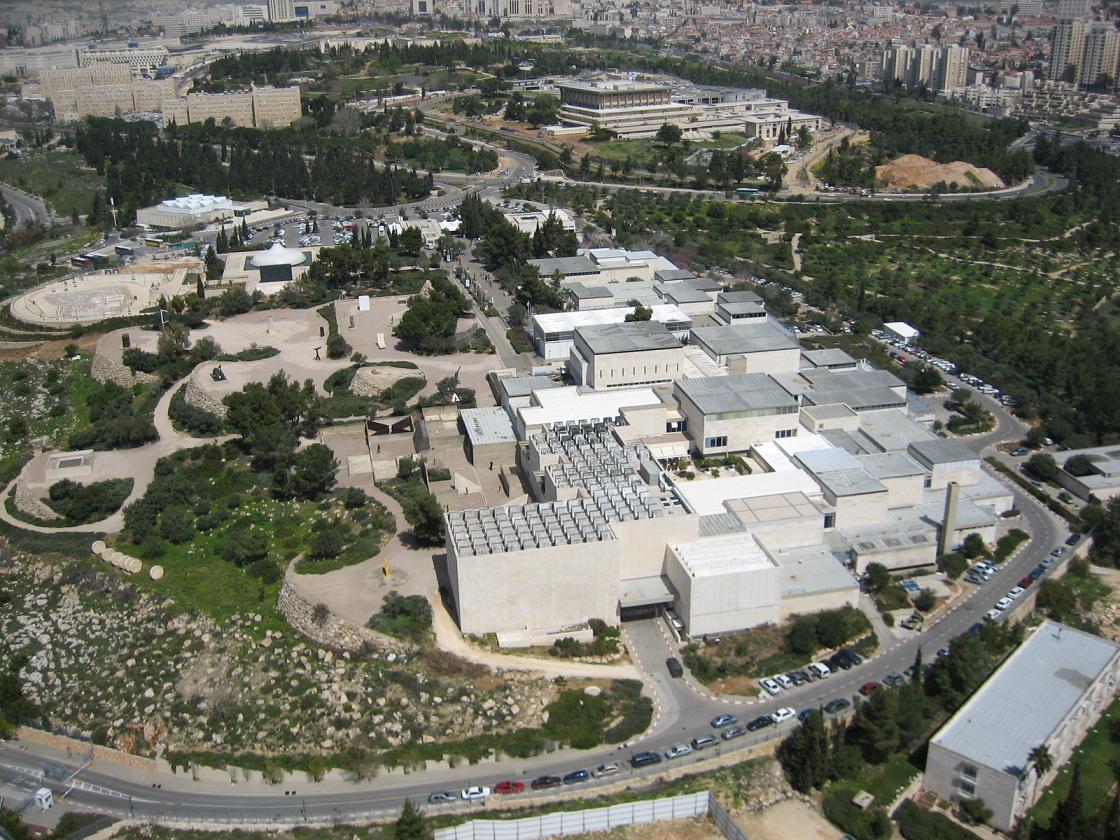
Israel Museum
The white dome appears to hover above the hillside like a lid half-lifted from a jar. This is the Shrine of the Book, and inside it, behind climate-controlled glass, lie fragments of parchment that rewrote the history of the Bible. The Dead Sea Scrolls -- the oldest known biblical manuscripts -- arrived at the Israel Museum through a chain of events that reads like a spy novel: Bedouin shepherds, antiquities dealers, a classified ad in the Wall Street Journal, and a Cold War purchase brokered through intermediaries. The shrine built to house them, opened in 1965 alongside the museum itself, remains one of the most distinctive buildings in Jerusalem. But the scrolls are only the beginning. Spread across a 20-acre hilltop campus in the Givat Ram neighborhood, the Israel Museum holds approximately 500,000 objects, making it one of the leading encyclopedic museums in the world.
Teddy Kollek's Grand Ambition
The museum was the vision of Teddy Kollek, Jerusalem's legendary mayor, who drove its establishment in 1965 -- just seventeen years after the founding of the state itself. For a young country still absorbing waves of immigrants, the decision to build a world-class museum was an act of cultural ambition that bordered on audacity. Kollek assembled an international coalition of donors and recruited architect Alfred Mansfeld and landscape designer Dora Gad to create a campus that would blend into the Judean Hills. The original design grouped low-rise pavilions along a ridge, connected by walkways that followed the natural contour of the land. The museum opened on May 11, 1965, with holdings that already spanned archaeology, fine art, and Jewish cultural artifacts -- the nucleus of a collection that would grow to fill eleven curatorial departments.
The Shrine and the Scrolls
The Shrine of the Book was designed by Armand Bartos and Frederick Kiesler, and funded by the family of Hungarian-American philanthropist David Samuel Gottesman. Its iconic white dome, shaped to echo the lids of the clay jars in which the scrolls were found in caves near Qumran between 1947 and 1956, stands in deliberate contrast to a black basalt wall opposite it -- representing the battle between the Sons of Light and the Sons of Darkness described in the scrolls themselves. Inside, the Great Isaiah Scroll, the most complete of the ancient manuscripts, is displayed in a circular case beneath the dome. The shrine also houses rare medieval biblical manuscripts and other artifacts from the Second Temple period. An elaborate seven-year planning process preceded its construction, reflecting both the scrolls' cultural weight and the technical challenges of preserving two-thousand-year-old parchment.
Half a Million Objects
Beyond the scrolls, the museum's holdings are staggering in their range. The Archaeology Wing houses what is considered the world's most comprehensive collection of Holy Land archaeology, from Neolithic tools to Crusader-era ceramics. The Fine Arts Wing spans European Old Masters, Impressionism, and contemporary art across departments covering Israeli art, photography, design, and Asian art. The Billy Rose Art Garden, designed by Japanese American sculptor Isamu Noguchi, places works by Picasso, Rodin, and Henry Moore against the backdrop of the Jerusalem hillside -- an outdoor gallery where ancient landscape and modern sculpture exist in quiet dialogue. In the Jewish Art and Life Wing, synagogue interiors transported whole from Italy, Germany, India, and Suriname have been reconstructed, preserving architectural traditions from communities that no longer exist. The museum also houses a 1:50 scale model of Jerusalem as it appeared in 66 CE, just before the Roman destruction, offering visitors a panoramic view of the city that produced many of the artifacts inside.
A Museum That Pays Its Own Way
The Israel Museum operates under financial constraints unusual for an institution of its stature. The Israeli government provides only 10 to 12 percent of its operating budget, leaving the museum to raise the remaining 88 percent through private donations, endowment income, and earned revenue -- all while paying 17.5 percent VAT and real-estate taxes on its campus. A major renovation completed in 2010, designed by James Carpenter Design Associates and Efrat Kowalsky Architects, reorganized the campus circulation, added new gallery space, and introduced natural-light elements that transformed the visitor experience. The $100 million capital project was funded almost entirely through private philanthropy. Despite these pressures, the museum has continued to expand its collection and programming, drawing roughly 800,000 visitors annually to a hilltop that Teddy Kollek first envisioned as a cultural anchor for a nation still finding its footing.
From the Air
Located at 31.773N, 35.204E on a hilltop in the Givat Ram neighborhood of western Jerusalem, at approximately 800m elevation. The museum campus is identifiable from the air by the distinctive white dome of the Shrine of the Book and the nearby Knesset building with its menorah monument. Adjacent landmarks include the Hebrew University Givat Ram campus, the Bible Lands Museum, and the Supreme Court. Nearest major airport is Ben Gurion International (LLBG), approximately 45 km northwest. The campus sits about 2 km west of the Old City.