Israeli Air Force Museum
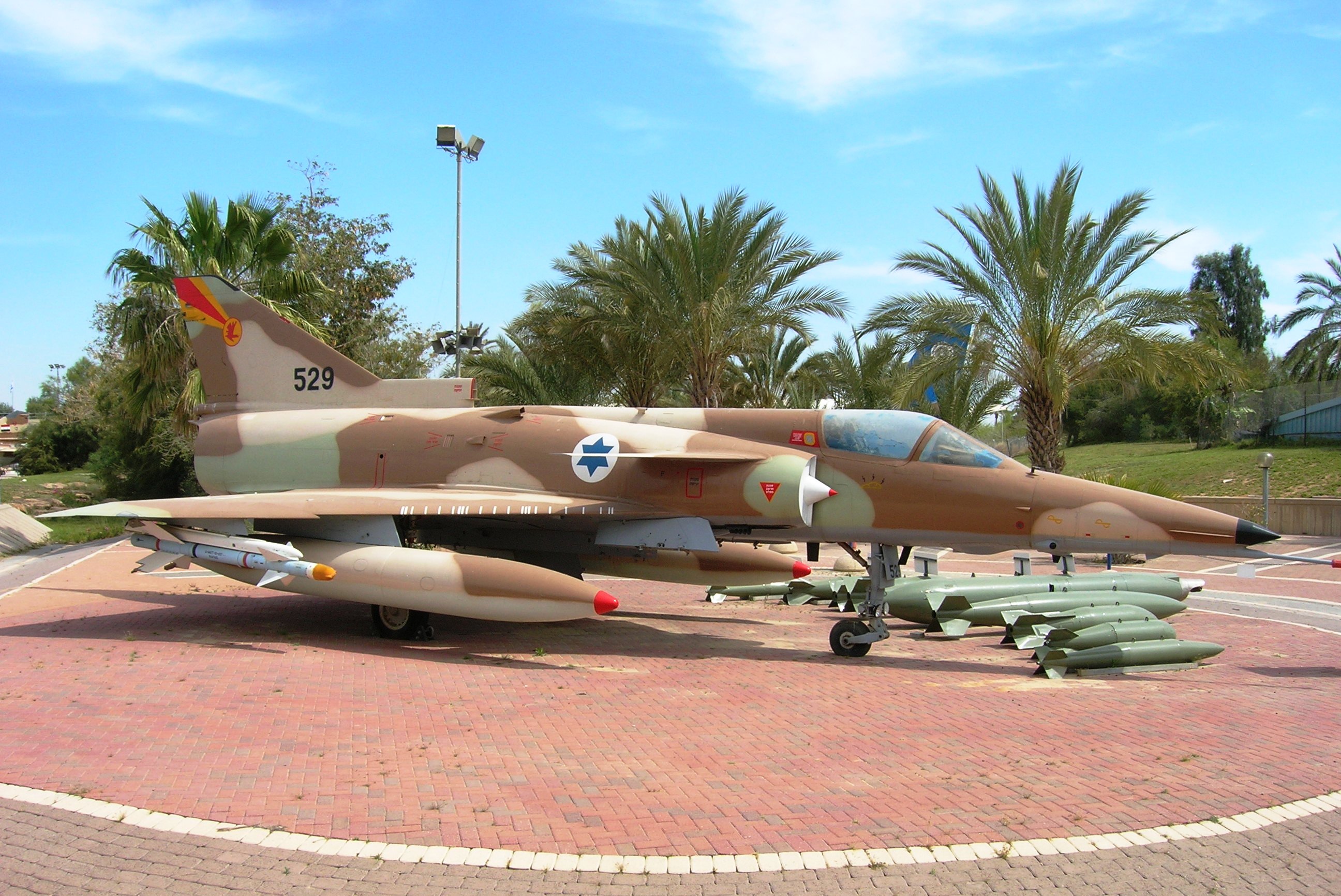
A MiG-21 bearing the tail number 007 sits in the Negev sun, its Iraqi Air Force markings long since replaced with Israeli roundels. This particular aircraft never fired a shot in combat. It was flown out of Iraq in 1966 by defecting pilot Munir Redfa during Operation Diamond, a Mossad intelligence coup that gave Israel detailed knowledge of its adversaries' frontline fighter. At the Israeli Air Force Museum on Hatzerim Airbase, every aircraft on display carries a story like this one -- not just of engineering, but of espionage, survival, and the air wars that shaped the modern Middle East.
Machines with Kill Marks
The collection reads like a combat ledger. A Dassault Mirage III Shahak, tail number 159, bears thirteen kill markings from its service during the Six-Day War and beyond. An F-15 Baz displays four kills, while an F-16 Netz, number 107, carries the unusual tally of six and a half -- the half credit shared with another pilot. These are not replicas or models but the actual airframes, their aluminum skins scarred by decades of service. Ezer Weizman's personal Supermarine Spitfire, the so-called 'Black Spit,' was maintained in flying condition for air shows until it became too precious to risk. The museum also houses the IAI Lavi, Israel's ambitious but ultimately cancelled indigenous fighter program, a monument to what might have been.
Spoils and Trophies
Walking the tarmac at Hatzerim, you encounter the aircraft of a half-dozen air forces. A Syrian Aerospatiale Gazelle helicopter captured during the 1982 Lebanon War. A MiG-23 flown to Israel by a defecting Syrian pilot in 1989. The tail section of an Egyptian Sukhoi Su-7 shot down during the Yom Kippur War. Fragments of an Iraqi Tupolev Tu-16 bomber brought down in 1967. Even the partial remains tell stories: a Bristol Beaufighter shot down in 1948 during Israel's War of Independence was retrieved from the ground in 1994, its wreckage a relic of the very first days of Israeli air power. The foreign aircraft section amounts to a three-dimensional map of the region's conflicts, each captured or destroyed machine representing a moment when the balance of power shifted.
A General's Obsession
The museum owes its existence largely to Brigadier General Yaakov Turner, who championed the project from its cornerstone laying on July 16, 1985, through its public opening on June 20, 1991. Turner was so personally invested that he regularly piloted the museum's Boeing-Stearman biplane at air shows, keeping the vintage trainer in flying condition as a living exhibit. When that silver Stearman was destroyed by a fire caused by poor maintenance in February 2015, the loss was felt as something more than the destruction of an artifact. In November 2016, the Ministry of Defense announced an architecture competition to redesign the museum as a modern heritage center. The Haifa firm Schwartz Besnosoff won the commission, though the museum's future has also involved painful choices: in February 2022, twenty aircraft were scrapped, including the Boeing 707 that served as a flying command post during the legendary 1976 Operation Entebbe rescue at Uganda's airport.
Desert Airfield, Living History
Hatzerim is an active air force base, and during Passover and Independence Day the boundary between museum and military blurs entirely. Active-duty F-15I Ra'am and F-16I Sufa fighters park alongside their retired predecessors, while Apache helicopters perform flyovers and children climb through cockpit mockups. Soldiers from the Israeli Air Force staff the museum year-round, lending it the atmosphere of a working installation rather than a static collection. An exhibit called 'Pull to Life' honors Unit 669, the tactical airborne rescue and evacuation unit whose pararescuemen operate behind enemy lines. Anti-aircraft weapons from captured Soviet-made SA-2 Guideline missiles to ZSU-23-4 Shilka self-propelled guns line the perimeter, a reminder that air power is defined as much by what tries to bring it down as by what flies.
From the Air
Located at 31.24N, 34.70E at Hatzerim Airbase in the Negev desert, approximately 8 km west of Beersheba. The museum's open-air aircraft displays are visible from low altitude. Nearest major airport is Ramon Airport (ICAO: LLER) about 90 km to the south, with Ben Gurion International (ICAO: LLBG) approximately 100 km to the north-northwest. Note: Hatzerim is an active military airbase -- the museum area is on the base perimeter. Fly at 2,000-3,000 ft AGL for best viewing of the aircraft collection arranged on the tarmac.