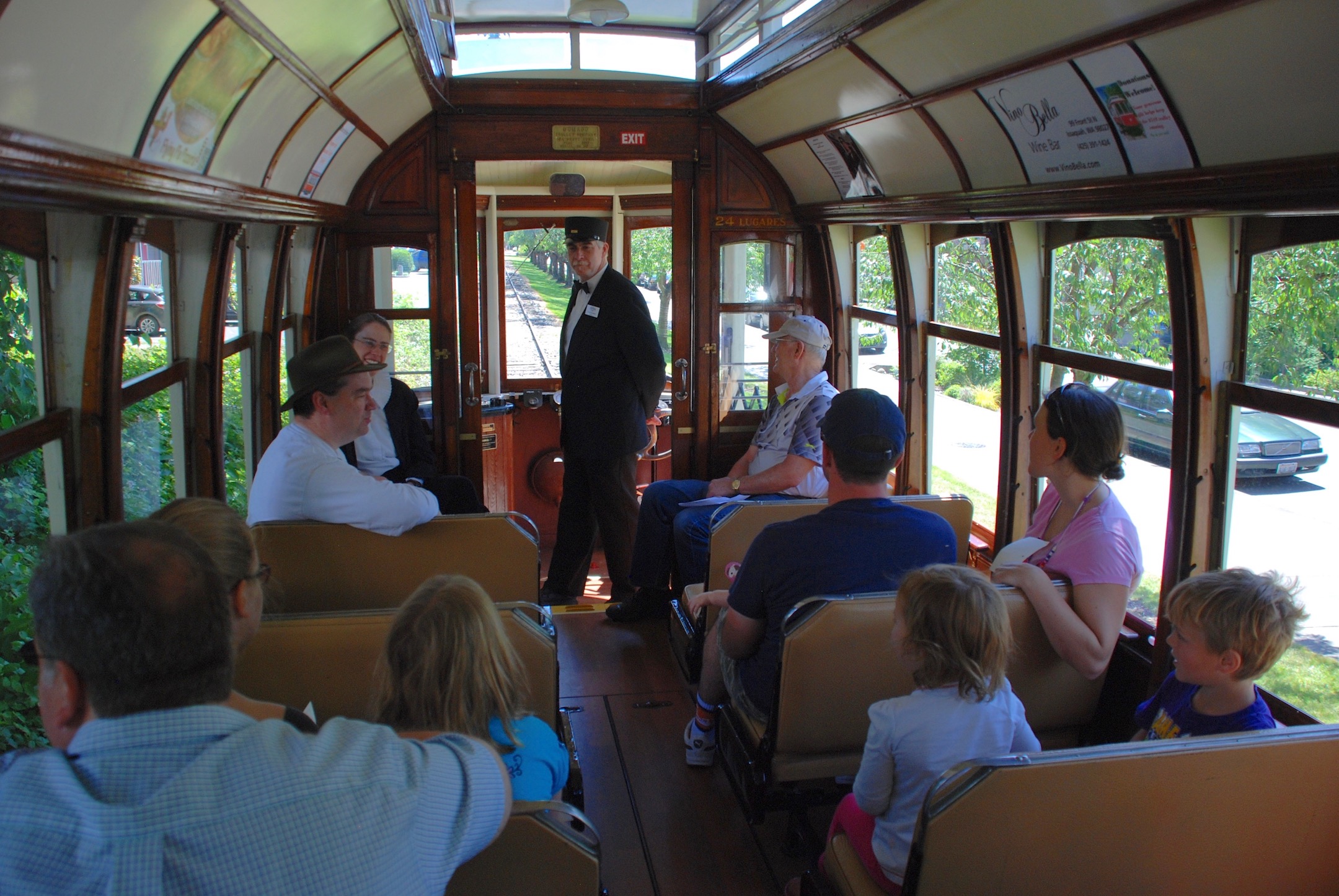
Issaquah Valley Trolley
The trolleys came from Lisbon by way of Aspen. Built in 1925 for the hills of the Portuguese capital, cars 519 and 521 were shipped to Colorado in the 1990s for a heritage streetcar line that never materialized. When that plan collapsed, the Issaquah Historical Society saw an opportunity. By 2012, one of those narrow-gauge Lisbon cars was carrying passengers along former freight tracks in downtown Issaquah, Washington, its electric motors humming on power from a generator car it towed behind it like a reluctant dance partner. It was an improbable transit line, and for eight years it worked.
Tracks to Nowhere, Then Somewhere
The story begins at the Issaquah Depot, a restored railroad station that sits at 78 First Avenue NE in downtown Issaquah. When the depot's restoration neared completion in 1989, members of the Issaquah Historical Society started eyeing the freight tracks that still ran past the building. Dinner trains and excursion runs were discussed, but a streetcar proved more practical. A borrowed trolley ran a proof-of-concept service in 2001 and 2002, operating on Saturdays and Sundays from 11 a.m. to 3 p.m. through the summer. It attracted enough riders to prove the idea had legs, even if the legs moved at trolley speed. A small carbarn was built next to the depot in spring 2001 to house the car.
Aspen's Loss, Issaquah's Charm
The society acquired three trolleys for its permanent collection: an ex-Milan interurban car (No. 96) from the San Francisco Municipal Transportation Agency, and two narrow-gauge ex-Lisbon trolleys (Nos. 519 and 521) that had been purchased for the abandoned Aspen streetcar project. The Lisbon cars, built by J.G. Brill Company in 1925, were the right size for Issaquah's modest ambitions. Car 519 became the workhorse of the line. The Milan car, a 1930-built interurban too large and unwieldy for the short route, never carried a single passenger in Issaquah and was eventually put up for sale. There is something fitting about a mountain town's rejected trolleys finding a second life in a valley fifteen hundred miles north.
A Short Ride with Big Dreams
Public service launched on October 14, 2012. The operating line was short, stopping just before the bridge over the East Fork of Issaquah Creek, with one level crossing at Front Street. The trolley towed a generator car to supply electricity to its traction motors rather than drawing power from overhead wires, a pragmatic solution that gave the line its distinctive look: a century-old streetcar trailing a boxy modern generator like a parenthetical afterthought. The museum kept a Plymouth 0-4-0 gasoline-mechanical locomotive on standby as a rescue vehicle in case the trolley broke down mid-trip. Before the line closed, organizers had envisioned extending service to a new platform near the Issaquah Chamber of Commerce, creating a genuine if modest transit link between the historic depot and the Gilman Village shopping district.
The Last Bell
In autumn 2020, the COVID-19 pandemic delivered the final blow. The Issaquah History Museums, which had taken over stewardship of the project from the Issaquah Historical Society, announced that the trolley would not return. Rising insurance costs and other operational expenses had been squeezing the budget for years, and the pandemic's financial impact made continued service unsustainable. The trolley had run seasonally for eight years, ferrying families and history buffs along a route that once carried coal and freight. Its closure ended one of the few heritage streetcar operations in Washington state and left the Lisbon-built cars without a regular assignment for the first time since they crossed the Atlantic.
Echoes Along the Freight Spur
From the air, the old trolley route traces a thin line through downtown Issaquah, parallel to the East Fork of Issaquah Creek and barely distinguishable from the surrounding streets and trails. The Issaquah Depot still stands at First Avenue NE, and the carbarn remains nearby. The tracks that once carried trolley 519 on its weekend rounds are quiet now. But the line's story, a chain of improbable connections linking Lisbon, Milan, San Francisco, Aspen, and a small town in the Cascade foothills, captures something essential about heritage preservation: the stubborn belief that old things deserve new journeys, even short ones.
From the Air
Located at 47.531N, 122.036W in downtown Issaquah, in the valley between the Issaquah Alps and the Sammamish Plateau. The trolley route runs near the East Fork of Issaquah Creek, close to the Issaquah Depot at First Avenue NE. Nearest airports: KRNT (Renton Municipal, 10 nm west), KBFI (Boeing Field/King County International, 13 nm northwest), KSEA (Seattle-Tacoma International, 18 nm southwest). Look for the I-90 corridor running east-west through the Issaquah valley as a reference point.