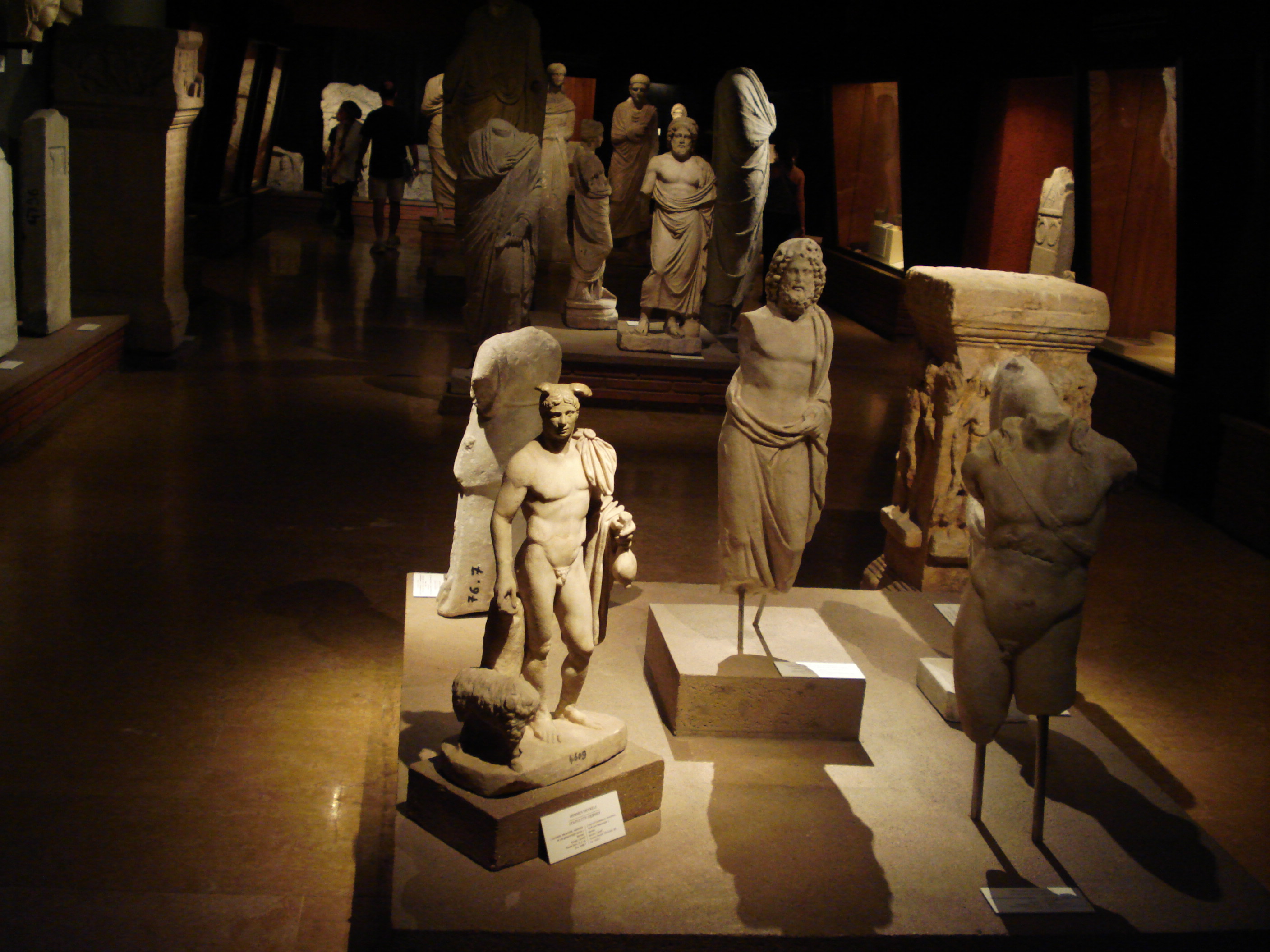
Istanbul Archaeology Museums
On a clay tablet barely larger than a paperback, two ancient empires made peace. Ramesses II of Egypt and Hattusili III of the Hittite Empire signed it in 1258 BCE, ending a bitter conflict over what is now Syria. The tablet sits in a glass case in Istanbul, the oldest known peace treaty in the world, and the United Nations thought it important enough that a giant copy hangs on a wall in New York. The Istanbul Archaeology Museums hold this tablet alongside roughly a million other objects, gathered across decades from territories the Ottoman Empire once governed: Babylon, Sidon, Karnak, Nineveh, Jericho. To walk the galleries is to move through three thousand years of human ambition, from cuneiform love poems to porphyry sarcophagi of Byzantine emperors.
A Painter Who Built a Museum
Osman Hamdi Bey was an unlikely founder. He was a painter first, the son of a Grand Vizier, trained in Paris and capable of producing work that still commands extraordinary prices. In 2019 his canvas Girl Reading the Quran sold at auction for 6.3 million British pounds, the most ever paid at the time for a Turkish painting. Appointed curator in 1881, he spent the next decade hunting for a building large enough to hold what was rapidly becoming a national collection. He commissioned the architect Alexander Vallaury, the same man who designed the Pera Palace Hotel where Agatha Christie would later write, and chose for the facade a design inspired by the Alexander Sarcophagus inside. The main building opened on June 13, 1891. A century later, in 1991, it received the European Council Museum Award.
The Sarcophagus That Was Not Alexander's
The Alexander Sarcophagus is the museum's celebrity object, and the name is a beautiful misunderstanding. Found in 1887 at the Royal Necropolis of Ayaa in Sidon, on the Lebanese coast, it depicts the conqueror in vivid relief, hunting lions and routing Persians. Scholars now believe it was carved for Abdalonymus, a king of Sidon installed by Alexander himself, sometime around 320 BCE. Traces of original paint still cling to the marble, hints that the figures once blazed in red and yellow and blue. Around it cluster other Sidon sarcophagi: the Tabnit, carved from black diorite and inscribed with a Phoenician curse against grave robbers; the Lycian sarcophagus in Parian marble; the Sarcophagus of the Mourning Women, eighteen draped figures frozen in grief.
Three Buildings, A Million Objects
The complex is actually three museums on one terrace: the main Archaeological Museum, the Museum of the Ancient Orient (commissioned in 1883 originally as a fine arts school), and the Tiled Kiosk, a 15th-century pavilion that holds Islamic ceramics and now houses the Museum of Islamic Art. The Ancient Orient wing alone holds about 1,200 Egyptian objects and roughly 10,000 Mesopotamian pieces drawn from Assur, Nippur, Lagash, Uruk, and Nineveh. Glazed brick from the Ishtar Gate of Babylon catches the light through tall windows. A serpentine head broken from the column that once stood in the Hippodrome of Constantinople rests under glass, the rest of its bronze body still standing on the square outside. A snake torn from a column, a tablet preserving the world's oldest love poem, the Code of Ur-Nammu, the Siloam Inscription that Israel formally requested back in 2007.
Empire's Inheritance
There is a tension built into the place. Most of these objects came from somewhere else, gathered by Ottoman governors and shipped to the capital under the antiquities law of 1869, the empire's first formal protection statute for cultural property. That law forbade exporting finds abroad but encouraged provincial governors to send them to Istanbul. Sidon, Babylon, Karnak, Jericho, the temples of Pergamon and Miletus, all sent their pieces. When the empire dissolved, the museum did not. The Siloam Inscription, found in a Jerusalem tunnel in 1880, became a diplomatic flashpoint when Israel asked for its return. Many objects in the Mesopotamian and Palestinian galleries are claimed by other modern states. The museum responds to these requests case by case, but the broader question lingers in the galleries: whose history is being told here, and by whom?
Visiting the Place
The museums sit just inside the outer wall of Topkapı Palace, on the slope between Gülhane Park and the Bosphorus. The neoclassical facade with its tughra of Sultan Abdulhamid II is one of the most photographed museum entrances in Turkey. Inside, the lighting is honest, sometimes harsh on stone but right for it. Most visitors come for the Sidon sarcophagi and stay for the surprises, a Byzantine sarcophagus believed to belong to Constantine the Great, a marble lion saved from the Mausoleum of Mausolus at Halicarnassus, the bust of Alexander signed by the sculptor Menas. A morning is not enough.
From the Air
Located at 41.0117 degrees N, 28.9814 degrees E in Istanbul's Eminönü district, on the historic peninsula between the Golden Horn and the Sea of Marmara. Best viewed in the cluster of museums and palaces around Topkapı; from above, look for the green of Gülhane Park beside the larger gardens of the palace itself. Nearest airport is Istanbul Airport (LTFM, 30nm northwest); Sabiha Gökçen (LTFJ) lies about 22nm southeast on the Asian side.