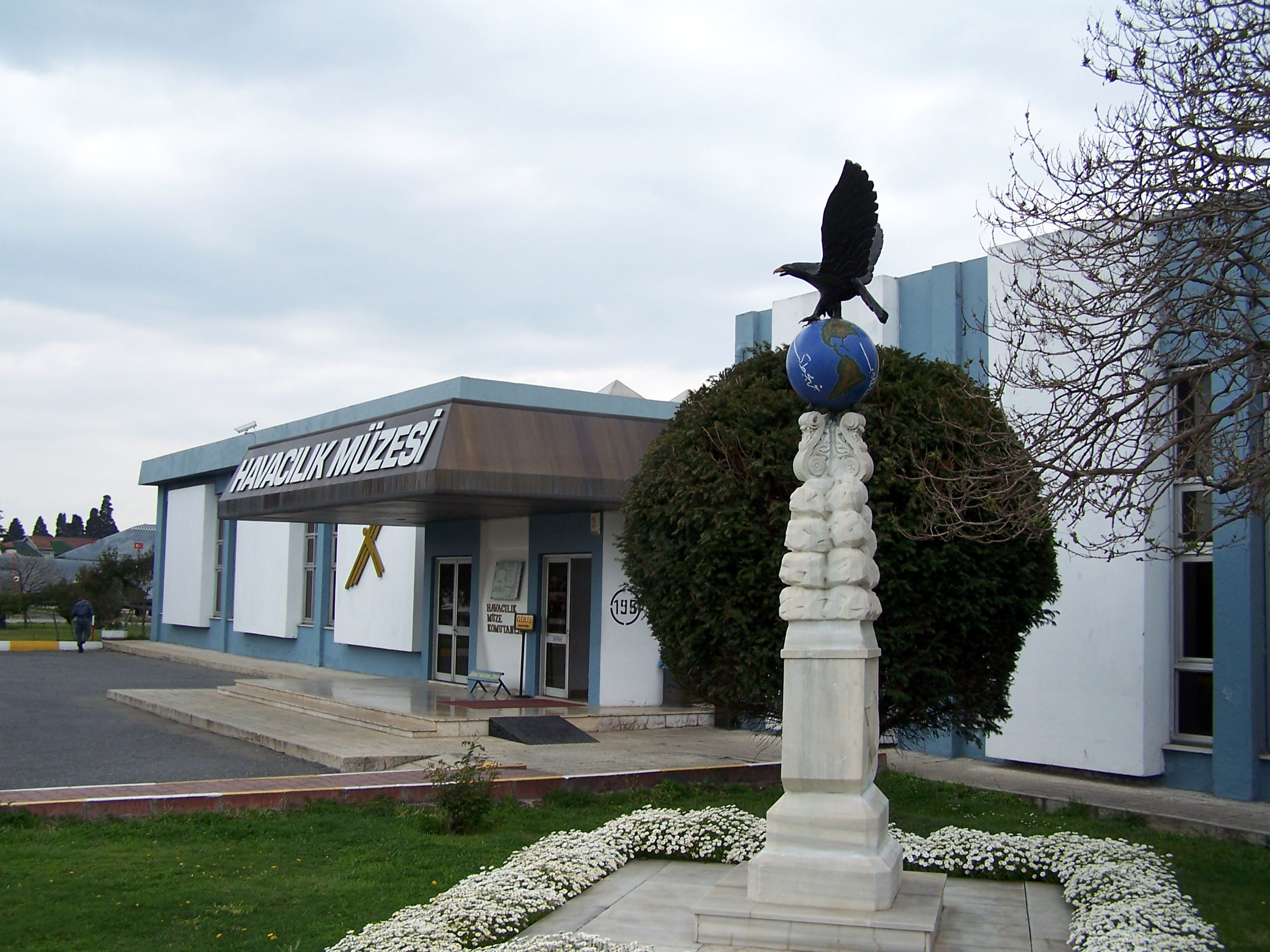
Istanbul Aviation Museum
The aircraft sit nose to tail under an open sky, painted in the dust grays and forest greens of Cold War service. An F-4E Phantom II with the serial 67-0360, an F-86F Sabre that once climbed into Anatolian dawns, a C-160 Transall that hauled paratroopers and supplies. Six and a half hectares of asphalt and lawn at Yeşilköy hold the planes the Turkish Air Force has set down for good. The Istanbul Aviation Museum is also the Turkish Air Force Museum, and it occupies a peculiar corner of geography: the same airfield where the nation's first air unit took off, a stone's throw from what used to be Istanbul Atatürk Airport.
A Museum That Took Decades
The idea is older than the museum. At the end of the First World War, the Inspectorship of the Ottoman Air Force found itself with a hangar of seized aircraft, some German, some captured booty, the oldest dating from 1912. Officers proposed a museum almost immediately. Then came the Turkish War of Independence. The aircraft were trucked from their hangars to Kartal-Maltepe to keep them safe from Allied control. Many were damaged in the move. The museum project was shelved. Forty years later, in 1960, Air Force Commander General İrfan Tansel revived the idea. By 1963 every Air Force unit was ordered to set aside one of each aircraft type for preservation. The first museum opened at İzmir-Cumaovası in 1971.
Why Yeşilköy
The İzmir location had a problem. It was too far from any city, and visitors had trouble reaching it. By the late 1970s the runway needed repair for training flights, and the museum was crowding what had become a working airfield. So the planning began for a move to Istanbul, specifically to Yeşilköy, the western end of Bakırköy district where the Turkish Air Force Academy already trained pilots. Construction started in 1977 and finished in 1983. Of the 65,000 square meters of grounds, about 12,000 are open-air display and 2,365 are enclosed exhibition space. General Halil Sözer, then commander of the Turkish Air Force, opened the doors to visitors on October 16, 1985.
What's on the Ramp
Walking the grounds is a quick lesson in postwar NATO aviation. The F-86F Sabre served as Turkey's frontline fighter through much of the 1950s, including in Korea. The F-4E Phantom II carried the air force into the supersonic era and stayed in service for half a century, with Turkey operating Phantoms longer than almost any other nation. The C-160 Transall, a Franco-German cargo aircraft, hauled men and matériel through decades of operations. There are helicopters, Nike Ajax surface-to-air missiles from a different era of air defense, and aircraft going back to the Ottoman period when Turkish aviation was just figuring out what it would be. The museum's interior wing, designed in part by experts from Mimar Sinan University, holds uniforms, instruments, photographs, and the smaller artifacts that don't survive outdoor weather.
The Airfield's Long Memory
Yeşilköy itself is part of the story. The grounds back onto what was Istanbul Atatürk Airport until passenger flights moved to the new Istanbul Airport in 2019. Before it became Atatürk Airport in 1985, this was Yeşilköy Airport, and before that, in the early years of the Republic, it was the field where Turkey's first air unit was based. The museum's location was chosen partly for that lineage. Walk the perimeter and you can still see the long runway through the fence. The Air Force Academy is next door, cadets in the same place where their grandfathers learned to fly.
Visiting
The museum is in Bakırköy on the European side, a short drive from the old airport, easy to combine with arrivals or departures. Entry is modest. Most of the experience is outdoors among the airframes, so the visit shifts with the weather, hard light in summer, raw wind off the Marmara in winter. For aviation visitors transiting Istanbul, it makes a satisfying detour: a chance to walk under the wings of aircraft that defined an era of NATO air power, and to see the long thread connecting them back to the canvas-and-wire pioneers of Ottoman flight.
From the Air
Located at 40.9639 degrees N, 28.8258 degrees E, in Yeşilköy on the European side of Istanbul, immediately adjacent to Istanbul Atatürk Airport (LTBA, now used for cargo and general aviation). The active passenger hub Istanbul Airport (LTFM) lies about 18nm to the northwest; Sabiha Gökçen International (LTFJ) sits roughly 25nm east on the Asian shore. The museum is visible from the eastern approach paths to LTBA, surrounded by the Air Force Academy campus.