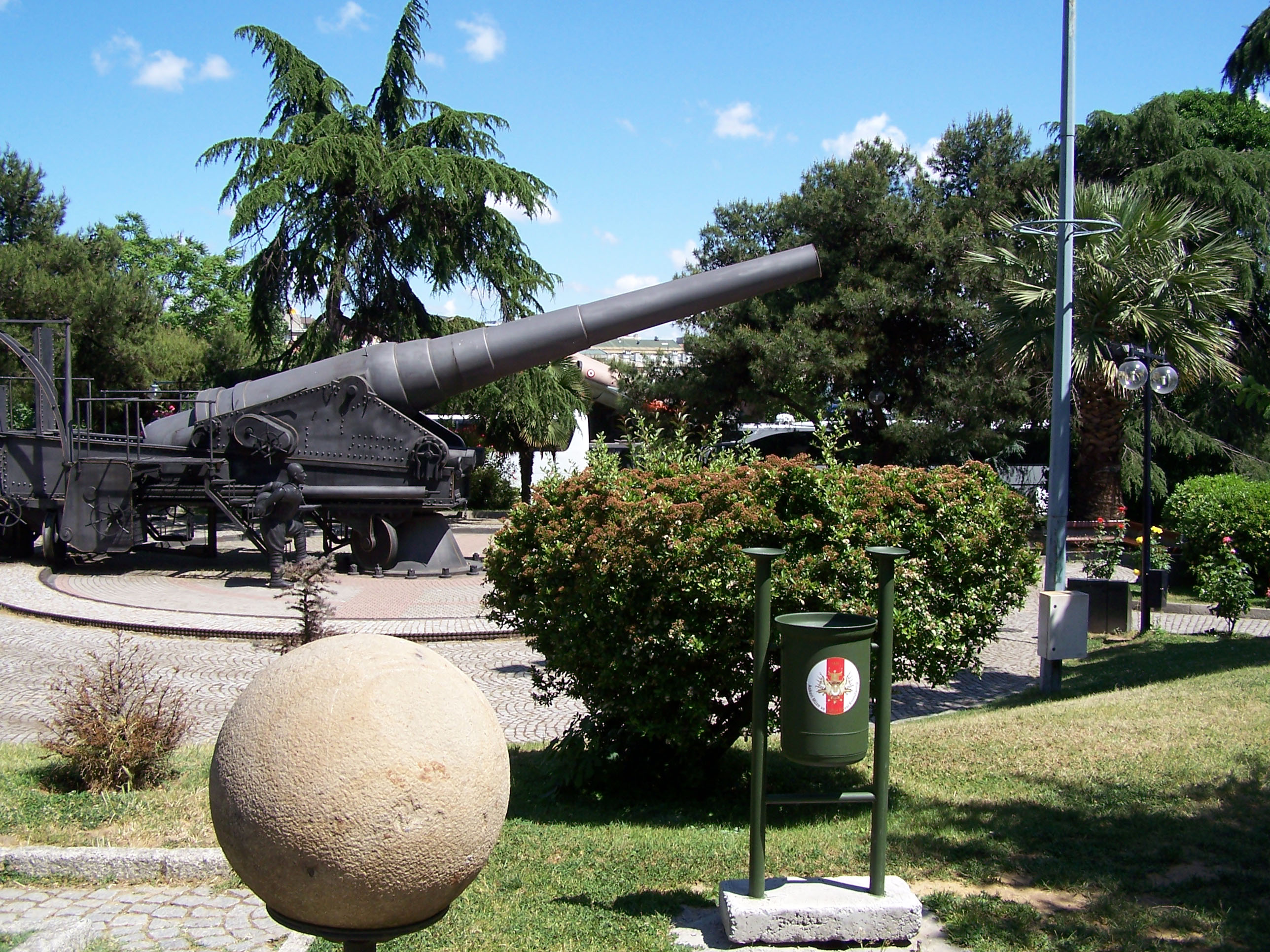
Istanbul Military Museum
Around three in the afternoon most days, kettledrums begin in a courtyard off Cumhuriyet Caddesi. Zurnas, the conical Anatolian oboes, slice the air. Cymbals crash. The Mehter Takımı, the Janissary Band, is doing what its predecessors did for the Ottoman sultans for centuries: announcing presence with loud, modal, deliberately slow-cadenced music designed to make conquered cities feel small. The performers wear plumed turbans and long red coats. The music is older than almost any other organized military music in the world. And it is performed inside the Istanbul Military Museum, where the Ottoman past is curated by the Turkish Land Forces in a building where Mustafa Kemal Atatürk himself studied between 1899 and 1905.
From Hagia Irene to Harbiye
The collection goes back to the late Ottoman era, when military relics were first displayed in Hagia Irene, the 4th-century Byzantine church just inside the outer walls of Topkapı Palace. After the conquest of Constantinople in 1453, the Janissaries had used Hagia Irene as their inner arsenal, the storehouse for the sultan's most prized weapons. By 1726 it was officially the Dar-ül Esliha, the House of Weapons. So when the empire's military museum was first organized there in the 19th century, the building had already been cataloging arms for generations. In 1950, the collection moved north to its current home: the First Army Headquarters building in Harbiye, near Taksim Square. The neighborhood's name comes from the Arabic harb, meaning warfare, and reflects its long use as the site of the Ottoman Military College, often described as the empire's West Point.
The Chain Across the Golden Horn
The single most arresting object in the collection looks at first like an industrial relic: heavy iron links, dark with age, draped in a long line. This is what remains of the chain the Byzantines stretched across the mouth of the Golden Horn in the spring of 1453, trying to keep Mehmed II's navy out of the inner harbor during the siege of Constantinople. The chain held. So Mehmed had his ships hauled overland on greased logs, behind the Genoese walls of Galata, and lowered into the Golden Horn from the rear. The siege ended on May 29, 1453, and the empire that had defended Constantinople for over a thousand years ended with it. The chain in this room is the surviving evidence of one of history's more famous failed defenses.
Twenty-Two Rooms
The museum holds about 50,000 objects total, of which roughly 9,000 are on display across 22 rooms. The ground floor moves chronologically and thematically: bows and arrows in the first room, then cavalry weapons, then 15th-century daggers and lancets carried by foot soldiers, then 17th-century copper headpieces forged for war horses. There are sections on Selim I, on Mehmed II, on the conquest of Istanbul itself rendered in dioramas. Rooms hold weapons from early Islamic, Iranian, Caucasian, European, and Turkish traditions, side by side. A unique gallery of helmets and armor sits beside the firearms hall. And then the great campaign tents the sultans took on military expeditions, vast embroidered canopies that turned a battlefield into a moving palace. Upstairs, the World War I rooms, the Battle of Gallipoli, the Turkish War of Independence, and a room dedicated to Atatürk himself, who walked these halls as a young military student.
The Mehter, Still Playing
The Janissary Band, the Mehter Takımı, is one of the museum's signature draws. The Mehter style is often called the world's oldest tradition of organized military music, with origins reaching back to the Ottomans and earlier Turkic armies. The modern ensemble's continuous lineage dates from later centuries, but the form itself is genuinely ancient. The Ottomans were among the first to integrate musicians into both military campaigns and ceremonial processions. After conquering a town, the Mehter would accompany the victorious commander through the streets, performing slow-cadence marches in distinctive modal scales. The instrumentation, kettledrums, zurnas, cymbals, was designed simultaneously to inspire troops and to announce, at volume, the arrival of imperial power. Modern performances at the museum are held most afternoons. Visitors stand on the courtyard's edge as the procession enters, and you can feel the drums in your sternum before you hear them.
Visiting
The museum sits in the Harbiye neighborhood of Şişli, a short walk from Taksim Square along Cumhuriyet Caddesi. It is open every day except Mondays. Outside, in the back streets, sit the larger pieces of artillery: open-air Ottoman cannons, mortars, a railway gun, retired aircraft and helicopters. The 1957 reorganization under General Ahmet Hulki Saral set the modern shape of the exhibits, and a 1993 renovation gave them their current presentation. Plan around the Mehter performance time, which is posted at the entrance, and give the upper-floor Atatürk room more time than its modest size suggests.
From the Air
Located at 41.0484 degrees N, 28.9883 degrees E in the Harbiye neighborhood of Şişli, on the European side of Istanbul about 1nm north of Taksim Square. From above, look for the rectangular building set back from Cumhuriyet Caddesi, with the open-air artillery yard behind. Nearest airports are Istanbul Airport (LTFM, 25nm northwest) and Sabiha Gökçen (LTFJ, 18nm southeast across the Bosphorus).