Istiqlal Mosque, Jakarta
The architect who won the design competition for Indonesia's national mosque was Friedrich Silaban, the son of a Lutheran pastor from the Batak Protestant Christian Church. That a Christian designed the largest mosque in Southeast Asia was not an accident or an oversight -- it was the point. President Sukarno, who personally supervised the project, insisted the mosque be built directly across from Jakarta Cathedral and near Immanuel Church, so that the nation's religious diversity would be visible in a single glance from Merdeka Square. Even the name is political: Istiqlal is Arabic for "independence."
A Mosque Where a Fortress Stood
Before the mosque, there was a park. Before the park, there was a citadel. The Citadel Prins Frederick, a Dutch fortification built in 1837, occupied the site until it was demolished to make room for Sukarno's vision. The idea for a grand national mosque had first been raised by Wahid Hasyim, Indonesia's first minister for religious affairs, and Anwar Cokroaminoto shortly after the 1945 proclamation of independence. A construction committee was founded in 1953. Vice President Mohammad Hatta suggested building on Thamrin Avenue, where Hotel Indonesia now stands, but Sukarno overruled him. The mosque had to be near Merdeka Square, he argued, following the Javanese tradition that the kraton, the masjid agung, and the alun-alun should stand together at the heart of a city. The foundation stone was laid on August 24, 1961. Construction took seventeen years. President Suharto inaugurated it on February 22, 1978.
Numbers as Architecture
Every dimension of Istiqlal carries symbolic weight. The main dome spans 45 meters -- for 1945, the year of independence. Twelve columns support it, representing the birthday of the Prophet Muhammad on the 12th of Rabi al-Awwal. Five floors echo the Five Pillars of Islam and the five principles of Pancasila. The entrance dome measures eight meters across: August, the month Indonesia declared its freedom. The single minaret rises 66.66 meters, intended to symbolize the 6,666 verses of the Quran. Even the seven entrance gates carry meaning, each named after one of the 99 Names of Allah, their number representing the Seven Heavens in Islamic cosmology. The interior is minimalist -- stainless steel geometric ornaments, marble from Tulungagung quarries in East Java rather than the Italian marble originally planned, and Arabic calligraphy spelling Allah and Muhammad on the qibla wall.
Scale Beyond Imagining
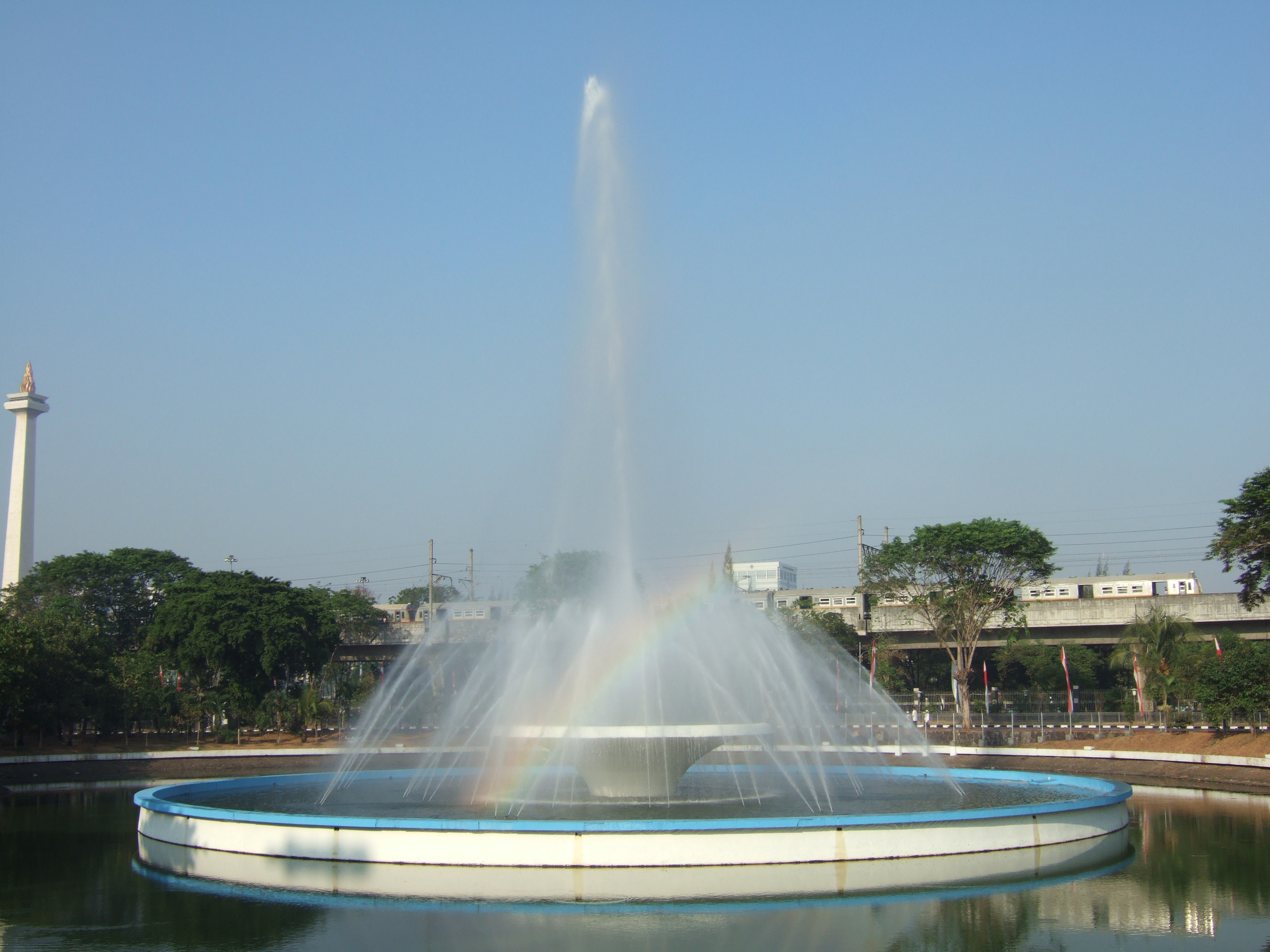
At capacity, Istiqlal holds over 200,000 worshippers. The main prayer hall and its four levels of balconies accommodate 61,000. The open terrace on the second floor holds another 50,000. Corridors and overflow spaces absorb the rest. During Eid ul-Fitr, the mosque overflows into the surrounding gardens, where century-old trees from the former Wilhelmina Park still shade the grounds and the Ciliwung River flows along the eastern boundary. A grand fountain in the southwestern corner shoots water 45 meters high -- that symbolic number again -- though it operates only on Fridays during congregational prayer and on Islamic holidays. The mosque's sound system runs 200 speakers on the main floor alone, controlled by 26 amplifiers, with six technicians working in shifts around the clock.
The Tunnel of Friendship
In 2021, Indonesian authorities completed a pedestrian tunnel connecting Istiqlal Mosque to the neighboring St. Mary of the Assumption Cathedral. They named it the Terowongan Silaturahmi -- the Tunnel of Friendship. During Christmas, the mosque provides overflow parking for cathedral worshippers. The gesture is not just neighborly; it is architectural theology, the physical embodiment of the religious tolerance that Sukarno encoded into Pancasila. In September 2024, Pope Francis visited the mosque and signed the Istiqlal Declaration alongside Grand Imam Nasaruddin Umar, calling the building "concrete proof of the presence of religious moderation in Indonesia." The mosque has also hosted Hebrew language courses, taught by Muslim scholar Sapri Sale, as part of its interfaith dialogue programs -- a detail that would have delighted Silaban, the Christian architect who gave the building its bones.
Green and Growing
Between 2019 and 2020, Istiqlal underwent a $35 million renovation that went beyond cosmetics. The marble exterior was polished, electrical and plumbing systems were upgraded, LED lighting replaced older fixtures, and a two-story basement parking structure was added. Grand Imam Nasaruddin Umar pushed further, installing solar panels, slow-flow faucets, and a water recycling system. In 2022, the mosque received EDGE certification from the International Finance Corporation, a World Bank subsidiary, becoming the world's first green-certified place of worship. For a building whose every measurement was chosen to encode religious and national symbolism, the addition of environmental stewardship feels fitting -- another layer of meaning in a structure that was designed, from the very beginning, to carry the weight of an entire nation's aspirations.
From the Air
Located at 6.17S, 106.83E in Central Jakarta, immediately northeast of Merdeka Square. From the air, the mosque is unmistakable: its massive white dome and single minaret stand adjacent to the smaller twin spires of Jakarta Cathedral, with the National Monument (Monas) obelisk dominating the center of Merdeka Square to the west. Nearest major airport is Soekarno-Hatta International (WIII), approximately 25 km northwest. Halim Perdanakusuma Airport (WIHH) is about 12 km southeast. The mosque complex, gardens, and Ciliwung River channel are clearly visible from low altitude.