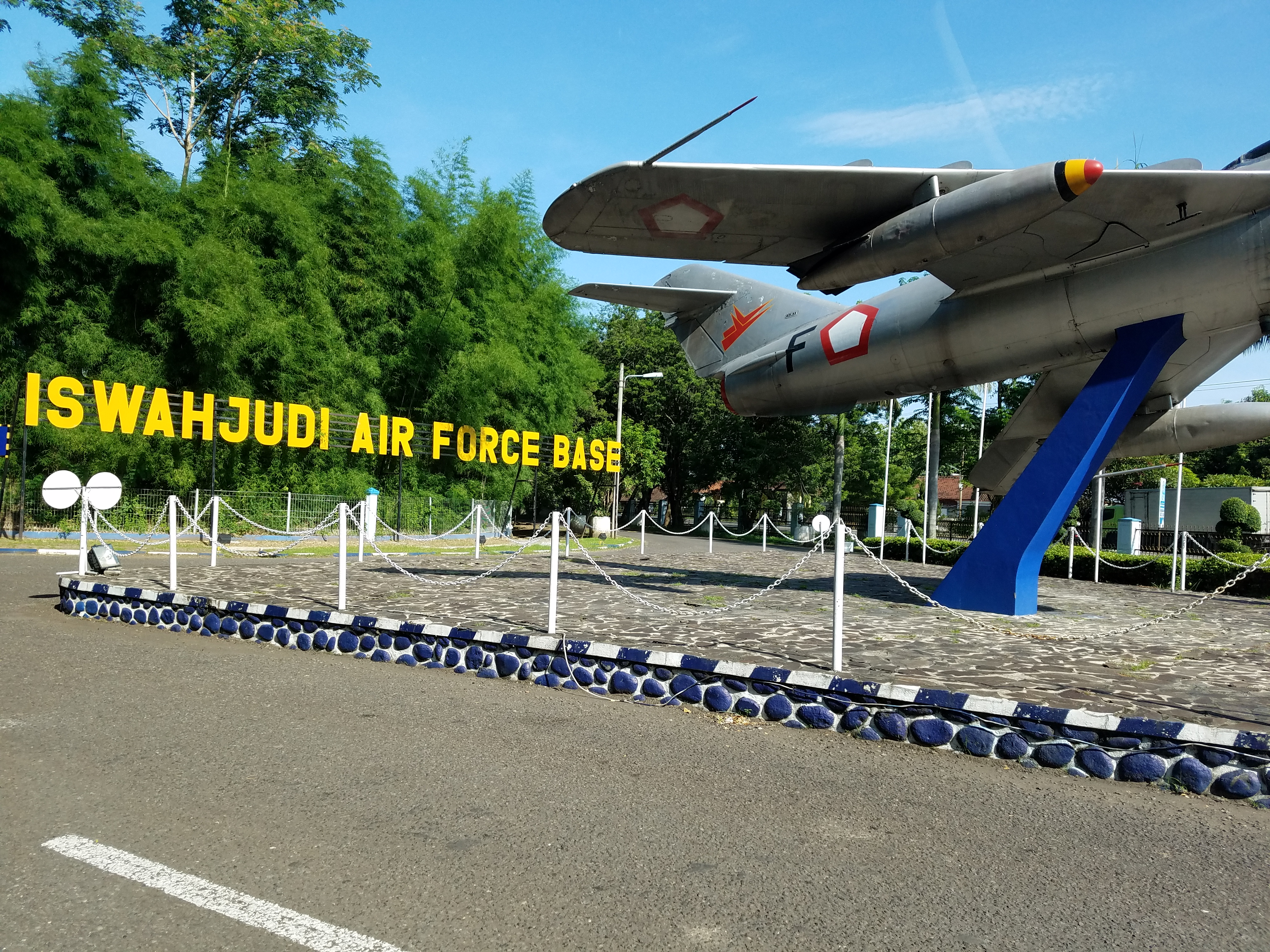
Iswahjudi Air Force Base
The name on the gate belongs to a man who never made it home. In 1947, Indonesian Air Force officer Iswahjudi and fellow pilot Halim Perdanakusuma were flying back to their newly independent country from Thailand when their aircraft crashed, killing both men. The airbase near Madiun in East Java was renamed in Iswahjudi's honor in 1960, but the field itself is far older than the nation it now serves. Built by the Dutch in 1939 to defend against a Japanese invasion that came anyway, the base has changed hands four times, survived two wars, and absorbed the displacement of entire villages -- all on a flat stretch of land squeezed between two volcanoes.
Villages Erased for a Runway
When the Dutch Ministry of War decided in 1939 to build an airfield at Maospati, in the regency of Magetan, the landscape was rice paddies and small Javanese villages. The runway they planned -- 1,586 meters long and 53 meters wide, at 120 meters above sea level -- required far more land than the paddies could spare. Entire communities were uprooted. Ngujung, Lemahbang, Kinandang, and Kincang Kulon were relocated completely. Residents of Pandeyan were split in two, the southern half moved north across the main road to settle in what became the villages of Bogorejo and Sukolilo. Some families received compensation and moved voluntarily; others were part of what Javanese call bedol desa -- whole-village relocations where an entire community picks up and reassembles itself elsewhere. The construction began with the runway, then three hangars in the Klecorejo, Setren, and Ngujung areas, followed by workshops, warehouses, and campements for Dutch soldiers and their families. The base was finished by the end of May 1940, just weeks after the Netherlands fell to Germany.
Curtiss Hawks Against the Rising Sun
The completed airfield opened with 36 aircraft divided into three squadrons: thirteen Curtiss 75A-7 Hawks, seventeen Curtiss Wright 21B Interceptors, and six Brewster F2A Buffaloes for training. When the Pacific War erupted, Maospati became an Allied bastion in East Java, its pilots flying sorties against the advancing Japanese. The fighting was brutal and the losses heavy. Among the dead was the base commander himself, Captain H.J. Van De Pool, killed in action during the air battles that followed Japan's invasion of the Dutch East Indies. On March 8, 1942, after the Dutch high command surrendered, the Imperial Japanese Navy seized the airfield. Japanese Army units garrisoned the surrounding area, but unlike other captured airfields on Java, Maospati saw little Japanese air activity. The base served mostly as a warehouse for spare parts -- a strategic asset parked and waiting.
Independence and a New Name
Japan's surrender in August 1945 did not bring peace to Maospati. On August 27, the Japanese commander handed the base over to the local Javanese administration, and within months it was absorbed into the fledgling Indonesian Air Force. Prof. Dr. Abdul Rahman Saleh, a physician turned military leader, was appointed base commander. But the Dutch returned, and during the independence struggle their warplanes hammered Indonesian airbases across Java. Maospati was badly damaged; only the Maguwo Air Base near Yogyakarta escaped heavy bombardment, shielded by persistent bad weather. The base survived, and on November 4, 1960, a ministerial decree formally renamed it Iswahjudi Air Force Base, honoring the pilot who had died thirteen years earlier trying to reach the country he had fought to create. As Indonesia's military grew, Iswahjudi was elevated to a Type A Main Air Base under Air Operations Command II.
Between Two Volcanoes
Stand on the Iswahjudi flight line and the geography announces itself. To the west rises Mount Lawu, its peak at 10,712 feet, its slopes dotted with fifteenth-century Hindu temples that predate the airfield by five centuries. To the east stands Mount Wilis, reaching 8,400 feet. South of the base, the land folds into mountains that descend toward the Indian Ocean. North is lowland, the flat expanse of the Madiun plain where the highway forks toward Magetan and Ngawi. Today the base hosts the Indonesian Air Force's 3rd Air Wing, with three air squadrons, an engineering squadron, an air defense detachment, and a commando battalion. Fighter jets share the sky with the same thermals that rise off Lawu's volcanic slopes. The Pulung Air Weapon Range in nearby Ponorogo gives pilots a place to train, and the Dr. Efram Harsana Air Force Hospital serves the surrounding military community. Eight decades after Dutch engineers leveled Javanese villages to pour a concrete strip between two volcanoes, Iswahjudi remains one of Indonesia's most important military airfields.
From the Air
Iswahjudi Air Force Base (ICAO: WARI) is located at approximately 7.613S, 111.433E near Maospati, Magetan Regency, East Java, at an elevation of 120 meters (394 feet) above sea level. The runway is 1,586 meters long. Mount Lawu (3,265 m / 10,712 ft) lies to the west and Mount Wilis (2,563 m / 8,400 ft) to the east -- both are prominent visual landmarks. The base is approximately 15 km west of Madiun city. This is an active Indonesian Air Force installation; civilian traffic should check NOTAMs and exercise caution. Nearest civilian airport: Adisumarmo International (WARQ/SOC) in Solo, approximately 70 km west.