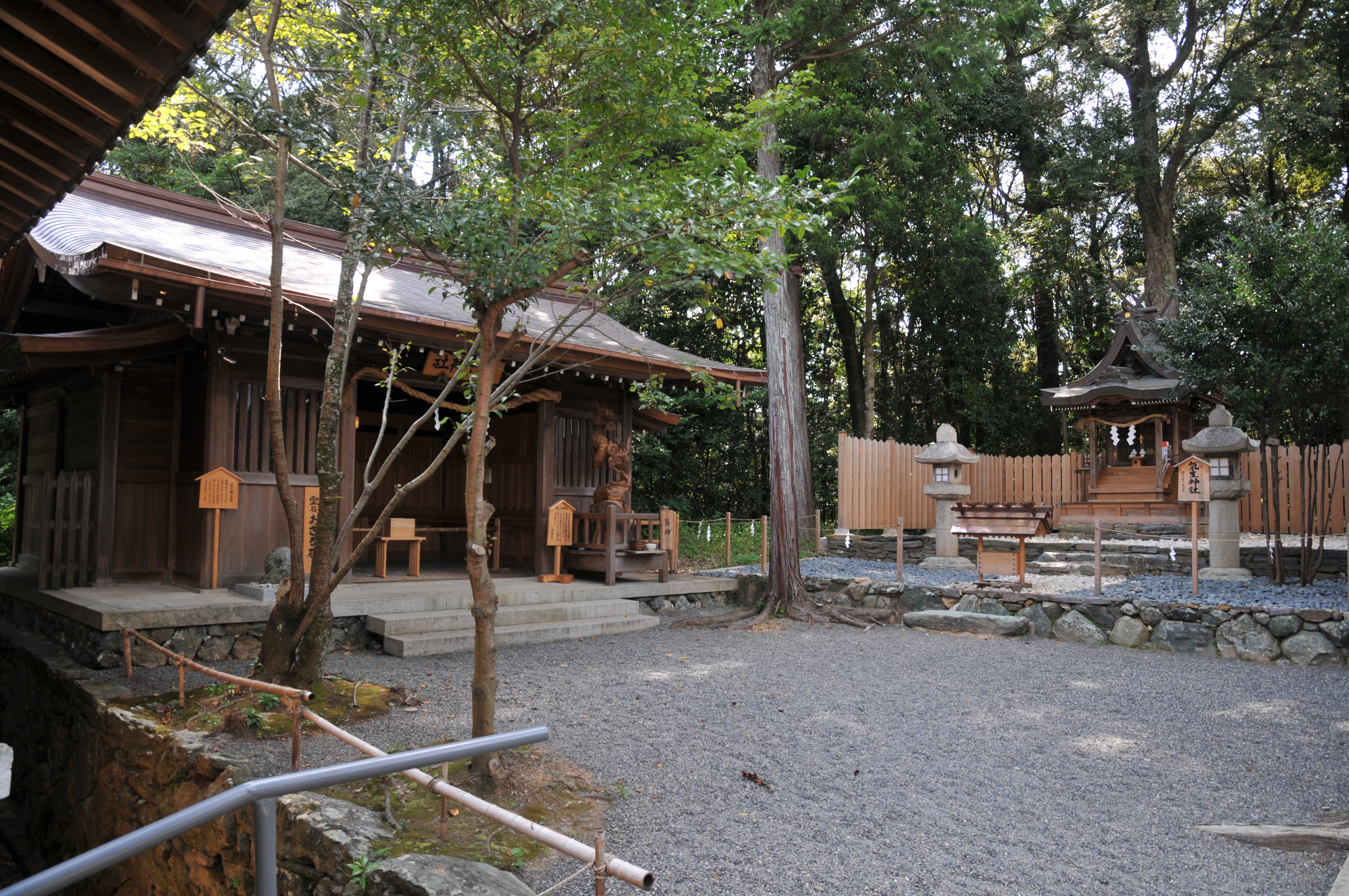
Itakiso Shrine: Where the God Who Planted Japan's Forests Came to Rest
The myth goes like this: Susanoo, the storm god, and his son Isotakeru were expelled from the heavenly realm of Takamagahara. They landed in the Korean kingdom of Silla, found it unsuitable, and sailed by boat to Izumo in western Japan. There, Susanoo handed his son a bundle of tree seeds brought from heaven and gave him a mission -- plant them everywhere. Isotakeru, joined by his sisters Oyatsuhime and Tsutomuhime, traveled the length of the archipelago, sowing forests as they went, until they reached the densely wooded mountains of the Kii Peninsula. They stopped. The land was already so thick with trees that the ancient Japanese named it Kii no Kuni -- the Country of Trees. This was where the god of forests chose to stay, and this is where the shrine of Itakiso Jinja has honored him for more than thirteen centuries.
Three Deities of Wood and Root
Itakiso Jinja does not enshrine a single kami but a family of three. Isotakeru, the principal deity, is the god of forests and forestry -- the divine planter who covered Japan in trees. Beside him stand his younger sisters: Oyatsuhime, goddess of horticulture, who governs the cultivation of fruit trees and garden plants, and Tsutomuhime, goddess of lumber and construction, who presides over the transformation of living trees into built structures. Together, the three siblings encompass the full cycle of humanity's relationship with wood: the wild forest, the tended orchard, and the timber that becomes a home. In a country where traditional architecture, from shrine buildings to farmhouses, depends almost entirely on wood, this triad carries practical as well as spiritual weight. Visitors to Itakiso Jinja are effectively paying respects to the forces that made Japanese civilization possible.
A Shrine That Predates Its Own Records
The origins of Itakiso Jinja are genuinely unknown. It first surfaces in the written record in 702 AD, in an entry in the Shoku Nihongi compiled under Emperor Monmu, but the shrine was already ancient by then. Tradition holds that it originally stood on the site now occupied by nearby Hinokuma Shrine, was relocated during the semi-legendary reign of Emperor Suinin to a place called Anomori, and then moved again to its present location in 713. That three relocations occurred before the Nara period even ended suggests a shrine of considerable importance and institutional weight. By the time the Engishiki -- Japan's great catalogue of Shinto institutions -- was compiled in 927 AD, Itakiso Jinja was listed as a shrine of the highest rank and designated the ichinomiya of Kii Province, meaning the first-ranked shrine of the entire region.
Centuries of Shifting Power
Being the top-ranked shrine of a province brought both prestige and entanglement. During the Muromachi period, from the fourteenth to sixteenth centuries, Itakiso Jinja developed a close relationship with Negoro-ji, a powerful Buddhist temple associated with the Shingi-Shingon sect. This was not unusual in pre-modern Japan, where Shinto shrines and Buddhist temples frequently shared grounds, rituals, and patronage in a syncretic arrangement that persisted for centuries. The Meiji Restoration of 1868 forcibly separated Shinto and Buddhism, and Itakiso Jinja was formally incorporated into the modern system of ranked State Shinto shrines in 1885. It was promoted to a higher classification in 1918. Today the shrine exists independent of state sponsorship, but its annual festival on October 15 continues to draw worshippers who walk beneath the torii gate, cross the arched Taiko-bashi bridge, and approach the honden -- the main hall -- along a path that has been trodden for over a millennium.
The Country of Trees, Still Standing
The name Kii no Kuni -- Country of Trees -- is not just myth. Wakayama Prefecture remains one of the most densely forested regions in Japan, with mountains carpeted in cedar, cypress, and broadleaf trees that roll from the interior down to the coast. Itakiso Jinja sits in the city of Wakayama itself, reachable by a five-minute walk from Idakiso Station on the Wakayama Electric Railway's Kishigawa Line. The shrine grounds are shaded and quiet, a pocket of old growth amid urban development. The torii gate frames a view of cedar-lined approach paths. The Taiko-bashi, a ceremonial arched bridge, curves over a small stream. The honden sits at the rear, a traditional wooden structure housing the three sibling kami. For a shrine dedicated to the god who planted the forests, the setting is fitting -- Itakiso Jinja remains embedded in the trees its deity is said to have sown.
From the Air
Located at 34.20°N, 135.25°E in the city of Wakayama, in the Itakiso neighborhood on the eastern side of the urban area. The shrine grounds appear as a forested patch within the suburban landscape, near Idakiso Station on the Kishigawa Line. From the air, the Kii Peninsula's extensively forested mountains are visible to the south and east, consistent with the ancient name 'Country of Trees.' Kansai International Airport (RJBB) is approximately 18 nautical miles to the north across the bay. Wakayama City's coastal edge and Wakayama Castle are visible to the west. Best viewed at 2,000-3,000 feet AGL. The broader Kii Peninsula landscape of mountains and forests provides context for the shrine's mythology of Japan's divine forester.