Italian Somaliland
In November 1896, a small Italian expedition on a pleasure trip passed through Lafoole, a village a few kilometers from Afgooye, south of Mogadishu. The local Wa'daan fighters ambushed and killed fourteen Italians, including the colonial administrator Antonio Cecchi. It was not the first act of Somali resistance to Italian colonialism, nor would it be the last. From the Bimaal revolts near Merca to the Dervish wars in the interior, the story of Italian Somaliland is not simply one of European expansion -- it is equally a story of the Somali people who fought it at every turn, decade after decade, from the 1890s until the colony's dissolution in 1960.
Treaties Signed, Sovereignty Sold
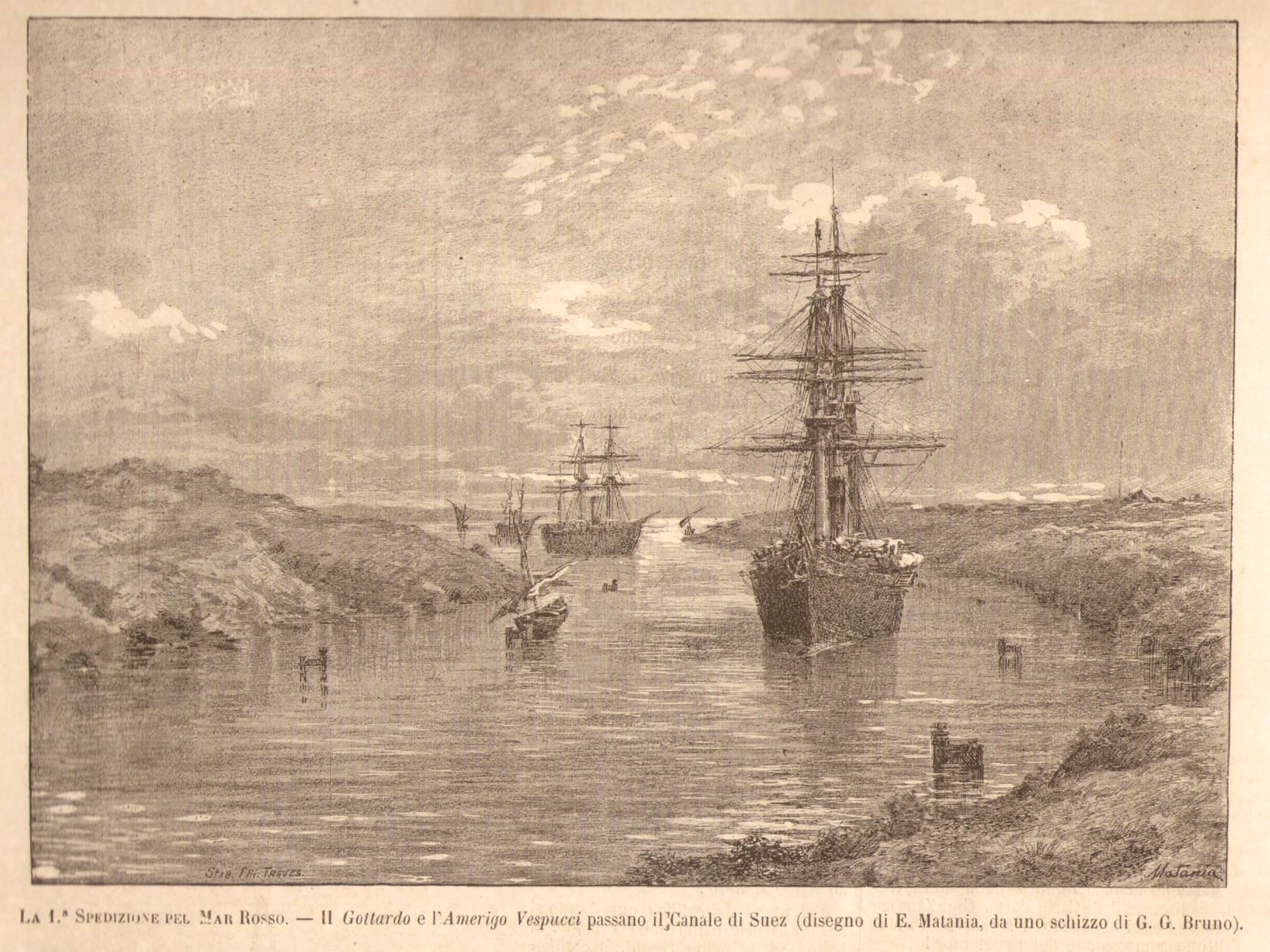
Italy's foothold in Somalia began not with invasion but with paperwork. In 1889, Sultan Yusuf Ali Kenadid of the Sultanate of Hobyo signed a protectorate treaty with Italy, followed weeks later by his rival Boqor Osman Mahamuud of the Majeerteen Sultanate. Both rulers had their own agendas -- Kenadid sought Italian backing in his power struggle with Osman, while both hoped to play European empires against each other to preserve their autonomy. The treaties specified that Italy would not interfere in the sultanates' internal affairs. In return for arms and an annual subsidy, the sultans conceded limited economic access and a handful of Italian ambassadors. Italy, for its part, was less interested in the arid territory itself than in its ports, which offered access to the strategically vital Suez Canal and Gulf of Aden. On the Benadir coast to the south, Italian outposts spread incrementally: Adale in 1892, Mogadishu and Merca in 1893, Giumbo and Luuq by 1895.
Resistance Written in Blood
The Somali response to Italian encroachment was immediate and sustained. In Merca, the Bimaal clan -- led by the Islamic scholars Sheikh Abdi Gafle and Ma'alin Mursal Abdi Yusuf -- launched a prolonged campaign that became the core of initial Somali resistance. Italian victories at Bula-Iach, Gilib, and Mellet in 1905 forced some Bimaal fighters to submit, but others fought on. At the Battle of Danane in February 1907, an Italian column in square formation was attacked by approximately 2,500 Bimaal warriors; over 100 Bimaal were killed. Hostilities resumed in 1908 with further Italian campaigns under Major Di Giorgio, who defeated a Dervish-Bimaal coalition at Mellet and the Wa'daan at Merere, where rebel ships were sunk. Meanwhile, far to the north, the Dervish movement under Mohammed Abdullah Hassan waged a separate and formidable guerrilla war. In 1913, Dervish forces successfully repelled an Italian advance near Beledweyne, seizing control of the Hiraan region and fortifying it with new strongholds. These were not isolated skirmishes but a pattern: wherever Italy extended its reach, armed resistance followed.
The Colony the Fascists Built
Colonial development accelerated after World War I. In 1920, the Duke of Abruzzi, a member of the Italian royal family and famous explorer, founded the agricultural settlement of Villaggio Duca degli Abruzzi -- known as Villabruzzi, later Jowhar -- establishing sugar, banana, and cotton plantations along the Shabelle River. A 114-kilometer railway connected the settlement to Mogadishu. By 1930, some 22,000 Italians lived in the territory, most in Mogadishu. The arrival of fascist Governor Cesare Maria De Vecchi in 1923 marked a harder turn: Mussolini ordered the direct takeover of the northern sultanates, abrogating the earlier protection treaties. Sultan Ali Yusuf Kenadid was exiled, as his father had been before him. Under Mussolini, Mogadishu was developed as a major naval base, and Italian Somaliland was folded into Italian East Africa in 1936 after the invasion of Ethiopia -- a war in which over 40,000 Somali soldiers served in Italian forces. The infrastructure built during this period -- roads, railways, schools, hospitals -- came at the cost of Somali sovereignty and self-determination.
Trust, Transition, and the Road to Independence
Britain seized Italian Somaliland in 1941, administering it through the war's end. The first modern Somali political party, the Somali Youth Club -- later the Somali Youth League -- was founded in Mogadishu in 1943, channeling aspirations for independence that had smoldered through decades of colonial rule. In 1949, the United Nations granted Italy trusteeship of its former colony, but with a condition first proposed by the Somali political organizations themselves: independence within ten years. The trust territory period was marked by tension between Italian administrators and the SYL, whose officials were demoted, imprisoned, or marginalized. Demonstrations were suppressed. Yet the SYL's political power only grew, capturing over 54 percent of the vote in the 1956 parliamentary election and over 75 percent by 1959. On July 1, 1960, the Trust Territory of Somaliland merged with the former British Somaliland to form the Somali Republic. The colonial era was over -- though its legacies, in borders drawn by European powers and institutions shaped by foreign administration, would shape the country's trajectory for decades to come.
From the Air
Located at 2.05N, 45.34E, centered on Mogadishu, the colonial capital. Aden Adde International Airport (HCMM) is the nearest major facility. The colonial-era city grid of Mogadishu, the Shabelle River valley stretching northwest toward Afgooye and Jowhar, and the Benadir coastline are visible from 10,000-20,000 ft AGL. The Indian Ocean coastline defines the eastern boundary of the former territory.