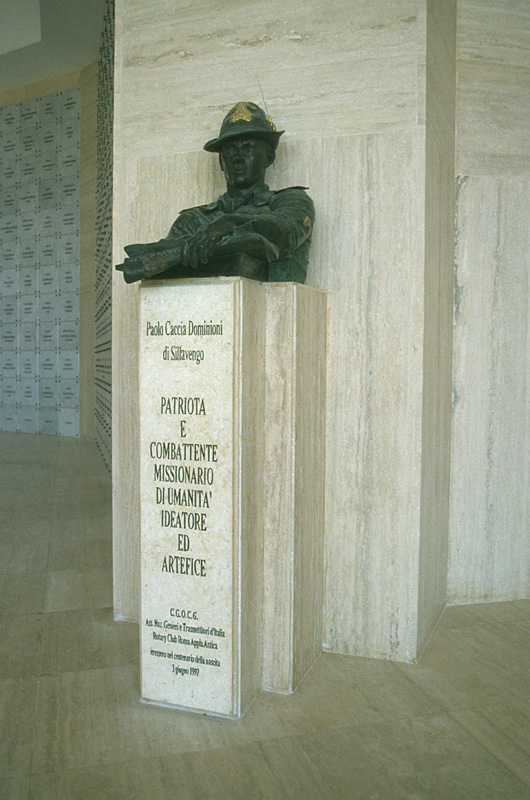
Italian War Memorial at El Alamein
The tower rises from the desert like a lighthouse that has lost its sea. Pale stone against pale sand, the Italian War Memorial at El Alamein stands a few kilometers west of the Commonwealth cemetery, marking a different kind of loss. The Italian soldiers buried and commemorated here were, in the words of their own commanders, lost with great honor. Many of them had no choice about being in North Africa, no say in the strategic decisions that stranded them in the desert without fuel or ammunition, and no way home when the battle turned against them.
The Divisions That Disappeared
At the Second Battle of El Alamein in October and November 1942, the Italian contribution to the Axis defense was enormous, and the Italian losses were catastrophic. The entire mechanized arm of the Italian Army in North Africa was destroyed: the 132nd Armored Division Ariete, the 133rd Armored Division Littorio, and the 102nd Motorized Division Trento, together composing the XX Motorized Corps. The infantry fared no better. The 185th Infantry Division Folgore, made up of paratroopers, the 27th Infantry Division Brescia, and the 17th Infantry Division Pavia were all effectively annihilated. These were not token formations. The Ariete and Folgore in particular fought with a tenacity that earned the respect of both their German allies and their British and Commonwealth enemies.
Fighting Without Fuel
The Italian soldiers at El Alamein suffered from the same supply crisis that crippled the entire Axis position in North Africa, but they suffered it more acutely. German units often received priority for fuel, ammunition, and replacement equipment, while Italian formations made do with what remained. The Italian 47mm anti-tank gun was obsolete against the new Sherman tanks that the Americans had supplied to the Eighth Army, yet Folgore paratroopers used them alongside petrol bombs and mortars to fight off British armor. When the Afrika Korps began its retreat after the second battle, the Italian infantry divisions, which were not motorized, could not withdraw. They were left in their positions as the front collapsed around them, unable to escape encirclement because they had no trucks.
To the Last Man
The stories that emerged from the final days of the battle became part of Italian military legend. The Bologna Division and the remnants of the Trento Division, cut off and surrounded, marched into the desert without water, food, or transport, trying to fight their way out before surrendering from exhaustion and dehydration. Colonel Arrigo Dall'Olio, commanding the 40th Infantry Regiment of the Bologna Division, reportedly told his captors, "We have ceased firing not because we haven't the desire but because we have spent every round." Berlin radio itself acknowledged that "the Italians fought to the last man." Whether spoken from genuine admiration or propaganda convenience, the claim was closer to the truth than most wartime broadcasts.
A Memorial in the Desert
The memorial complex includes a cemetery, a museum documenting the Italian role in the North African campaign, and the central tower that dominates the site. It stands at the western end of a stretch of desert that holds three nations' memorials to the same battle: the Commonwealth cemetery to the east, the German memorial further along the coast, and this Italian monument. Together they form an unintentional triptych of the war in the desert, each nation remembering its dead in its own architectural language. The Italian memorial's tower catches the eye from the coast road, a vertical interruption in the flat horizon. Inside, the museum tells a story that is often overshadowed by the Rommel legend and the Montgomery myth: the story of Italian soldiers who were sent to fight a war they could not win, in a desert they could not leave, with weapons that could not match what they faced.
From the Air
Located at 30.90N, 28.84E on Egypt's Mediterranean coast, a few kilometers west of the El Alamein Commonwealth War Cemetery along the coastal highway. The memorial's central tower is the most prominent vertical structure in the area and is visible from the air. El Alamein International Airport (HEAL) is approximately 15 km to the east. The three El Alamein memorials (Commonwealth, German, Italian) are spaced along the coast road within about 10 km of each other. Best viewed at 2,000-4,000 ft AGL.