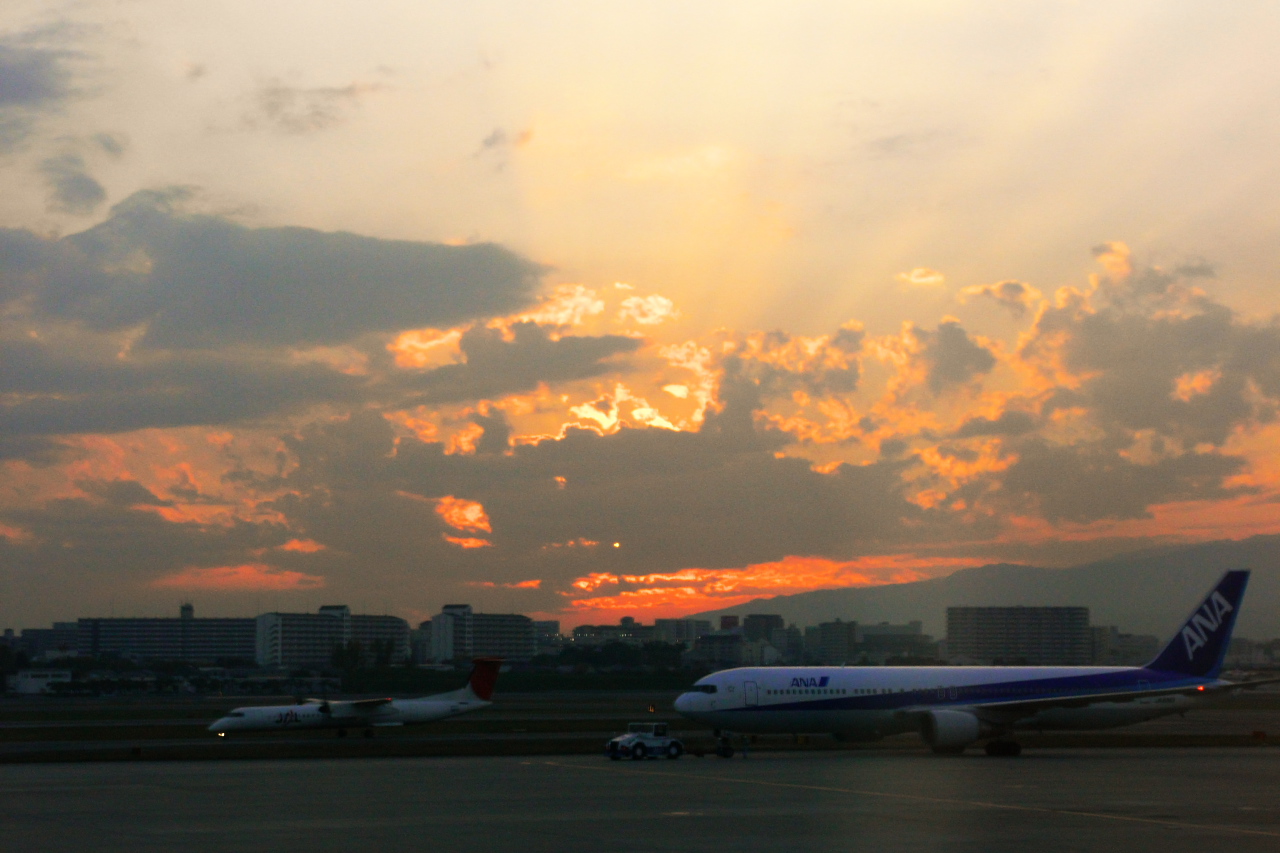
Itami Airport: The International Airport With No International Flights
For decades, an airport called 'Osaka International' handled zero international flights. The name confused travelers so thoroughly that in January 2025, officials finally changed the English signs to 'Osaka Itami Airport.' The confusion was understandable: Kansai International Airport, built on an artificial island in Osaka Bay, had taken over all international traffic in 1994. But Itami refused to fade away. Covering just 311 hectares of land wedged between three cities -- Itami in Hyogo Prefecture, and Toyonaka and Ikeda in Osaka Prefecture -- the airport sits closer to downtown Osaka and Kyoto than any competitor. Its terminal straddles municipal boundaries so thoroughly that the only way to reach it from the Itami city side is through a tunnel that passes beneath the runway.
From Seaplanes to Sayonara
Before Itami, Osaka's main airport was Kizugawa, which handled both seaplanes and conventional aircraft near the mouth of the Yamato River. Plans for a replacement began in 1931, but concerns about fog and objections from Kobe-based businesses redirected the project inland. Construction of 'Osaka No. 2 Airport' began in July 1936 on a 53-hectare site, and it opened on January 17, 1939, with four runways capable of handling aircraft as large as the Douglas DC-3. The Imperial Japanese Army used it through the war years. American occupation forces took over in 1945, expanding the field to 221 hectares and renaming it Itami Air Base. During the Korean War, the runways saw heavy military traffic. In 1954, Marilyn Monroe and Joe DiMaggio stopped at Itami during their honeymoon, and in 1956, the base served as a filming location for the movie Sayonara.
The Inaugural Flight and the Noise Wars
Japan Airlines launched its inaugural flight from Itami to Tokyo Haneda on October 25, 1951, using a Martin 2-0-2 leased from Northwest Airlines and operating from a small joint-use section of the U.S. air base. Jet flights began on June 1, 1964, and the noise complaints began almost immediately. As the Japanese economic miracle pushed suburban development right up to the runway perimeter, the airport became one of the most politically contentious sites in the country. In May 1968, local citizens decided to sue the government over noise pollution. The lawsuit was filed in December 1969. The government responded by banning takeoffs and landings between 10:30 PM and 6:30 AM, effective February 1970 -- a curfew that remains in force today. The noise restrictions shaped Itami's character permanently: a busy, efficient domestic hub that goes quiet every night.
Three Airports, One Region
The opening of Kansai International Airport in 1994 was supposed to solve Itami's problems by absorbing its international traffic. Instead, it created a three-way rivalry. Kobe Airport opened in 2006, adding a third competitor for domestic passengers. The Japanese government's policy has been to limit Itami to boost Kansai, restricting landing slots to 18 per hour and 370 per day. Proposals to ban widebody aircraft were dismissed as unrealistic given traffic volume. In 2011, the Diet of Japan merged the management of all three airports under a single entity. Privatization followed in 2016, when a consortium led by Orix and France's Vinci SA won a 45-year operating contract for approximately $18 billion. Despite years of governmental attempts to constrain it, Itami served 16.3 million passengers in 2018, ranking as Japan's seventh busiest airport.
Sorayan and the Boeing That Remembered
The airport's mascot, Sorayan, is a round, humanoid airplane wearing a captain's hat who speaks with an Osaka dialect accent. Her name combines 'sora' (sky) and 'yan' (a local emphatic particle), chosen from over 1,900 suggestions submitted for the airport's 75th anniversary. The mascot's lighthearted character contrasts sharply with some of Itami's darker aviation history. On June 2, 1978, a Japan Airlines Boeing 747 suffered a severe tailstrike while landing on Runway 32L, injuring 25 passengers. That same aircraft, registration JA8119, would go on to suffer a catastrophic structural failure on August 12, 1985, as Japan Air Lines Flight 123 -- the deadliest single-aircraft accident in history, killing 520 people. The 1978 tailstrike at Itami is now understood as the origin of the bulkhead damage that ultimately caused the 1985 disaster.
The Terminal Reborn
Itami's terminal underwent a complete renovation that began in February 2016 and finished on August 5, 2020, consolidating departures and arrivals facilities around a single central security checkpoint with expanded capacity, adding a new pier for additional aircraft gates, and creating new shopping and dining areas. The renovated facilities helped the airport climb to 78th in Skytrax's 2024 world airport rankings, up from 95th the previous year. Following Typhoon Jebi's temporary closure of Kansai Airport in September 2018, the government even considered permitting international service at Itami for the first time in decades. Japan Airlines operated two special flights to Hong Kong in October 2018 -- the first scheduled international passenger flights from Itami in 24 years. The compact airport that nobody could quite shut down keeps finding new reasons to stay relevant.
From the Air
Itami Airport (ICAO: RJOO, IATA: ITM) is located at 34.78N, 135.44E in the northern Osaka metropolitan area, straddling the border of Hyogo and Osaka Prefectures. Runway 32L/14R (3,000m) and Runway 32R/14L (1,828m) run roughly NNW-SSE. The airport has a nighttime curfew (no operations 10:30 PM to 6:30 AM). Osaka's dense urban grid surrounds the field on all sides. Kansai International Airport (RJBB) lies approximately 26 nm to the south-southwest on an artificial island; Kobe Airport (RJBE) is approximately 18 nm to the southwest. Osaka Monorail connects the airport to the city. Best viewed at approach altitude for full runway perspective.