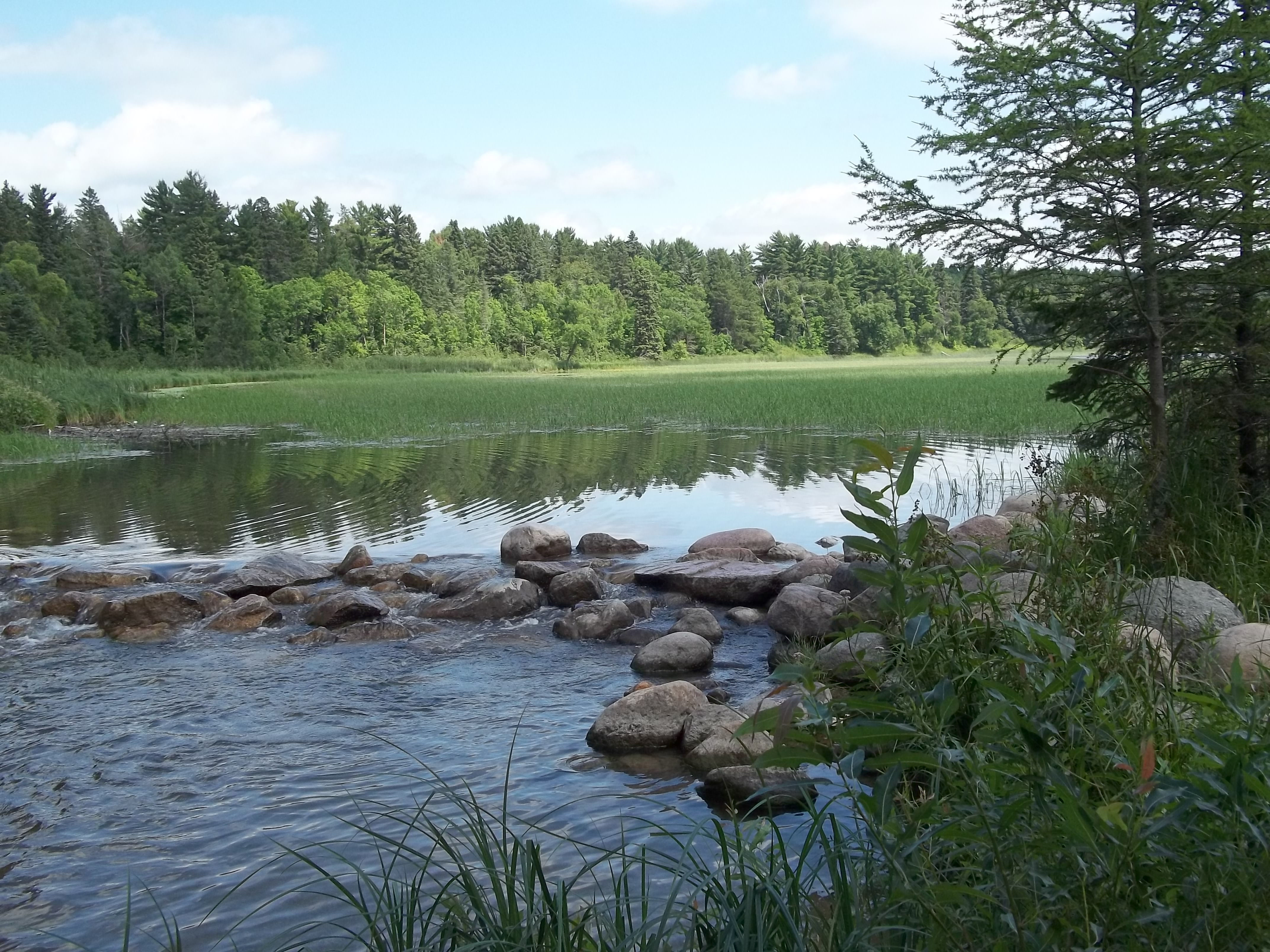
Itasca State Park
You can walk across the Mississippi River here. Not on a bridge, not in a boat -- on foot, stepping from rock to rock where the water is barely ankle-deep and perhaps 20 feet wide. This is the spot where the longest river system in North America begins its 2,340-mile journey to the Gulf of Mexico, and it starts so modestly that the moment feels almost absurd. Itasca State Park, established in 1891 as Minnesota's first state park, protects this origin point along with 32,690 acres of old-growth pine forest, more than 100 lakes, and over 8,000 years of human history. The park exists because one man saw the loggers closing in and convinced the state legislature to act -- by a margin of exactly one vote.
One Vote from Oblivion
Jacob V. Brower was a land surveyor, historian, and president of the Minnesota Historical Society who spent five months in the late 1880s exploring the lakes and streams around what he determined to be the true headwaters of the Mississippi. What he found alarmed him: loggers were systematically stripping the tall pine forests that surrounded Lake Itasca, and the landscape that defined the river's origin was disappearing. Brower campaigned aggressively to save it. On April 20, 1891, the Minnesota Legislature voted to establish Itasca as a state park, the first in Minnesota and the second oldest in the United States after Niagara Falls. The margin was a single vote. Brower is now called the 'Father of Lake Itasca,' and the park's visitor center bears his name. Without his stubbornness, the headwaters of the Mississippi might today be just another logged-over tract of northern Minnesota.
Log Walls and Wild Rice Soup
Itasca holds the largest collection of log-constructed buildings in Minnesota's state park system. Douglas Lodge, built in 1905, was the first structure designed in what became the park's signature Rustic Style -- log walls, natural materials, buildings that look as though they grew from the forest floor. It has served as a tourist lodge since 1911, and its restaurant is locally famous for wild rice soup. The Clubhouse, assembled in 1911 overlooking Lake Itasca, contains ten dormitory rooms arranged around a two-story lobby with a massive stone fireplace. The Civilian Conservation Corps arrived in the 1930s and left its mark with Forest Inn, one of the largest CCC creations in any Minnesota state park. It took 200 CCC members to build it, using split stone scavenged from quarries near St. Cloud and pine and balsam fir logs harvested from the park itself. The Old Timer's Cabin, the first CCC building in the park, was originally nicknamed the 'Honeymooner's Cabin' for its small size and secluded location on the shores of Lake Itasca.
Where Three Worlds Meet
The Lake Itasca region sits at a remarkable ecological crossroads: the juncture of the Great Plains, the Deciduous Forest of the south, and the Coniferous Forest of the north. Remnants of all three habitats can be observed within the park, and the area shelters roughly 25 percent of Minnesota's remaining old-growth forest. Spring brings wildflowers and the return of migratory birds. The May fishing opener draws anglers after walleye, northern pike, bass, and panfish. The park attracted 496,651 visitors in 2006 alone. The University of Minnesota maintains its Itasca Biological Station and Laboratories here, a research campus established in 1909 that offers field courses and year-round ecological research. The convergence of habitats makes this an unusually rich site for studying North American biodiversity -- and for visitors who simply want to walk through a forest that predates the state itself.
Bones Beneath the Pines
More than 30 known archaeological and cemetery sites lie within the park's boundaries, placing human activity in the Itasca area as far back as 8,000 years. The Itasca Bison Kill Site, discovered in 1937 during construction of Wilderness Drive, is the park's oldest archaeological site, dating to the Early Eastern Archaic period. Excavations by the University of Minnesota in 1964 and 1965 uncovered bones from an extinct species of bison alongside human tools -- knives, spears, and scrapers. Ten burial mounds approximately 800 years old line the northeastern shore of Lake Itasca. In 1903, a 24-year-old park commissioner named Mary Gibbs played a critical role in preserving the tall pine forests and shoreline of the headwaters by resisting renewed efforts to log the area. Her courage is honored by the Mary Gibbs Mississippi Headwaters Center, the park's main visitor facility, where guests can examine exhibits about the park's layered history before walking out to the rocks where they can step across the infant Mississippi.
From the Air
Located at 47.240°N, 95.208°W in north-central Minnesota, approximately 21 miles north of Park Rapids. The park covers 32,690 acres and contains over 100 lakes visible from the air, with Lake Itasca as the most prominent -- identifiable as the source point of the Mississippi River's narrow channel flowing north from the lake. Park Rapids Municipal Airport (KPKD) is the nearest field, about 21 miles south. Bemidji Regional Airport (KBJI) lies 49 miles to the northeast. The park's old-growth pine forest appears distinctly darker and taller than surrounding second-growth timber, making it identifiable from cruise altitude. Best viewed at 3,000-6,000 feet AGL. The Mississippi's thread-thin channel emerging from Lake Itasca is visible in clear conditions.