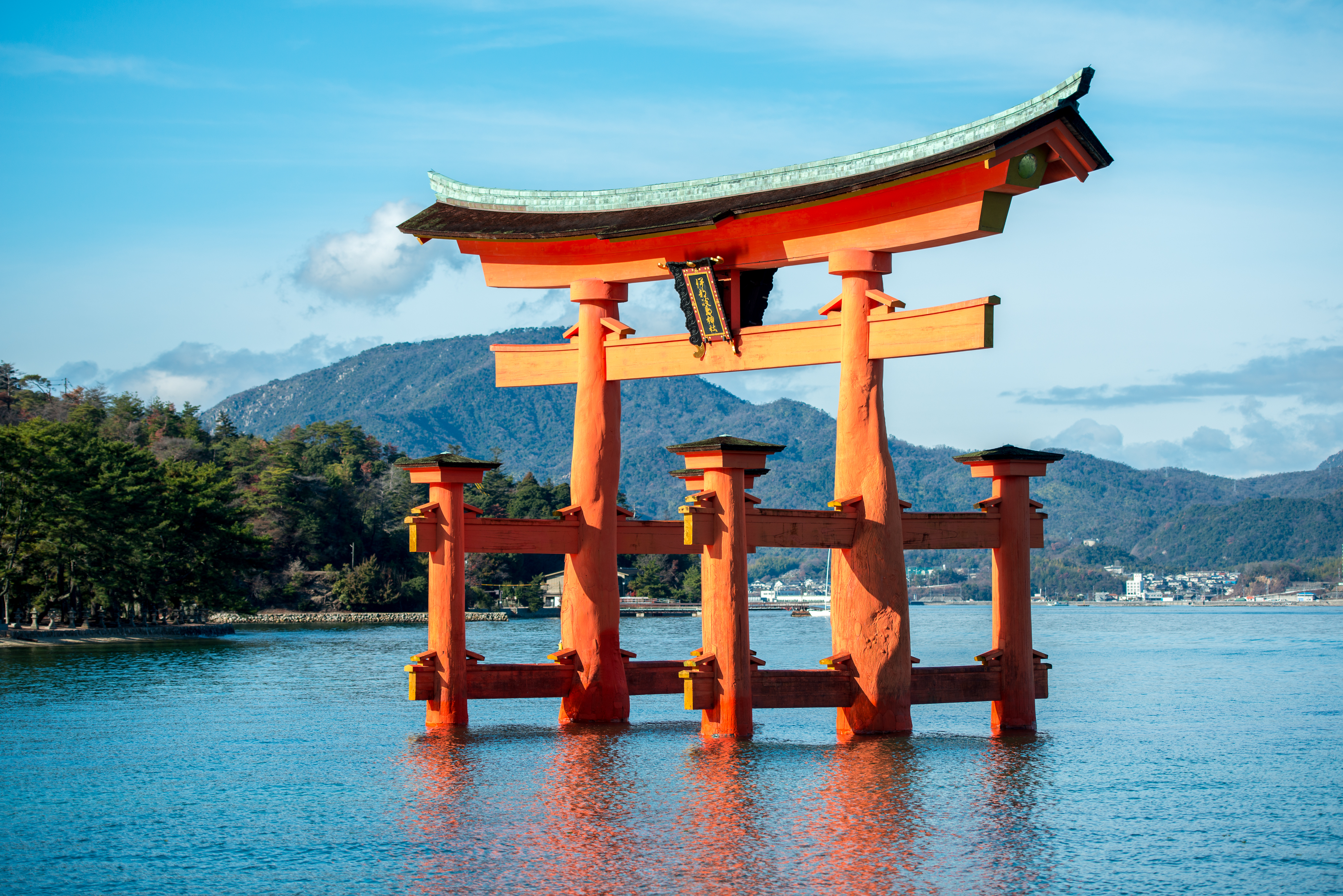
Itsukushima
Twice a day, the Seto Inland Sea reclaims the mudflats around Itsukushima Shrine, and for a few hours the great vermillion torii gate stands in open water, its reflection doubling in the still surface. At low tide, visitors walk out across the exposed seabed to touch its barnacled pillars. This rhythm -- sacred and tidal, ancient and daily -- defines Itsukushima, an island the Japanese call Miyajima, meaning simply "Shrine Island." In 1643, the Confucian scholar Hayashi Gaho named it one of the Three Views of Japan, and nearly four centuries later, no one has seriously disputed the ranking.
Sacred Ground, Sacred Water
The island sits in Hiroshima Bay, 30.39 square kilometers of forested mountains surrounded by the tidal waters of the Inland Sea. Roughly 2,000 people live here. There are no traffic signals. Because the island was considered the dwelling place of gods, trees could not be cut for lumber -- a prohibition that preserved forests so lush they have outlasted centuries of human habitation. Sika deer, regarded as divine messengers in the Shinto tradition, wander the streets without fear, nosing through the shopping district alongside tourists. The shrine complex may date to as early as 593 AD, though the current form owes its grandeur to Taira no Kiyomori, a warrior-courtier who rebuilt it in 1168 during the height of his power.
Layers of Faith on One Island
Shinto and Buddhism coexist here in ways that illuminate both traditions. The Itsukushima Shrine, a UNESCO World Heritage Site and National Treasure, honors three Shinto goddesses. Adjacent to it, Daiganji Temple is dedicated to Benzaiten, the goddess of eloquence, music, and knowledge -- one of the three most famous Benzaiten temples in Japan, opened to the public only once a year on June 17. Higher on the hillside, the Senjokaku -- the "Pavilion of 1,000 Mats" -- was begun by Toyotomi Hideyoshi as a Buddhist library for chanting sutras for fallen soldiers. Hideyoshi died in 1598 before it was completed, and the building remains unfinished to this day, its massive interior open to the wind. During the Meiji reformation, it was converted into a Shinto shrine honoring Hideyoshi himself.
Summit and Forest
Mount Misen rises 535 meters at the island's center, the highest point and a sacred summit associated with Kobo Daishi, the founder of Shingon Buddhism. The Miyajima Ropeway carries visitors partway up, leaving a thirty-minute hike to the top through primeval forest. Near the summit, Daisho-in temple preserves sites linked to Kobo Daishi's meditation practices. The mountain's forests transition from coastal broadleaf to ancient camphor and pine at elevation, sheltering plant communities that exist nowhere else in the Inland Sea region. From the peak, the view extends across the scattered islands of the Seto Inland Sea -- a panorama of water, islands, and distant mountains that compresses the geography of western Japan into a single sweep.
Maple Leaves and Rice Paddles
Miyajima's maple trees are famous across Japan, blanketing the hillsides in crimson each autumn. The island's signature souvenir, momiji manju, are small pastries shaped like maple leaves and filled with sweet azuki bean jam, custard, chocolate, or cheese -- vendors press them fresh in the shopping arcades near the ferry terminal. Another local icon is the shamoji, a flat wooden rice paddle said to have been invented by a monk on the island. Giant decorative shamoji appear throughout the shopping district, standing taller than the tourists who photograph them. A ten-minute ferry ride from Miyajimaguchi on the mainland is all that separates this island from modern Hiroshima Prefecture, but the crossing feels like a passage between centuries. The deer, the forests, the torii rising from the tide -- Miyajima earns its place among the Three Views of Japan not through spectacle but through something quieter and harder to name.
From the Air
Located at 34.28N, 132.31E in the western Seto Inland Sea, within Hiroshima Bay. The island is clearly visible as a mountainous landmass separated from the mainland by a narrow channel. The torii gate of Itsukushima Shrine is on the northeastern shore. Hiroshima Airport (RJOA) is approximately 50 km to the east; Iwakuni Kintaikyo Airport (RJOI) is closer at about 30 km to the southwest. Best viewed at 3,000-5,000 feet where the island's relationship to the mainland and surrounding Inland Sea islands is apparent.