Iwadono Castle: The Mountain Fortress That Outlasted Its Lord
Oyamada Nobushige thought switching sides would save his life. In 1582, as the armies of Oda Nobunaga and Tokugawa Ieyasu swept through Kai Province destroying the Takeda clan, Nobushige abandoned his master and surrendered Iwadono Castle to the invaders, hoping for mercy. Oda Nobunaga executed him instead, despising the betrayal. The castle on Mount Iwadono lost its military purpose that day, and the mountaintop fortifications were never garrisoned again. Four centuries later, the ruins draw hikers instead of warriors -- people climbing the same steep trails that once made this yamajiro nearly impregnable, arriving at a summit where stone walls crumble into wildflowers and the view of Mount Fuji stretches unbroken across the valley.
Watching the Road Below
Iwadono Castle was built in the early 16th century by the Oyamada clan, local retainers of the powerful Takeda family who controlled Kai Province -- present-day Yamanashi Prefecture. The site was chosen for a specific reason: Mount Iwadono commands a view of the Koshu Kaido, the vital highway connecting the Takeda heartlands with the eastern provinces. Any army marching toward the Takeda capital at Kofu would have to pass beneath this peak. The Oyamada positioned their fortress to watch that road and, if necessary, to block it. As a yamajiro -- a Japanese mountain castle -- Iwadono relied on the mountain itself as its primary defense. The terrain did what stone walls could only supplement: steep slopes on all sides, narrow approaches that could be held by small numbers of defenders, and an elevation that turned every assault into an uphill battle.
The Tiger's Paw
Under Takeda Shingen, the legendary warlord who dominated central Japan from the 1540s through his death in 1573, Iwadono Castle was significantly expanded. Shingen understood that controlling the eastern frontier meant holding the mountain passes, and Iwadono sat squarely on that boundary. Oyamada Nobushige, a senior Takeda general and head of the Oyamada clan, served as castle lord and proved himself a capable military commander. The castle's defenses were arranged in the classic yamajiro pattern: the honmaru, or main keep, occupied the summit, while terraced baileys called ninomaru and sannomaru stepped down the mountainside like a stone staircase. Stone walls reinforced the natural rock faces. Dry moats carved across the ridgeline slowed attackers who managed to gain the upper slopes. Wooden palisades filled the gaps between natural barriers. The entire complex turned Mount Iwadono into a layered defense that could bleed an attacking force dry before it ever reached the top.
A Lord's Miscalculation
Takeda Shingen's death in 1573 began the slow unraveling of the Takeda domain. His son Katsuyori suffered a devastating defeat at the Battle of Nagashino in 1575, and by 1582 the combined forces of Oda Nobunaga and Tokugawa Ieyasu were closing in for the final destruction of the Takeda. Oyamada Nobushige, watching the collapse from his mountain fortress, made a calculation that many Sengoku lords attempted: he defected. Nobushige initially resisted the invaders, then opened the gates of Iwadono Castle and surrendered to the Oda forces, expecting that his timely cooperation would be rewarded. He was wrong. Oda Nobunaga had contempt for lords who abandoned their masters at the last moment -- the very act that made them useful also made them untrustworthy. Nobushige was executed. The castle, its strategic purpose eliminated by the new political order, was abandoned. No one would rebuild it.
Stone and Root
What remains on Mount Iwadono today reads like a geological autobiography of a castle. The terraced baileys are still visible as flat platforms cut into the mountainside, their edges softened by centuries of erosion. Stone wall foundations poke through the undergrowth in places, their fitted surfaces still holding after more than four hundred years. The dry moats have filled with leaf litter and soil but their outlines are unmistakable -- long cuts across the ridgeline that once channeled attackers into killing zones. Tree roots have grown through and around the stonework, binding the castle remains into the mountain as if the forest is slowly reclaiming what was always part of the landscape. Interpretive signs placed along the hiking trail identify each feature, translating the lumps and terraces back into the vocabulary of siege warfare.
The Summit Reward
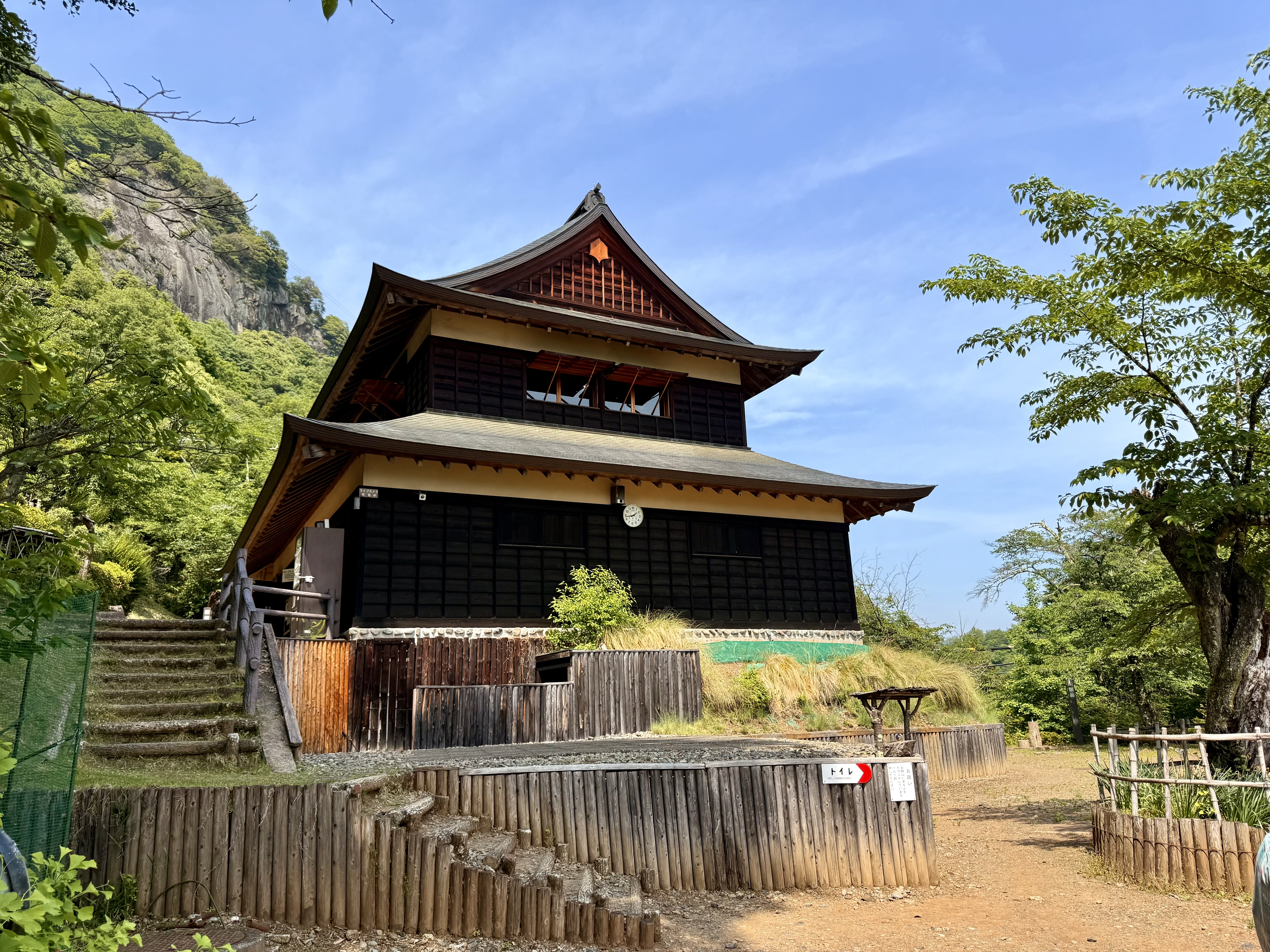
The hike from Otsuki Station to the castle summit takes roughly one to one and a half hours, climbing steadily through forest on well-maintained trails. The effort pays off with one of the finest panoramic views in the region. Mount Fuji dominates the southern horizon, rising in its iconic symmetry above the surrounding peaks. The city of Otsuki spreads through the valley below, and the mountains of Yamanashi Prefecture layer into the distance in shades of blue and gray. At the base of the mountain, the Iwadono Mountain Fureai Community Center -- built in the form of a castle keep -- serves as a starting point and visitor center. The site is free and open to the public, accessible year-round, and included in the Japan Castle Foundation's Continued Top 100 Castles list. It is a place where military history and mountain hiking converge, where the same steep terrain that once protected a doomed lord now offers anyone willing to climb a view that was worth fortifying.
From the Air
Located at 35.62N, 138.95E in Otsuki, Yamanashi Prefecture. Mount Iwadono rises steeply above the Katsura River valley, visible from 2,000-4,000 feet AGL as a prominent forested peak adjacent to the city of Otsuki. The castle ruins are on the summit and not visible from the air, but the mountain's distinctive shape stands out from surrounding terrain. Mount Fuji is visible to the south-southeast. Nearby airports include RJTO (Chofu Airport, approximately 45 nm east). The JR Chuo Main Line runs through the valley below, and Otsuki Station is visible at the mountain's base.