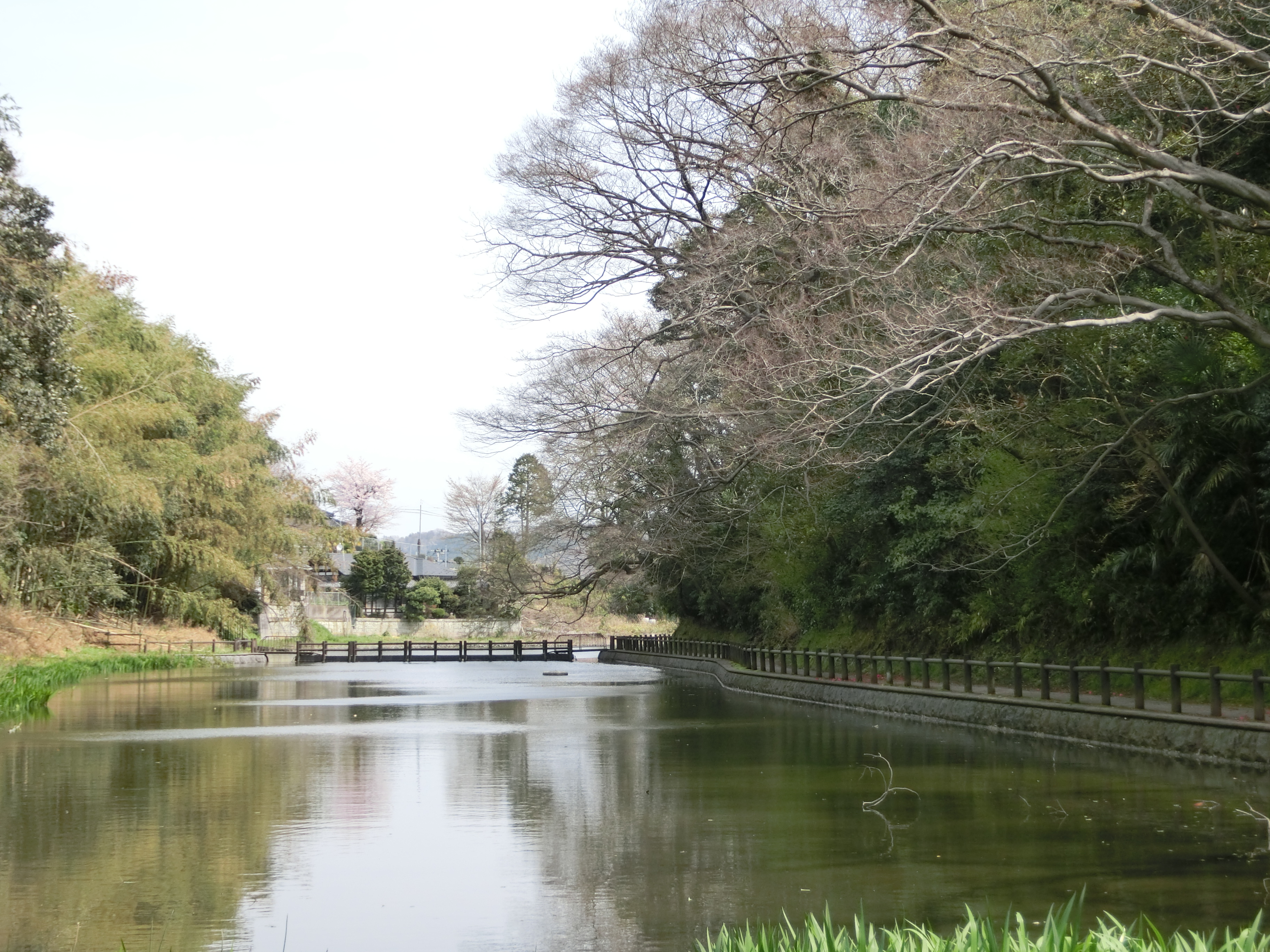
Iwakitaira Castle
The men who burned Iwakitaira Castle were the same men sworn to defend it. In 1868, as imperial forces closed in during the Boshin War, the domain's own karo -- senior retainers -- set the fortress alight rather than let it fall to the Meiji government. Three decades later, the new government drove the final indignity home: they filled in the inner moat and laid the tracks of the Joban Line railway straight through the middle of what remained. Today, Taira Station sits where samurai once marshaled. A small park and fragments of earthen ramparts are all that survive of a castle that took twelve years to build and a single night to destroy.
A Reward Written in Stone
Iwakitaira Castle owes its existence to one of the most consequential battles in Japanese history. In 1600, Iwaki Sadataka sided with the Western Army of Ishida Mitsunari against the Tokugawa clan at the Battle of Sekigahara. The gamble failed spectacularly. The Iwaki clan, which had controlled the southern Hamadori region since the late 11th century, was stripped of everything. Tokugawa Ieyasu awarded the territory to Torii Tadamasa as a new domain assessed at 100,000 koku. Tadamasa was the son of Torii Mototada, Ieyasu's childhood friend and loyal retainer, who had been killed by Toyotomi forces at the Siege of Fushimi shortly before Sekigahara. The new castle was, in a sense, a memorial built on the ashes of loyalty -- the father's sacrifice repaid through the son's inheritance.
Fortress on the Tongue
Tadamasa began construction in 1603 on a site of natural defensive genius: the tip of a tongue-shaped plateau extending eastward, protected on three sides by the U-shaped Tangosawa Lake. The Main Bailey, or Honmaru, occupied the southeastern end, with the Second Bailey on a ridge protruding northeast and the Third Bailey guarding the western approach. Two large, moated, rectangular enclosures completed the defenses. Though Iwakitaira Castle was built without a traditional donjon, a three-story yagura served in its place. At its height, the fortress bristled with 17 yagura and 24 gates. The construction was so impressive that Shogun Tokugawa Hidetada rewarded Tadamasa by reassigning him to Yamagata Domain with double the revenue -- a promotion that meant leaving behind the very castle he had spent twelve years perfecting.
A Parade of Lords
As a fudai daimyo holding -- a domain entrusted to hereditary Tokugawa loyalists -- Iwakitaira Castle changed hands repeatedly through the Edo period. The Naito clan governed from 1622 to 1747, a reign of 125 years. The Inoue clan followed for just eleven years, from 1747 to 1758. Then the Ando clan took the reins, holding the castle from 1758 until the tumult of 1868. Each succession of lords maintained the fortress and its surrounding castle town, the jokamachi, which grew into the economic and administrative center of the domain. Through centuries of relative peace under Tokugawa rule, the castle served more as a symbol of authority than a military strongpoint -- until war returned.
Fire and Rails
When the Boshin War erupted in 1868, the domain joined the Ouetsu Reppan Domei, the alliance of northern domains resisting the new Meiji government. During the Battle of Iwakitaira, with defeat imminent, the castle's own senior retainers made the decision to set it ablaze. The flames consumed what twelve years of labor had raised. After the Meiji Restoration settled into governance, the abandoned ruins faced a second transformation: in 1897, the Japanese Government Railway filled in the inner moat and built Taira Station, threading the Joban Line through the castle's footprint. Most of the remaining land was sold as residential lots and passed into private hands.
What the Moat Remembers
Today, the city of Iwaki has grown over the bones of the old fortress. A small public park preserves a portion of the inner moat area, and fragments of the earthen ramparts survive near the train station, their grassy slopes a quiet echo of walls that once supported watchtowers. Discussions about restoring some portion of the castle have surfaced periodically over the years, but funding has never materialized. The castle's alternate name, Ryugajo -- Dragon Castle -- lingers in local memory. For those who know where to look, the topography still tells the story: the tongue plateau remains, the curve of the old lake is traceable, and the moat section near the station sits like a footnote in earth and water, a reminder that the ground beneath a modern Japanese city often holds centuries of silence.
From the Air
Located at 37.06N, 140.89E in the city of Iwaki, Fukushima Prefecture. The castle site is now largely covered by urban development and Taira Station (Joban Line). From the air, the tongue-shaped plateau extending eastward is still discernible, and remnants of the moat are visible near the railway station as a park area. Fukushima Airport (RJSF) lies approximately 80 km to the northwest. Ibaraki Airport (RJAH) is about 100 km to the south. The Pacific coastline 10 km to the east provides visual reference. The Hamadori coastal plain and the surrounding Abukuma Highlands frame the landscape.