Iwamura Castle: The Misty Fortress and Its Lady Commander
Oda Nobunaga crucified his own aunt on December 23, 1575. He had promised safe passage. He lied. Otsuya-no-kata and her second husband, Takeda general Akiyama Nobutomo, were executed as traitors outside the walls of the very castle she had defended, negotiated for, and ultimately surrendered to protect. Iwamura Castle sits at 721 meters above sea level in the mountains of eastern Gifu, frequently shrouded in fog that earned it the name "the Misty Castle." It is counted among Japan's three great mountain castles alongside Takatori Castle in Nara and Bitchu-Matsuyama Castle in Okayama. But what sets Iwamura apart from every other ruin on a Japanese mountaintop is the story of the woman who held it -- and the price she paid for choosing survival over loyalty to a warlord who happened to be family.
A Crossroads in the Mountains
Iwamura Castle was built on a steep mountain overlooking the Iwamura Basin in southeastern Mino Province, commanding the intersection of the Sanshu Kaido -- the road linking southern Shinano Province with central Mikawa Province and the Pacific Coast -- and the route connecting Mikawa with Totomi Province to the east. Control of this junction meant control of trade, troop movement, and communication across central Japan. During the Kamakura period, eastern Mino was held by Kato Kagekado, a vassal of Minamoto no Yoritomo. His descendants formed branch families named after their residences, and through the Muromachi period, the Toyama clan governed Iwamura. The Toyama were never powerful enough to stand alone. They survived by pledging fealty to whichever neighbor held the upper hand -- subordinate to the Takeda clan by 1545, then courted by Oda Nobunaga, who saw in the Toyama a useful buffer against his rival Saito Dosan of Gifu.
The Woman in the Castle
To cement his alliance with the Toyama, Nobunaga sent his aunt Otsuya-no-kata to marry Toyama Kageto, the castle lord. When the couple produced no heir, Nobunaga dispatched his sixth son, Oda Katsunaga, to be adopted into the clan -- a living insurance policy on a strategic fortress. The arrangement held until 1572, when Takeda Shingen broke his agreement with Nobunaga and turned west. Shingen sent general Akiyama Nobutomo against Iwamura. The Toyama garrison fought back fiercely, but Toyama Kageto died of wounds sustained in the defense. His widow, Otsuya-no-kata, assumed command. She held the castle for months, a woman directing a garrison in one of Japan's bloodiest eras. When she finally negotiated surrender, the terms required her adopted son to be sent to Kai Province as a hostage and Otsuya herself to marry Akiyama Nobutomo. It was a political marriage made to save her people -- and it enraged Oda Nobunaga beyond reason.
Betrayal and Crucifixion
Nobunaga attacked Iwamura Castle repeatedly after the Toyama defection, but the fortress held. It was not until 1575, after the decisive Oda-Tokugawa victory over Takeda Katsuyori at the Battle of Nagashino, that Nobunaga's forces finally surrounded the mountaintop stronghold. Even then, the castle resisted for six months. When Otsuya-no-kata agreed to negotiate, she likely believed in the promise of safe conduct -- after all, Nobunaga was her nephew. He reneged. On December 23, 1575, Otsuya-no-kata and Akiyama Nobutomo were crucified. The remaining defenders were slaughtered. The Iwamura branch of the Toyama clan was extinguished in a single day. The decision drew criticism even among Nobunaga's contemporaries. A commander who prized loyalty above all else had destroyed a woman whose only crime was choosing the survival of her garrison over blind allegiance to a relative who had placed her in an impossible position.
Stone Walls and New Masters
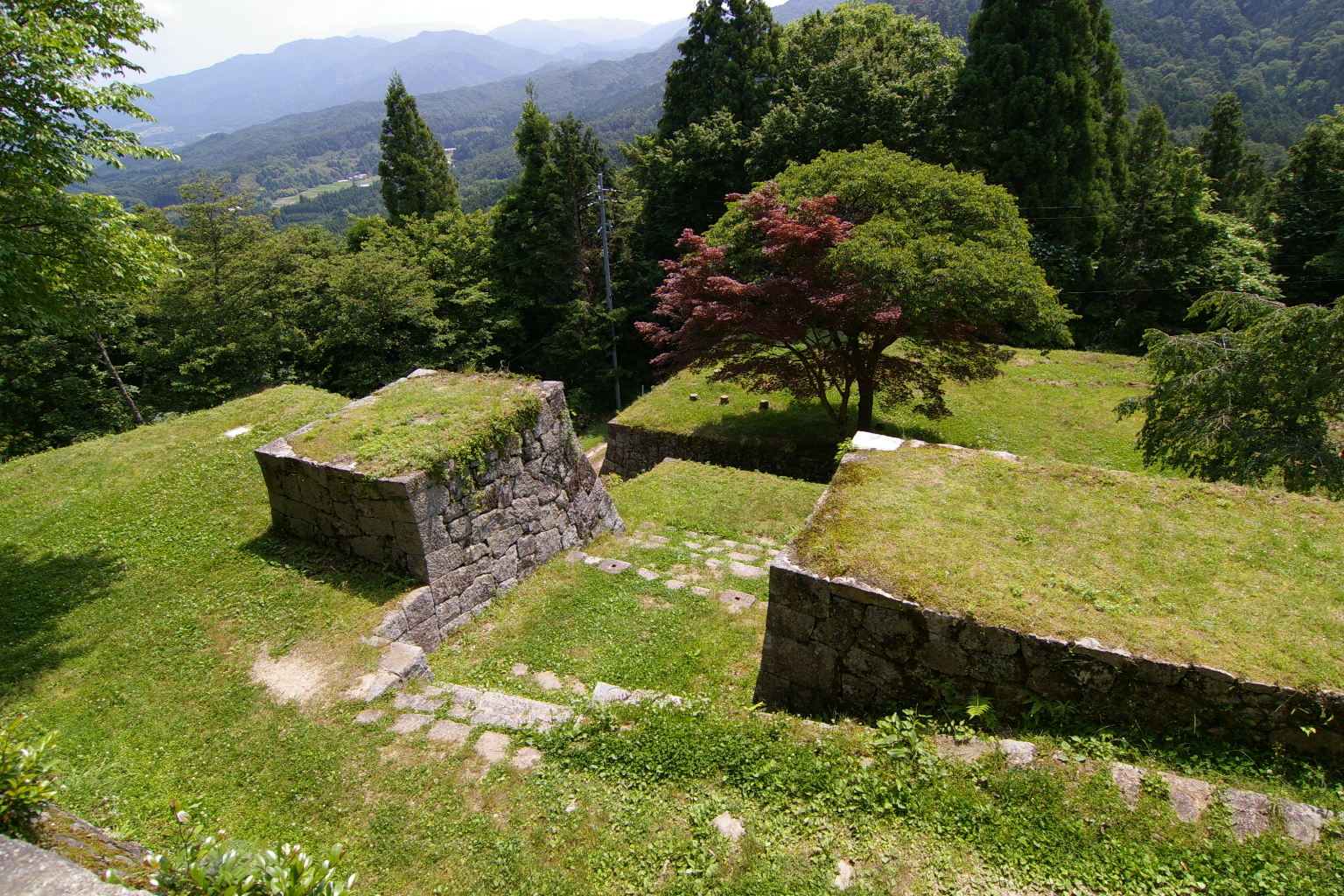
The castle changed hands repeatedly after the bloodshed. In 1582, Nobunaga used Iwamura as his base during the conquest of Kai Province. It passed to Mori Nagayoshi and then his son Mori Tadamasa, who during seventeen years of control transformed the fortress with the stone walls that define the ruins today. After the death of Toyotomi Hideyoshi, the castle went to Tamura Naomasa, who backed the losing side at the Battle of Sekigahara in 1600 and was promptly dispossessed. The Tokugawa government awarded Iwamura to Matsudaira Ienori, creating the Iwamura Domain. The Niwa clan governed from 1638 to 1702, followed by the Ishikawa clan from 1702 until the Meiji Restoration. In 1873, the new government ordered the castle demolished. Every building was torn down except one gate, which was moved to a neighboring temple. What remains on the mountaintop are the stone walls the Mori built -- massive, moss-covered, and disappearing into the fog that still wraps the peak most mornings.
Walking Into the Mist
Today, Iwamura's castle town is one of the most significant historic preservation districts in Gifu Prefecture, ranked behind only Takayama and Shirakawa-go. Traditional merchant houses and shops line the streets below the mountain, preserved in the Edo-period style that defined the town during its centuries as a domain seat. The castle ruins themselves require commitment: a twenty-minute walk from Iwamura Station on the Akechi Railway to the hillside entrance, then another thirty minutes climbing through forest to the central enclosure. The stone walls emerge gradually from the trees, their scale increasing as the path rises. At the summit, 721 meters above sea level and 200 meters above the surrounding basin, the fog rolls in and out with the mountain's breathing. There are no reconstructed towers, no ticket booths, no gift shops at the top -- just the bones of a fortress and the silence of a mountaintop where a woman once held the line.
From the Air
Located at 35.360N, 137.451E in the mountains east of Ena, Gifu Prefecture. The castle ruins sit at 721 meters (2,365 ft) elevation on a steep, forested mountaintop overlooking the Iwamura Basin. From the air, the site is identifiable by the cleared mountaintop with visible stone wall remnants surrounded by dense forest. The preserved castle town stretches along the valley below. Nearest airport is Chubu Centrair International Airport (RJGG), approximately 90 km southwest. Nagoya Airfield/Komaki (RJNA) is roughly 55 km west. Recommended viewing altitude: 4,000-6,000 ft AGL to appreciate the mountain elevation and the relationship between castle summit and town below. Morning flights may encounter the characteristic mountain fog that earned Iwamura its 'Misty Castle' nickname.