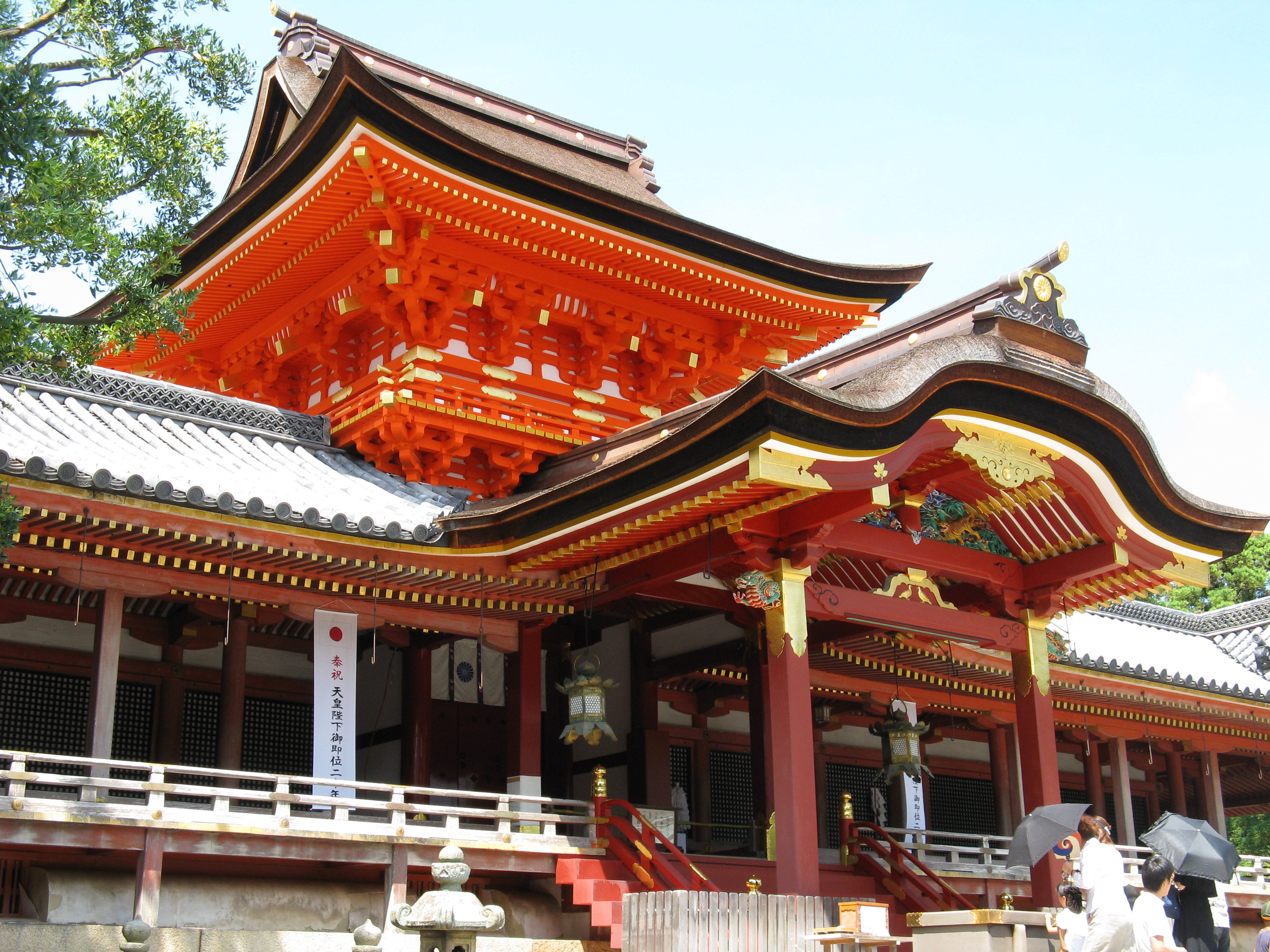
Iwashimizu Hachimangu
In 859, a monk named Gyokyo claimed the war god Hachiman had spoken to him: "Move my shrine to the peak of Mount Otoko near the capital, and I will protect the country." Emperor Seiwa took the message seriously. By the following year, construction was underway on a hilltop overlooking the confluence of the Uji, Katsura, and Kizu rivers, at the precise point where Kyoto's southwestern spiritual defenses were weakest. That shrine, Iwashimizu Hachimangu, still stands on Mount Otoko in the city of Yawata, Kyoto Prefecture. For nearly twelve centuries it has served as one of Japan's most important Shinto sanctuaries, a royal ancestral shrine for the imperial family, and a place where samurai prayed for victory before riding into battle.
Guardian of the Ura-Kimon
The ancient Japanese capital of Heian-kyo, present-day Kyoto, was designed according to Chinese geomantic principles that identified certain compass directions as supernaturally vulnerable. The northeastern direction, the kimon or demon gate, was guarded by the vast Buddhist monastery of Enryaku-ji on Mount Hiei. The southwestern direction, the ura-kimon, needed its own protector. Iwashimizu Hachimangu filled that role. Perched on Mount Otoko at the southwestern approach to the capital, the shrine was considered second in importance only to the Ise Grand Shrine by the Engishiki records of 939. Emperor Murakami ordered imperial messengers to report important events to its guardian kami. From 979 onward, nearly every emperor made pilgrimage here, and over the centuries more than 240 grand imperial visits were recorded.
Where Shinto Met Buddhism
Iwashimizu was born in an era when the boundaries between Shinto and Buddhism were deliberately blurred. From its founding, the shrine functioned primarily as a Buddhist complex called a jingu-ji, with a Yakushi Nyorai healing Buddha as its central icon. By 862 it had formally renamed itself Gokoku-ji, meaning Temple for the Protection of the Nation, emphasizing its Buddhist identity. This fusion of traditions, known as shinbutsu-shugo, persisted for a thousand years until the Meiji government forcibly separated Shinto from Buddhism in 1868. The shrine's Buddhist statues were removed, its temple structures dismantled or destroyed, and in 1869 it was renamed Otokoyama Hachimangu. The shrine did not regain its original name until 1918, and the scars of that separation remain visible in the gaps where Buddhist buildings once stood.
Shrine of the Samurai
Hachiman was not merely the protector of emperors. The kami was equally revered as the god of war, and Iwashimizu became the spiritual home of the Minamoto clan, one of the most powerful samurai families in Japanese history. The turning point came when the young warrior Minamoto no Yoshiie underwent his coming-of-age ceremony at the shrine and adopted the battle name Hachimantaro Yoshiie, literally Yoshiie, First Son of Hachiman. From that moment, the shrine's identity was bound to the samurai class. The Minamoto and their cadet branches, including the Ashikaga, established branch shrines wherever they held land. In 1456, Shogun Ashikaga Yoshimasa visited with the full court. But the devastating Onin War of 1467 to 1477 brought two centuries of silence, and imperial visits ceased until the Edo period restored stability.
National Treasures on a Hilltop
Ten buildings on the shrine grounds carry the designation of National Treasure, all constructed in 1634 by order of Shogun Tokugawa Iemitsu. The main hall, or honden, is divided into an inner hall and an outer hall, a rare architectural arrangement explained by the belief that the gods move to the outer hall during the day and retreat to the inner hall at night. Where the eaves of the two halls meet, a golden gutter donated by the warlord Oda Nobunaga in 1580 catches the rain. Among the shrine's carved decorations is the famous Monkey with Eye-Grain, attributed to the legendary sculptor Hidari Jingoro. According to shrine lore, the carved monkey escaped at night to ravage the fields at the mountain's foot, so a nail was driven into its right eye to stop it. A 2005 inventory of the shrine's treasures revealed an unexpected find: a kris, a jeweled Indonesian dagger, later exhibited at the Kyoto National Museum.
The View from Mount Otoko
Iwashimizu Hachimangu sits at the summit of Mount Otoko, roughly 143 meters above sea level, where the Yodo River corridor opens toward Osaka Bay. The approach passes through forested hillside lined with stone lanterns and through a series of torii gates. In the Edo period, 48 sub-shrines flanked the paths leading upward. The shrine grounds were designated a National Historic Site in January 2012. From the hilltop, the view stretches across the flat expanse of the Kansai Plain, with Kyoto to the north and Osaka to the southwest. It is the kind of strategic vantage point that explains why a god of war would choose it, and why emperors and samurai climbed here for more than a millennium.
From the Air
Located at 34.880N, 135.700E on Mount Otoko in Yawata, Kyoto Prefecture. The shrine sits at the hilltop where the Uji, Katsura, and Kizu rivers converge into the Yodo River, a prominent visual landmark from the air. Look for the forested hill rising from the flat river plain between Kyoto and Osaka. Nearest airports: Osaka Itami (RJOO) approximately 20 km southwest, Kansai International (RJBB) approximately 60 km south. Best viewed at 2,000-4,000 ft AGL. The river confluence and hilltop shrine complex are distinctive at moderate altitude.