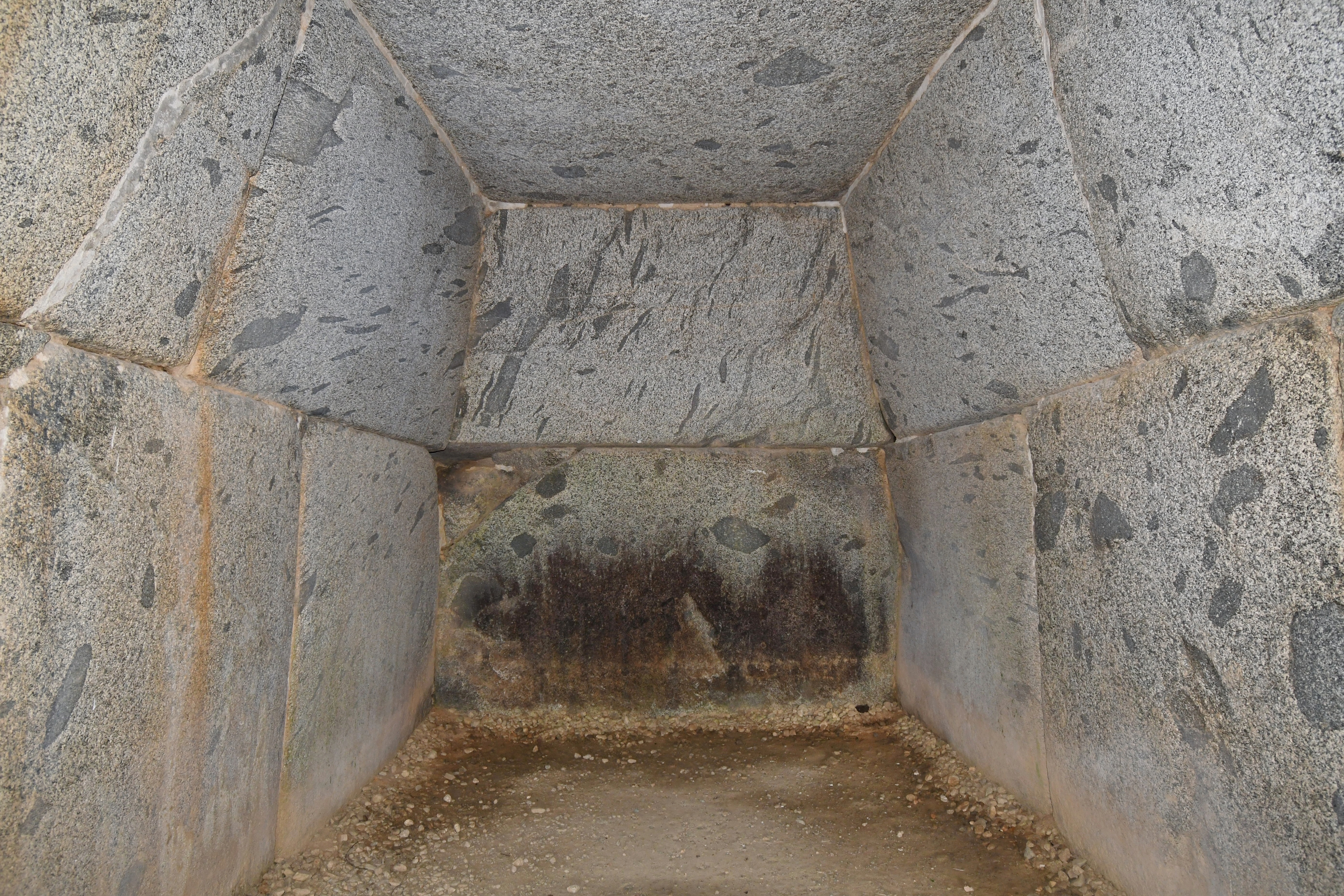
Iwayayama Kofun
The stone passage has been open for centuries, its granite walls polished smooth by the hands of curiosity seekers and grave robbers alike. Iwayayama Kofun, tucked into the hillside of Asuka village in Nara Prefecture, is one of Japan's most architecturally refined ancient burial chambers -- yet the identity of the person it was built to honor has never been settled. Was this the final resting place of Empress Saimei, who ruled Japan twice during the turbulent seventh century? Or does it belong to an earlier period altogether, connected to the legendary Prince Shotoku? The tomb's elaborate stonework offers clues but no definitive answers, and that ambiguity is part of what makes this place so compelling.
Stone Cut with Royal Precision
From the outside, Iwayayama Kofun appears deceptively modest -- a mound roughly 45 meters on each side, rising 12 meters high, carefully tamped earth over a two-stage construction. Modern archaeology has revealed that what was long assumed to be a simple square tumulus actually featured an octagonal upper section, a design detail typically reserved for the highest ranks of ancient Japanese royalty. Step inside the horizontal-entry passage and the craftsmanship becomes unmistakable. The burial chamber is built entirely of granite, its walls stacked in precisely cut double layers that tilt inward to support a massive monolithic ceiling stone. The chamber stretches 4.9 meters long, 2.7 meters wide, and 3 meters high, while the approach passage extends a full 12 meters -- an impressive corridor of stone that narrows from double-tiered walls in the front to single-tiered walls deeper in. The proportions match those of several elite tombs scattered across Nara and southern Osaka, including the Eifuku-ji Kita Kofun, traditionally associated with the tomb of Prince Shotoku.
An Englishman and the Emperor's Tomb
In 1897, an English mining engineer named William Gowland brought Iwayayama Kofun to the attention of the Western academic world. Gowland, who had arrived in Japan in 1872 to advise the Meiji government on metallurgy at the Osaka Mint, had developed an obsession with the country's burial mounds. He conducted the first scientifically rigorous surveys of numerous kofun across the Japanese archipelago, pioneering techniques like sieving excavated soil through different mesh sizes -- methods that were ahead of their time. His meticulous documentation of sites from Kyushu to Fukushima earned him the title 'father of Japanese archaeology.' For Gowland, the Iwayayama chamber's sophisticated stonework was evidence of a society with far greater engineering capabilities than commonly assumed. His reports sparked international scholarly interest in the Kofun period that continues to this day.
The Empress Who Ruled Twice
The question of who lies beneath Iwayayama Kofun hinges on dating. Based on the style of house-shaped sarcophagi found in similar tombs and the chronology of Sue ware pottery, archaeologists have estimated construction between the mid-seventh and third quarter of the seventh century. That timeline points to Empress Saimei, who uniquely held the throne twice -- first as Empress Kogyoku from 642 to 645, then again as Empress Saimei from 655 until her death in 661 while planning a military campaign to aid the Korean kingdom of Baekje. The octagonal upper section supports this theory, as that form was typically reserved for imperial burials of this era. But there is a counterargument: if the similar Eifuku-ji Kita Kofun truly belongs to Prince Shotoku, who died in 621 or 622, then Iwayayama's construction may have occurred in the first quarter of the seventh century -- too early for Saimei. The tomb's burial chamber was looted long ago, leaving no grave goods to settle the debate.
Asuka's Living Memory
Iwayayama Kofun sits just a two-minute walk from Asuka Station on the Kintetsu Yoshino Line, making it one of the most accessible ancient tombs in Japan. In 1978, flooding caused the western side of the mound to collapse, exposing eroded sections that had been hidden for centuries. Rather than a disaster, this became an opportunity: environmental restoration work allowed archaeologists to conduct new excavations that confirmed the two-stage construction method and the original dimensions of the mound. Japan designated the tumulus a National Historic Site in 2008, recognizing its importance as one of the finest examples of late Kofun-period stone chamber architecture. The village of Asuka itself is a landscape where ancient mounds, temples, and stone monuments dot the rice paddies, each one a fragment of the era when this quiet valley was the political and spiritual center of Japan.
From the Air
Located at 34.466N, 135.798E in the Asuka valley of Nara Prefecture, Japan. The site sits in a low-lying area surrounded by rice paddies and forested hills. The nearest significant airport is Kansai International (RJBB), approximately 50 km to the west. Osaka Itami (RJOO) is about 40 km to the northwest. From the air at 3,000-5,000 feet, the Asuka valley is identifiable as a patchwork of rice fields threaded by narrow roads, with scattered kofun mounds visible as tree-covered hillocks among the flat terrain. The Kintetsu railway line running through the valley is a useful visual reference.