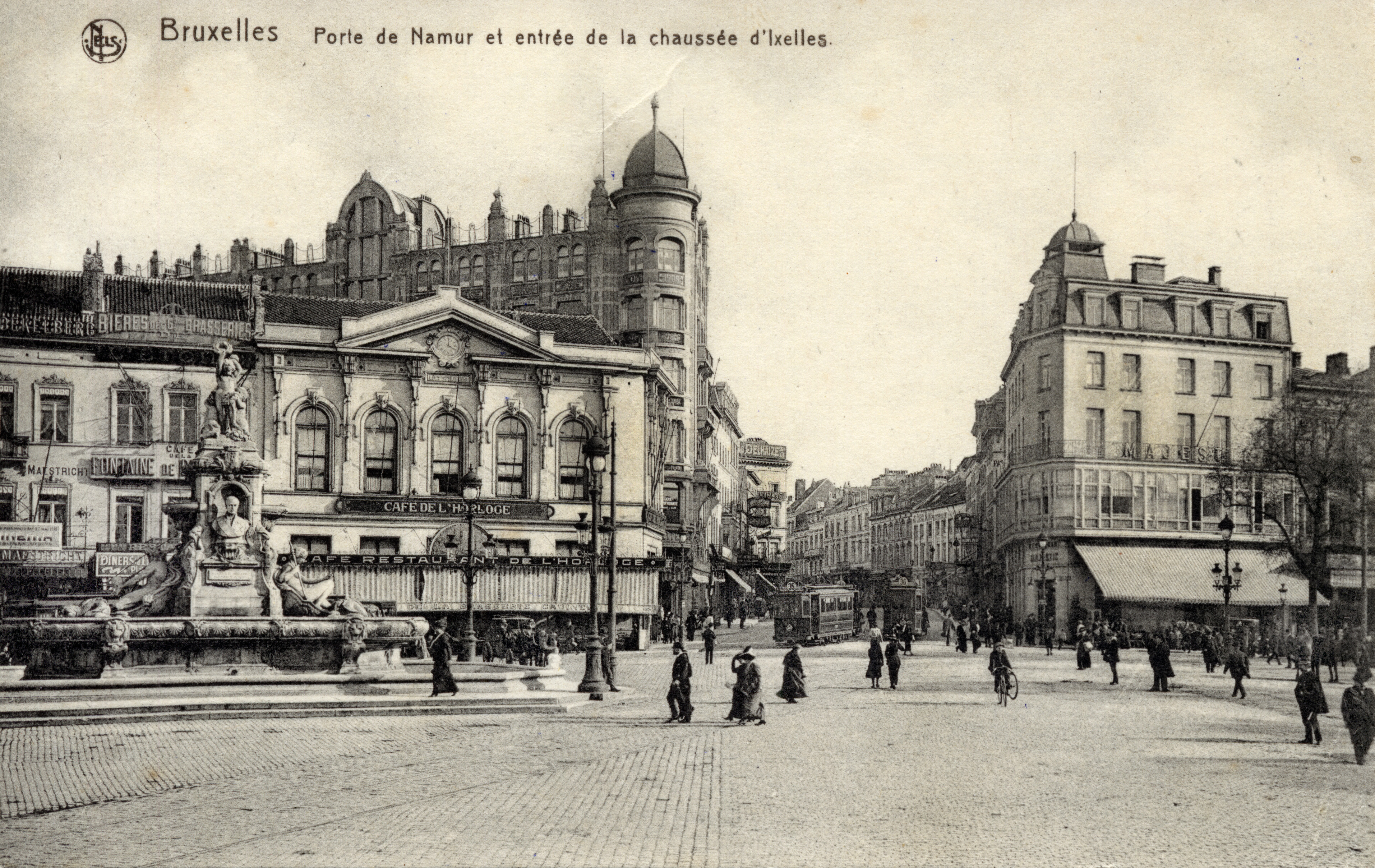
Ixelles
The plaque is small, easy to miss. It hangs on a building wall at the corner of Avenue de la Couronne, in Ixelles, marking the apartment where Giacomo Puccini died on November 29, 1924, while undergoing experimental radium treatment for throat cancer at a Brussels clinic. He had come north to be cured. Instead he died in the city, his last opera Turandot unfinished, leaving sketches for a final duet that Franco Alfano would later complete. Puccini is one entry on a list that, in any other municipality, would seem implausible. Karl Marx took rooms in Ixelles in the 1840s and wrote sections of what would become The Communist Manifesto. Vladimir Lenin lived here a generation later. Audrey Hepburn was born here in 1929. Edith Cavell ran a nursing school here from 1907 until her execution by the Germans in 1915. The geographer-anarchist Elisee Reclus settled here. Auguste Rodin worked here. Pierre-Joseph Proudhon wrote here. Ixelles is six and a half square kilometers of Brussels suburb where, for two centuries, almost everyone passing through Europe seems to have stayed long enough to leave a mark.
Alder Woods and an Abbey
The name is older than any of its famous residents. It first appears in 1210 as Elsela, from the Old Dutch Else-lo, meaning alder woods. A Cistercian nun named Gisela had received the Pennebeke domain from Hendrik I, Duke of Brabant, in 1201, and there she founded La Cambre Abbey near the springs of the Maelbeek stream in the Sonian Forest. The abbey shaped the area for six hundred years. Around 1300 a hostel went up nearby to feed the woodcutters working in the forest; a hamlet formed; a Church of the Holy Cross was built in 1459. Pure spring water from the Maelbeek made the Ixelles abbey a natural site for brewing, and by the seventeenth and eighteenth centuries some twenty breweries-cabarets clustered around the springs, with names like Saint-Hubert, De Sterre, and L'Italie. The French Revolution stripped the abbey of its religious functions in 1795 and turned it variously into a cotton mill, a farm, a military school, and a hospital. The buildings still stand. They now house, among other things, one of the most renowned visual arts schools in Belgium.
A Municipality Cut in Two
Ixelles has an unusual shape on the map, and the reason traces to a nineteenth-century quarrel. In 1847 the City of Brussels commissioned the Avenue Louise - a grand chestnut-lined boulevard meant to run from the city center straight to the popular Bois de la Cambre, an early Brussels imitation of the Haussmann boulevards then transforming Paris. The avenue had to cross Ixelles, which was then, as now, a separate municipality. Ixelles refused. After years of fruitless negotiation, Brussels simply annexed the narrow strip of land needed for the avenue itself, along with the Bois de la Cambre, in 1864. The result is the geography Ixelles still lives with: a larger eastern half and a smaller western half, sliced apart by a sliver of Brussels city territory running south. The population that filled the new neighborhoods grew nearly a hundredfold over the next century, from 677 residents in 1813 to more than 58,000 by 1900, and Ixelles became one of the most fashionable corners of the capital.
Where Marx Met Engels
What drew the revolutionaries was politics and what drew the artists was the look of the place. Karl Marx, expelled from Paris in 1845, settled in Brussels and lived in Ixelles between 1846 and 1848. It was here that he met regularly with Friedrich Engels, joined the Communist League, and produced the Manifesto that would be published in London weeks before the revolutions of 1848 swept Europe. Vladimir Lenin, in exile decades later, lived in the municipality too. Pierre-Joseph Proudhon, the French anarchist who first declared property to be theft, wrote in Ixelles after his own expulsion from Paris. Elisee Reclus, anarchist and geographer, produced his vast Nouvelle Geographie Universelle from rooms here. The mix - a tolerant Belgian capital just close enough to Paris to be a refuge, just far enough to be safe - made Ixelles a clearinghouse for nineteenth-century dissent. The famous nineteenth-century residents are still commemorated by quiet plaques on apartment doors that local children walk past every day on their way to school.
Matonge
In the late 1950s a different community began to shape Ixelles. The Maison Africaine - Maisaf - opened near the Namur Gate as a residence for university students from the Belgian Congo. When Congo became independent in 1960, the influx of Congolese immigrants who followed gave the neighborhood a new name: Matonge, after the famous marketplace and music district in the Kalamu commune of Kinshasa. By the 1970s, students and diplomats from Zaire - locally known as Belgicains - met in the cafes around the Chaussee d'Ixelles, and the Ixelles Gallery and the Namur Gate Gallery filled with shops selling fabric, plantains, hair products, and music from across central Africa. Communities from Rwanda, Burundi, Mali, Cameroon, and Senegal followed. The neighborhood is now among the most diverse in Belgium, with over forty-five nationalities counted among residents and shopkeepers; the annual Matonge en Couleurs festival, held since 2001 around the date of Congolese independence, transforms the streets each June. Matonge sits squeezed between the European Quarter on one side and the fashionable Avenue Louise on the other, and the pressure from both directions is constant. The festival, the shops, and the long-running BX1 television program Tele Matonge XL are how the community continues to claim the ground.
Universities and Ponds
The eastern half of Ixelles holds two of Brussels' great universities: the French-speaking Universite libre de Bruxelles and the Dutch-speaking Vrije Universiteit Brussel, sharing campuses on either side of the Boulevard du Triomphe. The student population shapes everything around them - the late-night cafes, the cyclo-cross race held every year across both campuses, the constant churn of new arrivals from across Europe. South of the campus, the Ixelles Ponds and Tenbosch Park preserve the remnants of the medieval water system that once turned the abbey mills. Around the Place Eugene Flagey, the Streamline Moderne Flagey Building - the old Radio House of Belgian public broadcasting - anchors a neighborhood of restaurants and Sunday markets. The streets between the ponds and the avenue are dotted with Art Nouveau houses by Victor Horta, several of which are now UNESCO World Heritage sites. To wander west from the universities through the ponds and toward Matonge is to walk through about a century of European urban history compressed into a half-hour stroll. That density - revolutionaries and movie stars, abbeys and African markets, ponds and Art Nouveau - is the Ixelles experience. It is what Audrey Hepburn was born into, in 1929, on a street that already had more history than the city she would later make famous.
From the Air
Ixelles occupies the southeast of the Brussels-Capital Region, with its center near 50.833 degrees N, 4.367 degrees E. From cruising altitude the municipality is hard to distinguish from surrounding Brussels by terrain alone, but two visual markers help: the Avenue Louise runs as a long straight green-and-white axis from the city center down to the Bois de la Cambre, the large wooded park at Ixelles' southern edge; and the Ixelles Ponds appear as a pair of dark elongated water features mid-municipality, opening onto the Place Eugene Flagey. The ULB and VUB campuses sit in the larger eastern half. Brussels Airport (EBBR) is 12 kilometers northeast; Brussels South Charleroi (EBCI) is about 50 kilometers south.