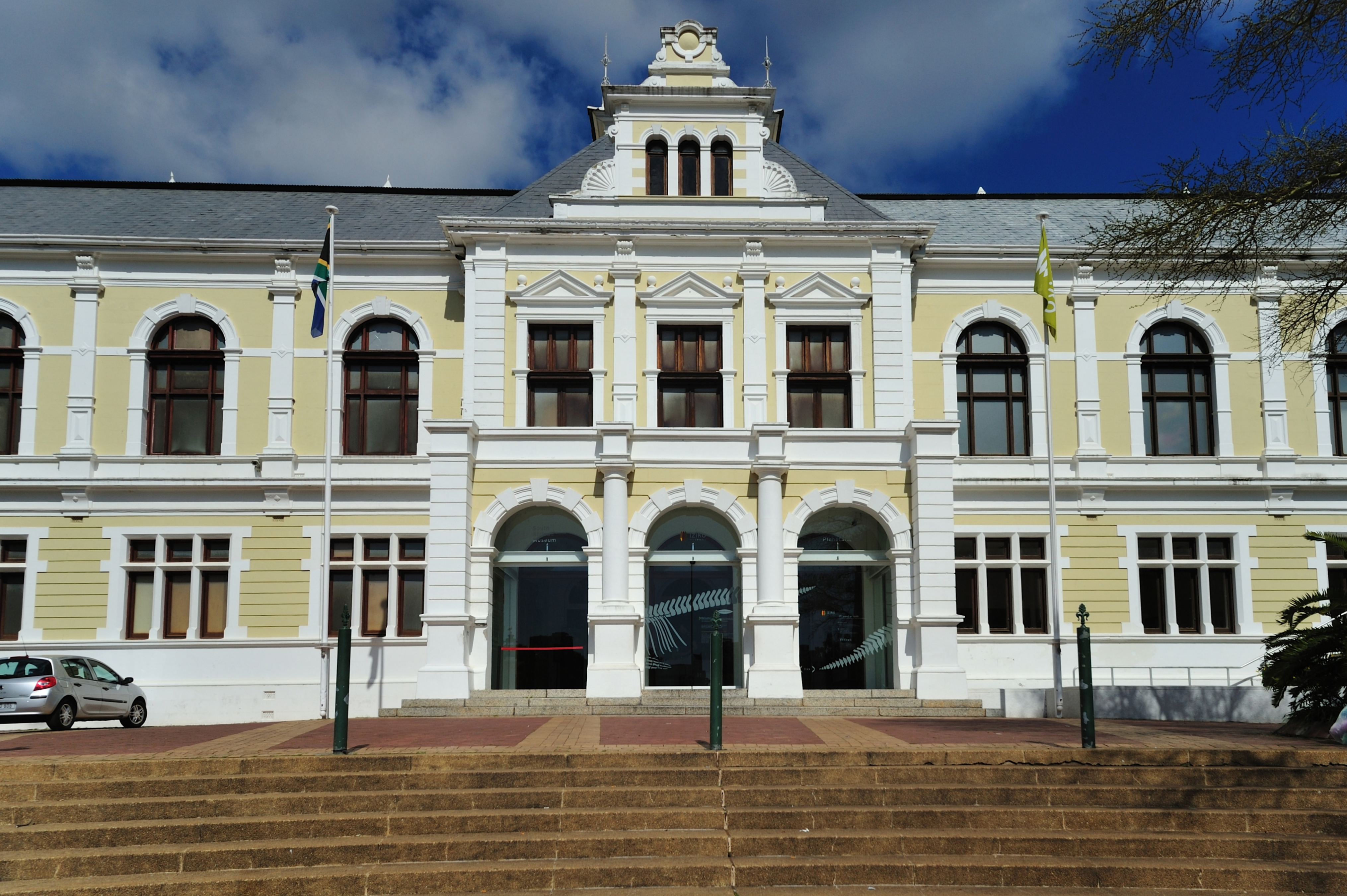
Iziko South African Museum
The word iziko means "hearth" in Xhosa, and the name was chosen deliberately. When the South African Museum was renamed in 2012, the new word was meant to signal warmth, gathering, a center of community -- qualities that had not always defined the institution. Founded in 1825 by Lord Charles Somerset, the governor of the Cape Colony, the museum in Cape Town's Company's Garden is the oldest in the country. Its collections span 250-million-year-old fossils, a foal of the extinct quagga, and the recorded song of the humpback whale. But the museum's most difficult story is about people, not specimens.
Deep Time in the Karoo
The museum's palaeontology wing houses therapsid fossils from the Karoo -- mammal-like reptiles that lived 250 million years ago, before the End-Permian Extinction wiped out roughly 90% of Earth's species. Reconstructions show what these creatures might have looked like, bridging the gap between dry bone and living animal. The collection traces the evolutionary line from therapsids to modern mammals, a lineage that took hundreds of millions of years to unfold. Elsewhere, the Sharkworld exhibition displays massive megatooth shark jaws, and three large iron meteorites sit as evidence of the violence the cosmos can deliver. The planetarium offers regular programs, and a cosmic zoom display traces the universe from local space back to nearly the beginning of everything.
Casts, Dioramas, and Dehumanization
Between 1907 and 1924, under director Louis Peringuey, museum modeller James Drury took 68 body casts of San and Khoi people described in official records as "pure Bushmen specimens." The process was humiliating and painful for the participants. Drury's memoir, titled Bushman, whale and dinosaur, placed these human beings in the same category as the museum's animal and geological exhibits. The casts were displayed from 1911 without any acknowledgment of the San and Khoi people's complex social and cultural lives. Museum labels referred to them in the past tense, consigning living cultures to extinction. When the Bushman Diorama was finally assembled in the late 1950s, it placed the casts in an invented scene based on a painting -- not their actual lives.
Reckoning and Revision
In 1989, the museum began confronting the diorama's problems, adding an exhibition that investigated the casting project and tried to restore the identities of the people who had been cast. In 1996, curator Pippa Skotnes mounted Miscast: Negotiating the Presence of Khoi and San History and Material Culture at the neighboring South African National Gallery. The installation included thirteen resin casts, instruments of physical anthropology, and a vinyl floor underlaid with derogatory newspaper articles and photographs. Visitors walked on representations of San people -- an act many interpreted as repeating, rather than challenging, the very dehumanization Skotnes meant to critique. San representatives argued that Skotnes could not speak for people she "did not understand." The Bushman Diorama was closed in April 2001, but the questions it raised about representation, consent, and whose story gets told remain central to the museum's identity.
A Hearth for the Future
Today the Iziko South African Museum operates as part of Iziko Museums of South Africa, an agency of the national Department of Arts and Culture. The collections span zoology, archaeology, and natural history across multiple floors -- from an indigenous knowledge exhibition to a geological model of Table Mountain to a display of South African and foreign minerals. During the COVID-19 pandemic, the museum launched virtual exhibitions, including one dedicated to Nelson Mandela and another on the journeys of the slave ship Sao Jose. The renaming to Iziko was more than bureaucratic: it was a statement that a museum founded in the colonial era could evolve into something warmer, more inclusive, more honest about its own past. Whether it has fully achieved that transformation is a question the institution continues to ask itself.
From the Air
Located at 33.93°S, 18.42°E in central Cape Town, within the Company's Garden precinct near the South African Parliament. Nearest airport: Cape Town International (FACT). The museum building is part of the cluster of civic institutions in the city bowl, below the north face of Table Mountain. Not individually distinguishable from altitude, but the Company's Garden green space is a useful visual reference.