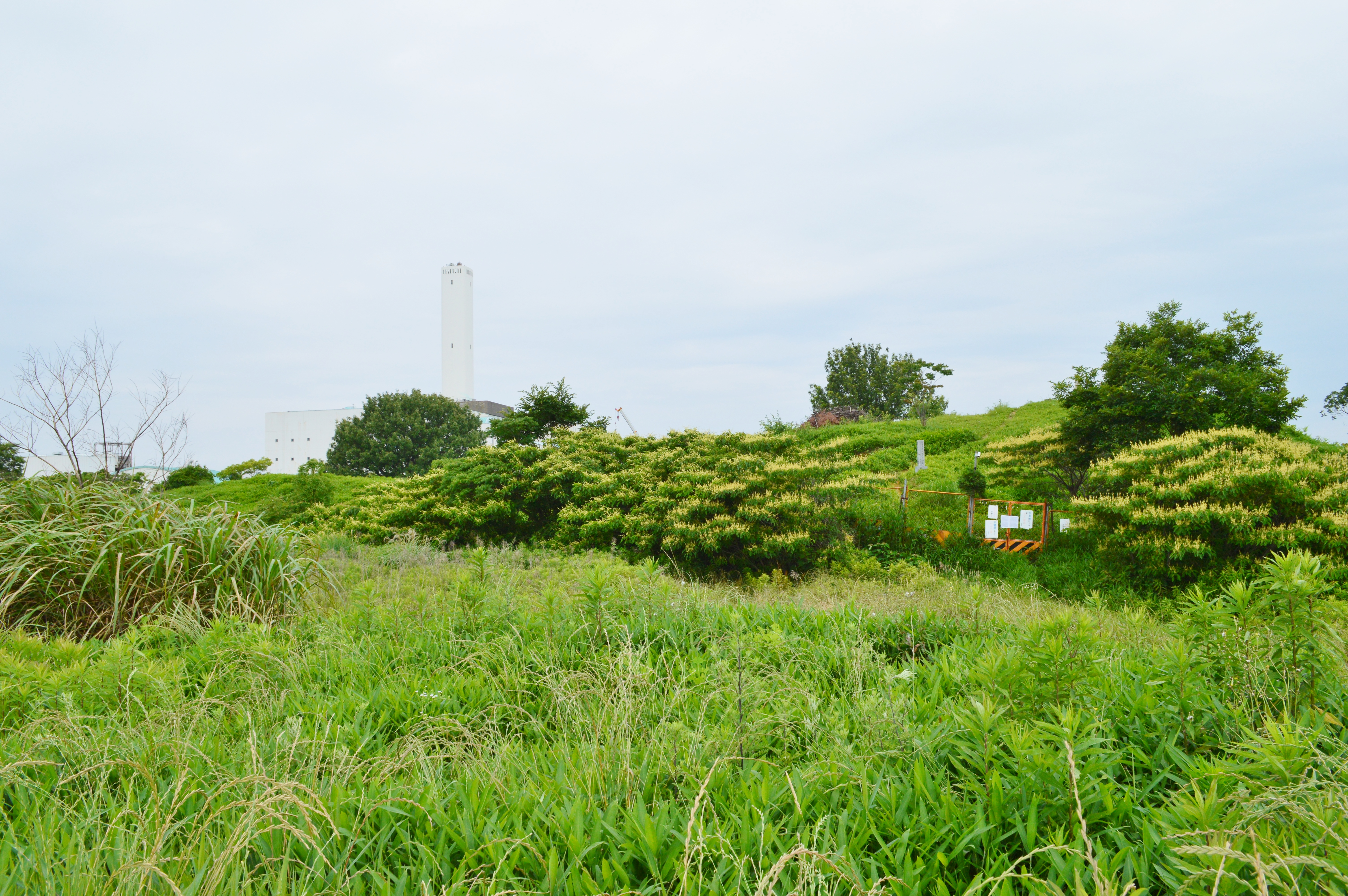
Izumi Koganezuka Kofun
In November 1945, with Japan still reeling from surrender, a seventeen-year-old student noticed that a burial mound near the city of Izumi, Osaka was falling apart. The earthen tumulus had been known for centuries -- its distinctive keyhole shape, visible from above as one square end joined to one circular end, marked it as a kofun, a tomb of the ancient ruling class. But wartime neglect had left it badly damaged. The teenager convinced local authorities to investigate before the site was lost entirely. What they found inside would connect a rice paddy in suburban Osaka to the courts of third-century China and one of Japan's most enduring historical mysteries: the identity and realm of Queen Himiko.
The Shape of Ancient Power
The Izumi Koganezuka Kofun is a zenpokoenfun -- a keyhole-shaped burial mound -- measuring 94 meters in total length. The anterior rectangular portion is 42 meters wide and rises 6.5 meters in two tiers. The posterior circular portion, where the burial chamber lies, spans 57 meters in diameter and stands 9 meters tall, also in two tiers. It sits on the northwestern edge of Shintayama hill, surrounded by paddy fields, close to the site of the ancient provincial capital of Izumi Province. The mound's construction, with its carefully engineered tiers and precise geometry, reflects the enormous labor and authority required to build such monuments. Based on haniwa clay figures and other artifacts recovered during excavations from 2001 to 2005, archaeologists date the tumulus to the latter half of the fourth century AD -- placing it squarely in the Kofun period, when Japan's ruling elite built these massive earthworks as statements of power and legitimacy.
Three Coffins, Side by Side
The full excavation came in 1950 and 1951, led by the Osaka Prefectural Board of Education and the Japanese Archaeological Association. Inside the posterior circular mound, they found a burial chamber containing three clay-covered wooden caskets arranged side by side. The central casket held the remains of a woman. Flanking her on either side lay two men. Surrounding all three were grave goods of extraordinary richness: Shinju-kyo bronze mirrors with intricate designs, curved magatama beads carved from jade and other precious stones, fragments of armor and a helm, iron swords, spears, and other weapons. The arrangement -- a woman at the center, men as attendants or guardians -- was itself significant, suggesting a person of high status in a society where female authority was not unusual. But it was one particular bronze mirror that set the archaeological world alight.
Himiko's Mirror?
One of the Shinju-kyo mirrors bore an inscription with the reign date Keisho 3, corresponding to 238 AD. That date resonated immediately with historians. According to the Wei Zhi -- the "Records of Wei," a Chinese chronicle forming part of the Records of the Three Kingdoms -- in 239 AD the Wei emperor Cao Rui sent "one hundred bronze mirrors" as a diplomatic gift to Queen Himiko of Wa, the Chinese name for ancient Japan. Himiko is one of the most debated figures in Japanese history: a shaman-queen who ruled through spiritual authority, mentioned in Chinese sources but absent from Japan's own earliest chronicles. The mirror's inscription date -- just one year before Cao Rui's recorded gift -- raised the tantalizing possibility that this was one of those hundred mirrors, passed down through generations of rulers until it was buried with the woman in this tomb a century later. The theory remains debated, but the connection between this paddy-field burial mound and the diplomatic networks of third-century East Asia is beyond question.
From Rice Paddy to National Museum
The artifacts from Izumi Koganezuka Kofun now reside in the Tokyo National Museum, collectively designated a National Important Cultural Property. The tumulus itself was designated a National Historic Site in 2008. It sits about twenty minutes on foot from Tonoki Station on the JR West Hanwa Line, an unremarkable walk through a suburban neighborhood that gives no hint of what waits at the end. The mound rises from the flat paddy landscape like a green island, its keyhole shape only fully legible from above. For the student who sounded the alarm in 1945, the instinct to preserve what others had overlooked proved extraordinarily well-placed. Without that intervention, one of the most significant archaeological finds in Osaka Prefecture -- and one of the most provocative links between ancient Japan and the wider world -- might have eroded into the surrounding rice fields and been lost.
From the Air
Located at 34.43N, 135.36E in the city of Izumi, Osaka Prefecture, on flat agricultural land at the northwestern edge of Shintayama hill. The keyhole-shaped tumulus (94 meters long) is distinctive from directly above but blends into the surrounding paddy fields at oblique angles. Look for a raised, tree-covered mound amid flat farmland near the urban fringe. Nearest major airport: Kansai International (RJBB) approximately 15nm southwest. Osaka Itami (RJOO) approximately 25nm north. The JR Hanwa Line rail corridor runs nearby. The site is on the Osaka plain with generally good visibility, though urban haze from the Osaka-Kobe-Kyoto metropolitan area can reduce contrast. Best viewed from low altitude (2000-3000 feet) for the keyhole shape to be discernible.