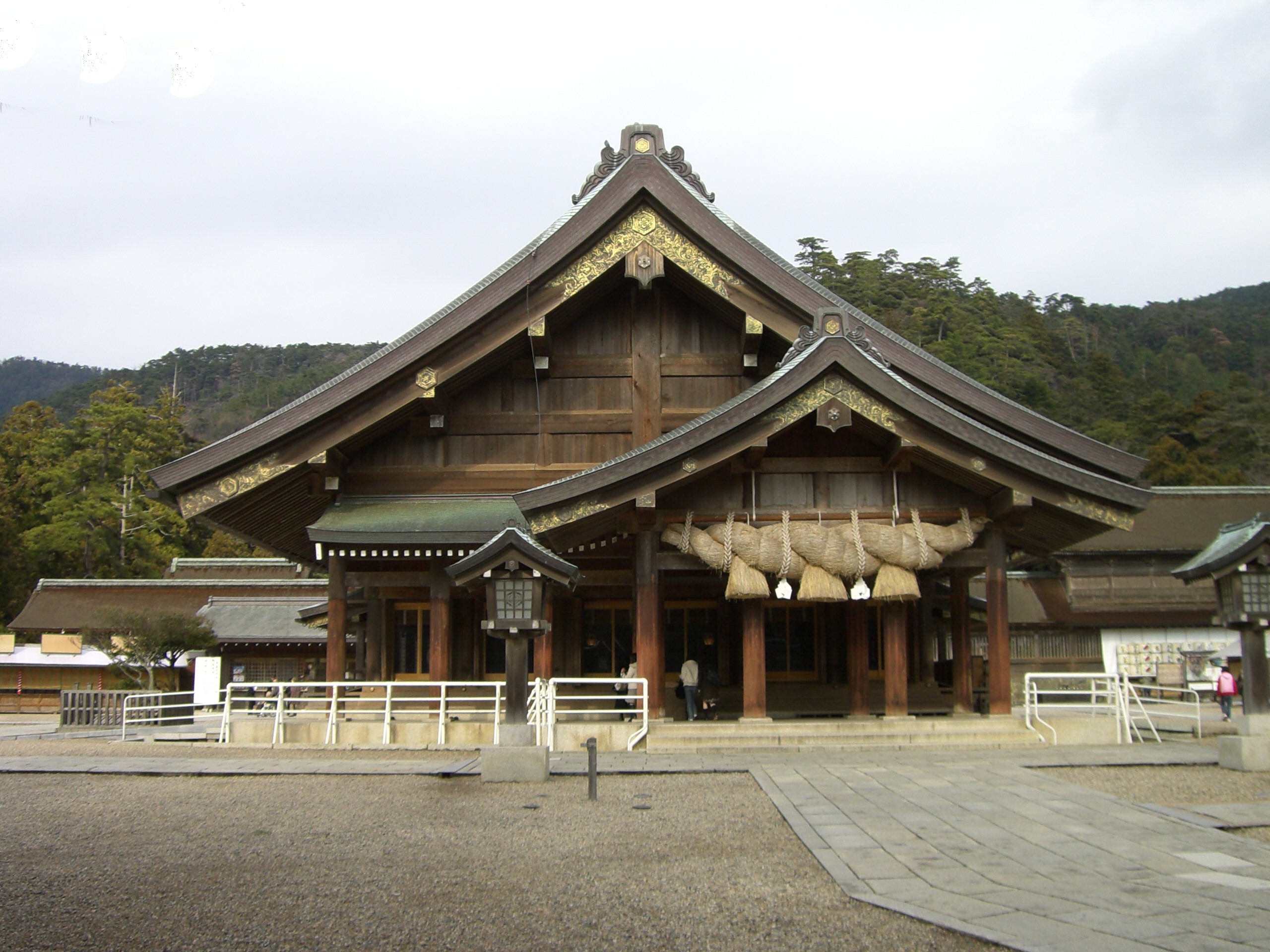
Izumo-taisha
Every October, the rest of Japan calls the month Kannazuki, "the month without gods." In Izumo, they call it Kamiarizuki, "the month with gods." The difference is not poetic. According to Shinto belief, all eight million kami leave their home shrines across the archipelago and travel to Izumo-taisha, the Grand Shrine of Izumo, to convene on matters of marriage, birth, and death for the coming year. For that one month, the gods are here and nowhere else. The shrine that hosts them is widely regarded as the oldest in Japan, predating even the Ise Shrine, and no record exists of when it was first built.
A Gift from the Sun Goddess
The shrine's origin is inseparable from Japan's creation mythology. According to the Kojiki and Nihon Shoki, the oldest chronicles in Japan, the god Okuninushi built the Japanese islands and then ceded his creation to Ninigi-no-Mikoto, grandson of the sun goddess Amaterasu. Pleased by his sacrifice, Amaterasu commanded a grand palace be built for Okuninushi at the foot of Mount Uga, with colossal columns and thick, broad planks. That palace became Izumo-taisha. Okuninushi's portfolio expanded over time: he became the guardian god, the god of happiness, and most famously the god of good relationships and marriage. Couples travel to Izumo-taisha specifically to pray for his blessing, and the shrine's connection to matchmaking is so deeply embedded in Japanese culture that it transcends religious observance.
The Tallest Building in Ancient Japan
A record from around 950 CE describes the main hall of Izumo-taisha as the tallest building in Japan, reaching approximately 48 meters, exceeding even the 45-meter temple housing the Great Buddha at Todai-ji. Scholars debated this claim for centuries. Then, in 2000, workers excavating near the shrine discovered the remains of enormous pillars, each composed of three massive cedar trunks bundled together. The discovery electrified the archaeological world, lending physical evidence to what had seemed like legendary exaggeration. The pillars suggested a structure of staggering scale, built when Shinto cosmology placed the gods literally above the human world. The shrine has been rebuilt every 60 to 70 years in a ritual process called Sengu, preserving both the kami's power and the architectural knowledge required to construct it.
An Architecture Unlike Any Other
The main hall gives its name to taisha-zukuri, the oldest style of shrine architecture in Japan. What makes it peculiar among Shinto buildings is its asymmetry. Most shrines are symmetrical, but Izumo-taisha's floor plan is deliberately off-center, with nine support pillars dividing the interior into four unequal sections and the entrance offset to one side. The layout resembles domestic architecture more than sacred space, suggesting a less formal relationship between the people of Izumo and their kami than existed at other shrines. The main hall was designated a National Treasure in 1952. During the Kamakura period, around 1200, the structure was reduced in size. The current building dates to a 1744 reconstruction, standing 24 meters high with an 11-meter-square base. Its roof bears enormous chigi, the scissor-shaped finials that are among the most recognizable features of Japanese sacred architecture.
Five Tons of Sacred Rope
The Kagura-den, the hall for ritual performances, features the largest shimenawa in Japan. This sacred straw rope stretches 13.5 meters long and weighs approximately five tons, hanging across the entrance in a thick, braided crescent that visitors photograph from every angle. The Kagura-den was first built in 1776 by the Senge family, hereditary governors of Izumo, and rebuilt in 1981 to mark the centennial of the Izumo Oyashiro-kyo order. Inside, traditional prayers, wedding ceremonies, and performances of sacred dance take place on a floor of 240 tatami mats. The Senge family has administered the shrine for over eighty generations. In 2014, Kunimaro Senge married Princess Noriko, daughter of the late Prince Takamado and cousin of the Emperor Emeritus, in a ceremony at the shrine that underscored Izumo-taisha's enduring place in the intersection of Japanese religion and imperial life.
From the Air
Izumo-taisha sits at 35.40N, 132.69E in Izumo, Shimane Prefecture, near the Sea of Japan coast on the western side of Honshu. The shrine compound is visible as a large forested area with distinctive traditional rooflines at the base of Mount Uga. Look for the long approach road (sando) leading south from the shrine to a large torii gate. Nearest airport: Izumo Enmusubi (RJOC) approximately 8nm east. Best viewed at 2,000-3,000 feet AGL on clear days.