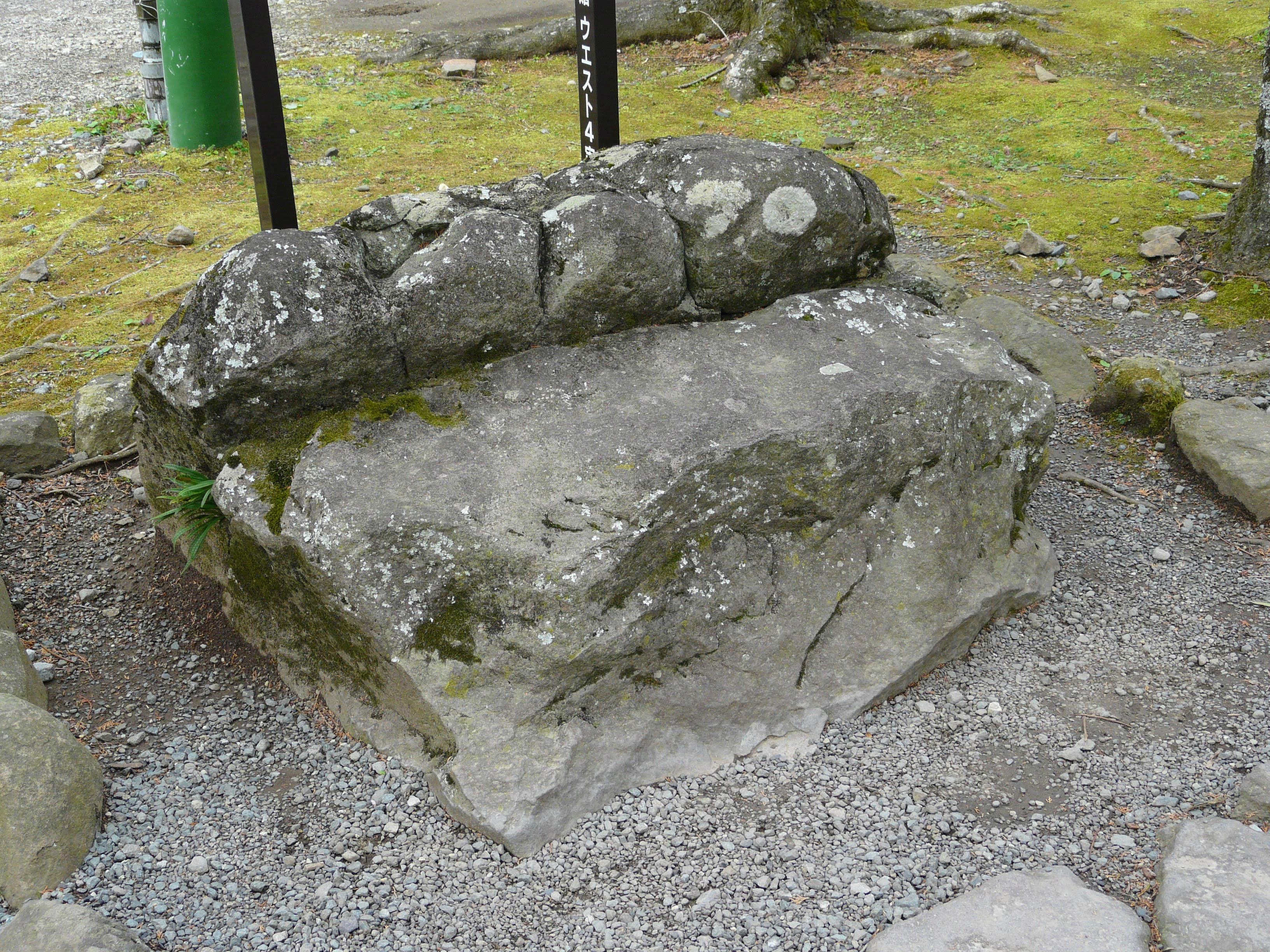
Izusan Shrine
It began with an elopement. Sometime in the late twelfth century, a political exile named Minamoto no Yoritomo slipped away from the watchful eyes of his captors on the Izu Peninsula and fled to this very shrine with Hojo Masako, the fierce daughter of a local clan leader. The match was forbidden. Her father had already promised her to another man. But the couple hid among the shrine's ancient cedars and volcanic steam, and when they emerged, they had forged an alliance that would topple an empire and create the first military government in Japanese history. Izusan Shrine, perched above the hot spring resort town of Atami in Shizuoka Prefecture, has been sacred ground since long before that fateful night -- ancient records confirm a shrine here by 594 AD -- but it was Yoritomo and Masako's desperate romance that sealed its place in the national story.
Where the Earth Breathes
The volcanic springs and a geyser that made Atami famous were the shrine's original reason for being. In ancient Japan, the hissing steam and scalding water that burst from the mountainside were understood not as geology but as the breath of the kami -- the divine spirits that inhabit the natural world. The Shugendo mountain ascetics, practitioners of a syncretic faith blending Buddhism, Shinto, and Taoism, made Izusan a center of their rituals, climbing the slopes to commune with the spirits through fasting, meditation, and exposure to the elements. The shrine's very name -- Izu-san, the mountain of Izu -- reflects this identity as a place where the boundary between the human and divine worlds grew thin. Its actual founding date is lost to time. Shrine legend reaches back to the semi-legendary Emperor Kosho, while other traditions credit Empress Suiko. What the historical record confirms is that by the sixth century, this was already a place of established worship.
The Fugitive and the Shogun's Wife
Minamoto no Yoritomo arrived on the Izu Peninsula not as a pilgrim but as a prisoner. Defeated in the Heiji Rebellion of 1160, he had been exiled to this remote province as a teenager. For two decades he waited, praying at Izusan Shrine for divine help in his struggle against the Heike clan, who controlled the imperial court. The shrine grounds became his rallying point -- the place where he gathered the support of local warrior clans. But it was his elopement with Hojo Masako that proved decisive. Their marriage brought the powerful Hojo clan to his cause, providing the military muscle he needed. When Yoritomo finally launched the Genpei War and defeated the Heike in 1185, he established the Kamakura shogunate -- Japan's first warrior government. Grateful for what he considered divine intervention, Yoritomo rebuilt Izusan Shrine on a grand scale, extending its land holdings as far as distant Echigo Province. The shrine had sheltered a fugitive and gained an emperor in return.
Patronage and the Road to Edo
Success breeds devotion. After the Kamakura period, a succession of Japan's most powerful clans continued to patronize the shrine: the Odawara Hojo, the Imagawa, and the mighty Tokugawa. During the Edo period, Izusan Shrine's fortunes rose with the traffic on the Tokaido, the great highway that connected the shogun's capital at Edo with the imperial seat in Kyoto. Atami sat near this road, and the sankin-kotai system -- which required feudal lords to make regular journeys between their domains and Edo -- brought a steady stream of wealthy pilgrims past its gates. The Tokugawa shogunate formalized the shrine's importance by granting it revenues of 300 koku, a measure of rice income that sustained the priests and maintained the buildings. For centuries, the shrine prospered as both a spiritual sanctuary and a waypoint for the powerful.
Survival Through Upheaval
The Meiji Restoration of 1868 nearly erased Izusan Shrine from the landscape. The new government's shinbutsu bunri policy -- the forced separation of Shinto and Buddhism -- tore through shrines and temples across Japan. At Izusan, where Shugendo practice had woven the two traditions together for centuries, the damage was severe. Most of the shrine's historical records were destroyed, and many of its structures were lost. What survived was rebuilt, and the shrine adapted to the new era of State Shinto. In 1914, Crown Prince Hirohito visited, and a Japanese Black Pine was planted beside the main hall to mark the occasion. By 1928, Izusan had been granted the rank of Kokuhei Shosha -- a National Shrine of the third rank -- a recognition that the site's significance could not be erased even by the convulsions of modernization. The shrine's main festival, held every April 15, continues a tradition that stretches back over a millennium, carried forward on the same volcanic mountainside where the kami once spoke through steam and stone.
From the Air
Located at 35.115N, 139.083E on a hillside above the coastal resort city of Atami, at the northeastern base of the Izu Peninsula. The shrine sits among dense tree cover on the mountain slopes above the city's hot spring district. From the air, Atami itself is recognizable as a dense cluster of hotels and buildings pressed between steep mountains and Sagami Bay. The Izu Peninsula extends dramatically to the southwest. Nearest airports: RJTT (Tokyo Haneda) approximately 50nm northeast, RJTO (Oshima) approximately 25nm east across Sagami Bay. Mount Fuji is often visible to the northwest in clear conditions. The Tokaido Shinkansen line passes through nearby Atami Station, visible as a railway corridor along the coast.