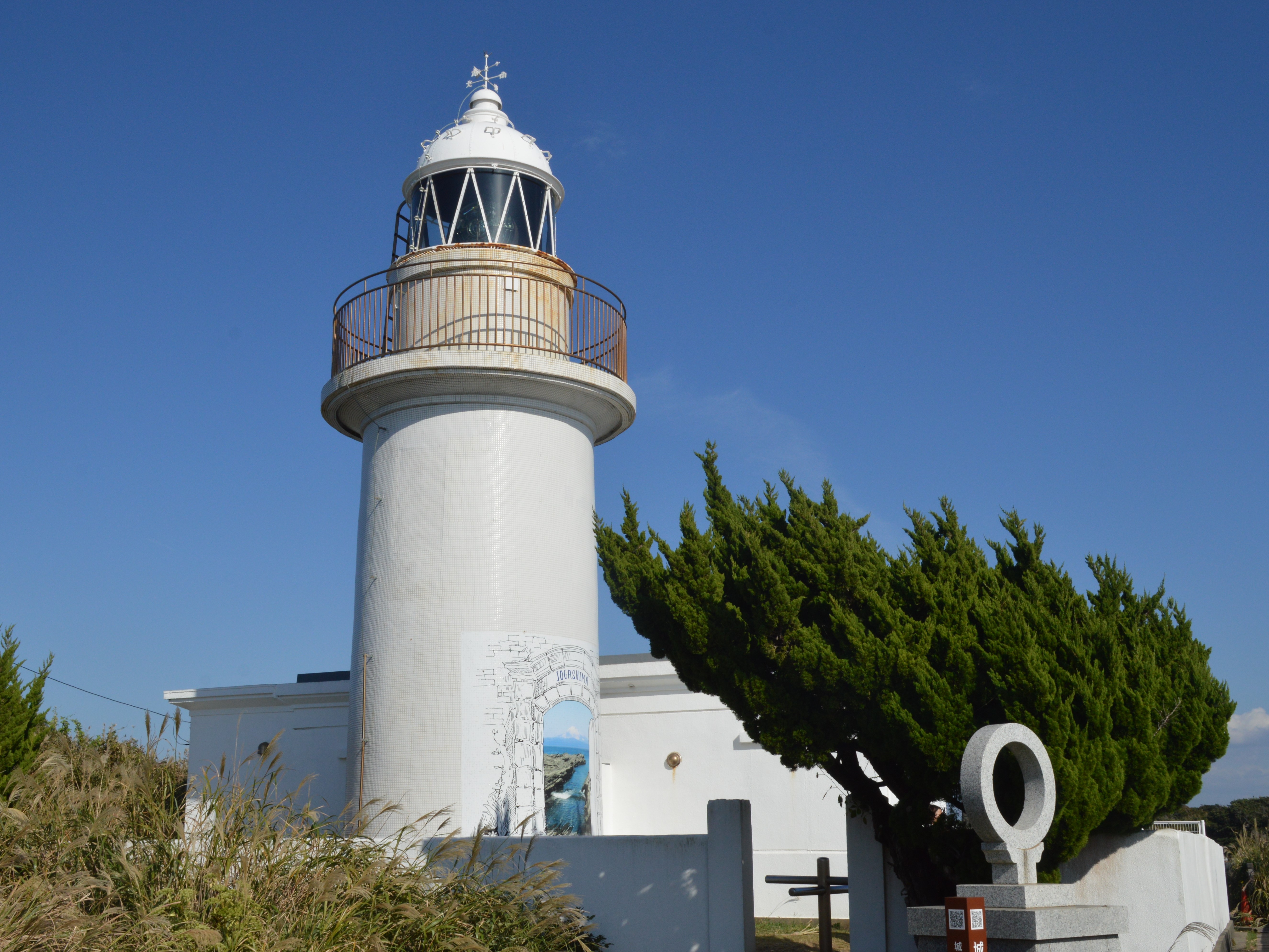
Jogashima Lighthouse
A Frenchman built it. An earthquake destroyed it. Japan rebuilt it and kept the light burning. The Jogashima Lighthouse stands on the windswept southwestern tip of the Miura Peninsula, where the rocky island of Jogashima juts into Sagami Bay like a clenched fist raised against the Pacific. Completed on September 8, 1870 -- just two years after the Meiji Restoration toppled the old feudal order -- it was the fourth Western-style lighthouse ever built in Japan, and today it is the second oldest still standing. Its story is inseparable from the turbulent moment when Japan opened its ports to the world, and a handful of foreign engineers helped transform the country's coastline from a patchwork of signal fires into a modern navigational network.
A Treaty Written in Light
The lighthouse exists because of a diplomatic bargain. The Anglo-Japanese Treaty of Amity and Commerce of 1858, signed under pressure by the Tokugawa Shogunate during the Bakumatsu period, opened Japanese ports to foreign trade -- and with foreign ships came the demand for Western-style navigation aids. Eight lighthouses were stipulated under the treaty, each one an acknowledgment that Japan's ancient coastline was now part of a global shipping network. The Shogunate hired foreign experts to make it happen. Among them was Leonce Verny, a French engineer whose ambitions stretched far beyond lighthouse construction. Verny had already been commissioned to build the Yokosuka Naval Arsenal, Japan's first modern shipyard, and he brought the same methodical precision to his coastal work. He designed and supervised the construction of four lighthouses around Tokyo Bay, including the one at Jogashima. The original structure was built of brick, its light visible across Sagami Bay to guide vessels navigating the treacherous approach to Edo Bay.
Ninety Seconds That Reset the Clock
At 11:58 a.m. on September 1, 1923, the Great Kanto Earthquake struck with a magnitude of 7.9, devastating Tokyo, Yokohama, and the surrounding coastline. The brick lighthouse on Jogashima was shaken apart. For the communities that depended on its light -- the fishing fleets of Miura, the merchant vessels threading through Sagami Bay -- its destruction was not merely symbolic. Navigation along this stretch of coast became immediately more dangerous. Reconstruction began quickly. By August 1, 1925, a new lighthouse stood on the same rocky promontory, this time built of reinforced concrete in a clean, cylindrical tower that would prove far more resilient than its predecessor. Three years later, in 1928, the light source was upgraded from acetylene gas to electric power, dramatically increasing its range and reliability. The new Jogashima Lighthouse was built not just to replace what was lost, but to exceed it.
The Island at the Edge
Jogashima itself is a small, rugged island connected to the mainland tip of the Miura Peninsula by a bridge. It sits at the very southern end of Kanagawa Prefecture, closer to the open Pacific than to the urban sprawl of Yokohama and Tokyo to the north. The coastline here is dramatic -- sea-carved cliffs, tide pools, and rocky shelves battered by waves rolling in from Sagami Bay. The lighthouse perches on the island's western headland, its white concrete tower a stark contrast against dark volcanic rock and the deep blue water beyond. Fishing boats from Miura's harbors work these waters daily, and the lighthouse remains an active navigational aid maintained by the Japan Coast Guard. It has been unmanned since 1991, its operations fully automated, but the light still sweeps across the bay each night as it has for more than 150 years.
Verny's Wider Legacy
Leonce Verny's work in Japan extended far beyond a single lighthouse on a windswept island. As one of the o-yatoi gaikokujin -- the hired foreign experts who helped modernize Meiji-era Japan -- Verny spent years in the country building the infrastructure of a nation in transformation. The Yokosuka Naval Arsenal he constructed became one of Japan's most important military shipyards. His lighthouses around Tokyo Bay helped make the capital's harbor safe for the flood of international commerce that followed the opening of Japan's ports. Verny's name is still remembered in Yokosuka, where Verny Park commemorates his contributions. But at Jogashima, his legacy is most elemental: a point of light on a dark coast. The original brick tower is gone, replaced by concrete and electricity, yet the purpose Verny established in 1870 endures unchanged. Ships still need to find their way past the rocks of the Miura Peninsula, and the Jogashima Lighthouse still shows them how.
From the Air
Located at 35.135N, 139.611E on the southwestern tip of Jogashima island, at the southern end of the Miura Peninsula in Kanagawa Prefecture. The white concrete tower is visible against the dark rocky coastline. Approach from the south or west over Sagami Bay for the best perspective. Recommended viewing altitude: 1,500-3,000 feet. The Miura Peninsula narrows dramatically at its southern end, making the lighthouse easy to spot. Nearby airports: Yokota Air Base (RJTY) approximately 40nm north, Tokyo Narita (RJAA) approximately 55nm northeast, Tokyo Haneda (RJTT) approximately 30nm north. Naval Air Facility Atsugi (RJTA) approximately 20nm north-northwest. Expect coastal winds and occasional fog, particularly in spring and early summer.