J-PARC
Every few seconds, a pulse of protons whips around a 1,567-meter ring at nearly the speed of light, slams into a graphite target, and conjures a beam of neutrinos out of the debris. Those neutrinos then do something no wall, no mountain, no continent can prevent: they pass straight through the Earth. At J-PARC -- the Japan Proton Accelerator Research Complex -- on the Tokai campus of the Japan Atomic Energy Agency in Ibaraki Prefecture, this is routine. Operational since 2007 and jointly run by KEK and JAEA, J-PARC is one of the most intense proton beam facilities on the planet, producing secondary beams of neutrons, muons, pions, kaons, and neutrinos for experiments that span materials science, life science, nuclear physics, and the deepest questions about matter itself.
Three Rings to Rule the Beam
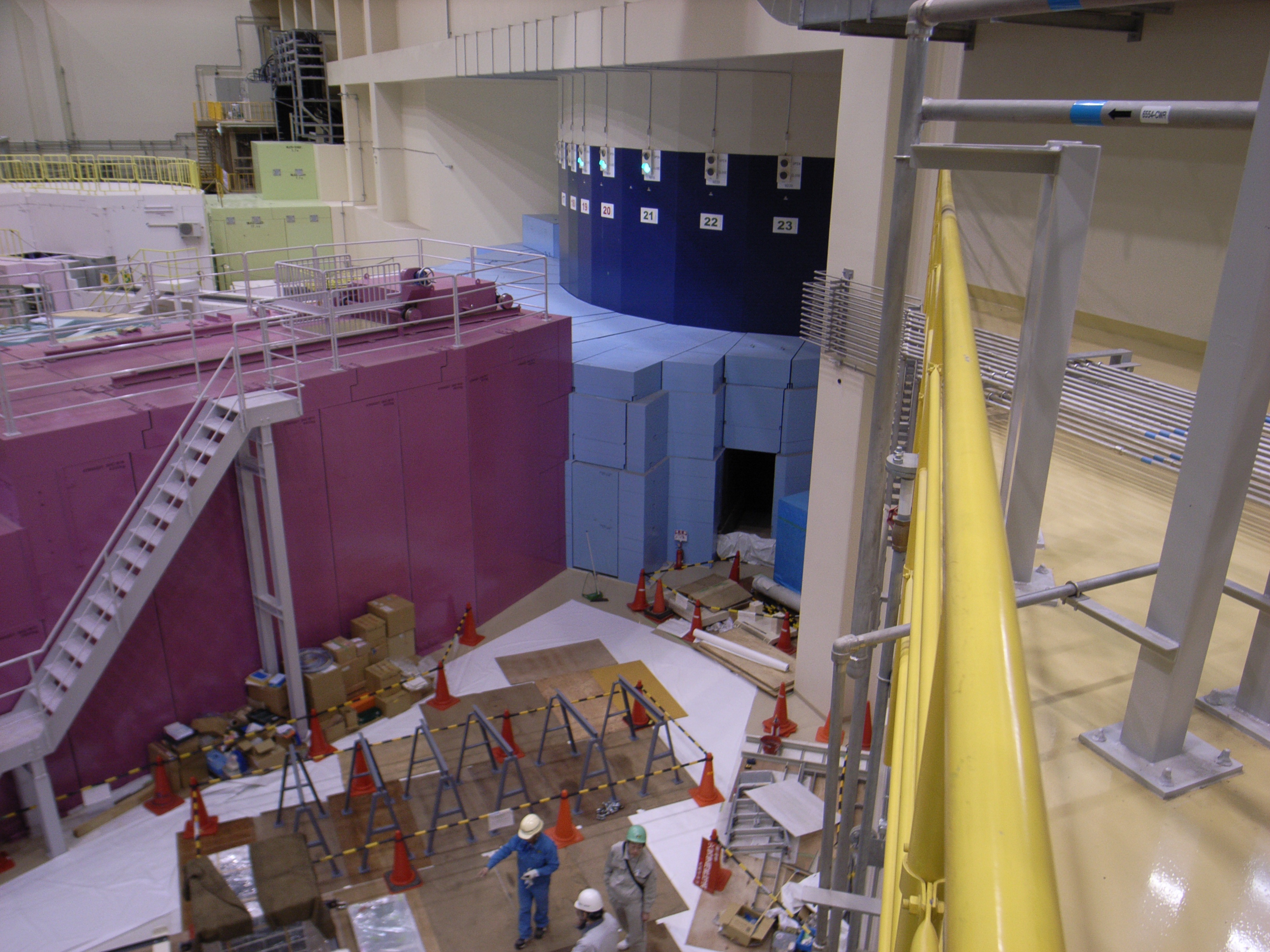
J-PARC's power comes from a chain of three accelerators, each handing off protons at higher energies. The 400 MeV linear accelerator -- the linac -- fires protons into the 3 GeV Rapid Cycling Synchrotron, a ring that pulses 25 times per second and delivers the most intense pulsed proton beam of its kind in the world. Most of those protons head to the Materials and Life Science Experimental Facility, where they smash into mercury and tungsten targets to generate torrents of neutrons and muons. The remaining beam feeds into the 30 GeV Main Ring synchrotron, a larger ring that accelerates protons to even higher energies. From the Main Ring, beams split toward two destinations: the Hadron Experimental Facility, where collisions produce exotic particles like kaons and pions, and the Neutrino Experimental Facility, where protons strike a graphite target to create the neutrino beam that travels 295 kilometers west to the Super-Kamiokande and future Hyper-Kamiokande detectors in Gifu Prefecture.
Neutrinos Across Honshu
The neutrino beam line is J-PARC's most celebrated feature. It powers the T2K experiment -- Tokai to Kamioka -- which in 2013 provided the first conclusive evidence that muon neutrinos transform into electron neutrinos as they travel. This discovery confirmed a key piece of the puzzle of neutrino oscillation, a phenomenon that proves neutrinos have mass and earned a Nobel Prize for the scientists who first demonstrated it at Super-Kamiokande. The beam is aimed slightly off-axis from the detector, a deliberate trick that narrows the energy spectrum and makes oscillation measurements more precise. When Hyper-Kamiokande begins collecting data around 2028, J-PARC's upgraded beam will drive the next generation of these experiments, probing the matter-antimatter asymmetry that may explain why the universe is made of matter rather than nothing.
A Factory of Discovery
Beyond neutrinos, J-PARC serves as a versatile research engine. The Materials and Life Science Facility hosts instruments that use neutron and muon beams to study everything from the molecular structure of proteins and polymers to the behavior of battery materials and superconductors. Neutron scattering reveals the positions of atoms inside crystals with a precision that X-rays struggle to match, particularly for light elements like hydrogen. The Hadron Facility pushes into stranger territory: experiments there study rare decays of kaons and search for particles that could signal physics beyond the Standard Model. The complex also hosts research into accelerator-driven nuclear waste transmutation, a technology that could one day use intense proton beams to transform long-lived radioactive waste into shorter-lived or stable isotopes.
Coastal Science Hub
J-PARC sits on a campus that has been central to Japanese nuclear research since the postwar era. The village of Tokai, facing the Pacific on the eastern coast of Ibaraki Prefecture, also hosts the Tokai Nuclear Power Plant and nuclear reprocessing facilities. Construction on J-PARC began in 2001, and the linac delivered its first beam in 2007. The facility survived the 2011 Tohoku earthquake -- located roughly 300 kilometers south of the epicenter -- and resumed operations after repairs. Today the complex sprawls across a campus visible from the air as a cluster of large, low-slung buildings and the distinctive circular outlines of its synchrotron rings, set between farmland and the Pacific shoreline. It employs hundreds of scientists and engineers and attracts visiting researchers from around the world.
From the Air
J-PARC is located at 36.45N, 140.61E on the Pacific coast of Ibaraki Prefecture, in the village of Tokai. From the air, the facility is identifiable by the large circular outlines of its synchrotron rings and the cluster of experimental halls on the JAEA campus. Nearest airport: Ibaraki Airport / Hyakuri Air Base (RJAH) approximately 30nm south. Narita International Airport (RJAA) is approximately 45nm southwest. The coastal location offers generally good visibility, though sea fog can roll in during spring and early summer. The facility sits near other nuclear installations including the Tokai Nuclear Power Plant, visible as large industrial structures along the shoreline.