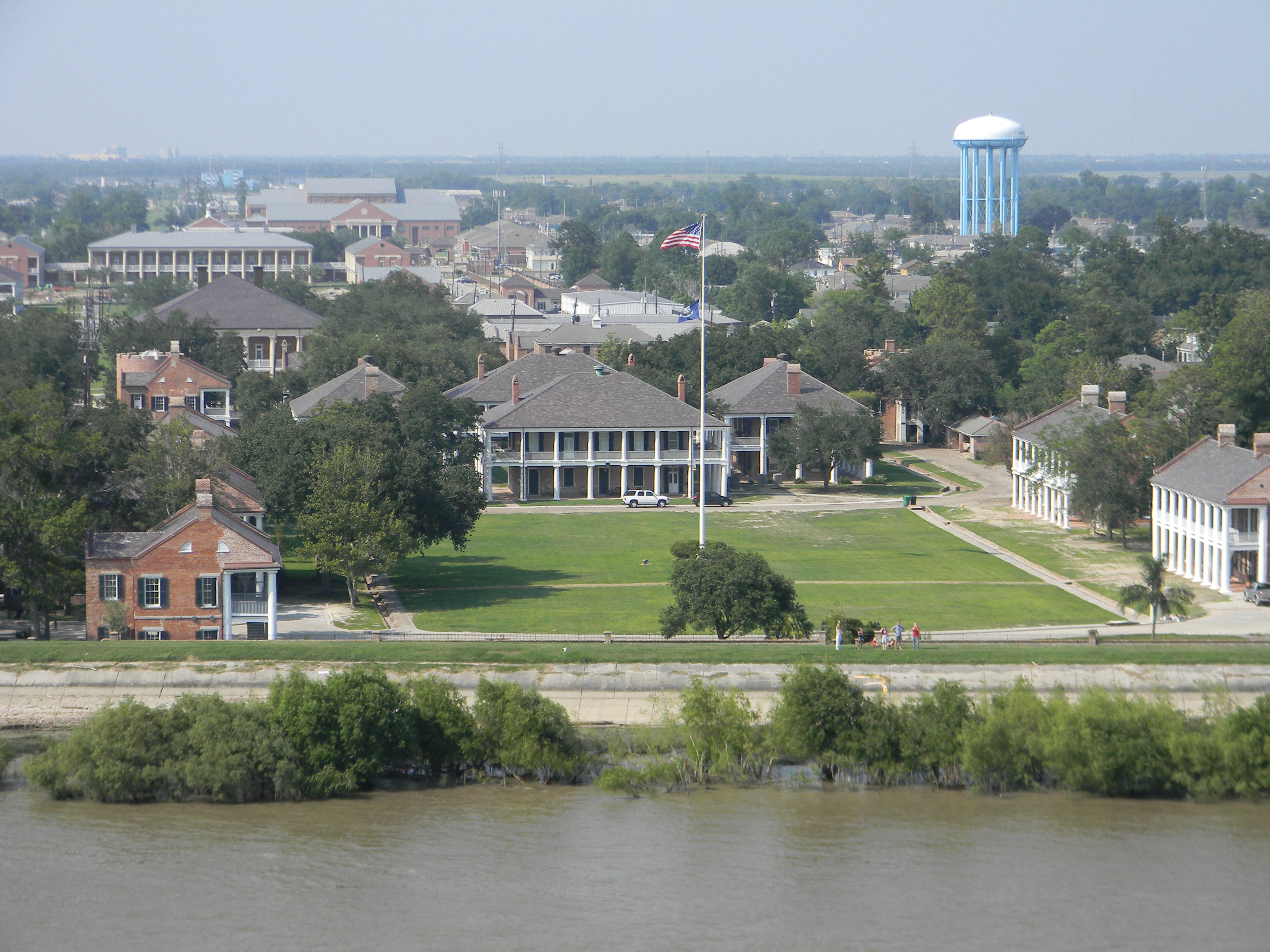
Jackson Barracks
Ulysses S. Grant, Robert E. Lee, J.E.B. Stuart, and P.G.T. Beauregard all walked the same quadrangle -- though never at the same time. That quadrangle belongs to Jackson Barracks, a fortified compound pressed between the Mississippi River levee and St. Claude Avenue in New Orleans' Lower Ninth Ward. Established in 1834 as "New Orleans Barracks," the post was designed by Lieutenant Frederick Wilkinson as a logistics hub for a chain of Gulf Coast forts. Its four three-story guard towers, windowless rear walls, and ten-foot brick facade gave the complex the profile of a small fortress rather than a simple garrison. By February 1837, the first troops had moved in, and the post began its long, tangled service to a nation that would soon tear itself apart.
A Fortress Between River and Road
The Federal Fortifications Act of 1832 provided over $180,000 to shore up coastal defenses after the War of 1812 exposed America's vulnerabilities. On December 14, 1833, the government purchased a 100-by-300-yard parcel from Pierre Cotteret, and Wilkinson set to work designing a compound that doubled as a defensive position. The buildings formed a quadrangle intended as a rallying point in the event of attack, with their backs serving as walls. The river side featured a levee, road, railroad, and trolley track; the St. Claude side housed a powder magazine for ammunition storage. Colonel David E. Twiggs of the 2nd Regiment of Dragoons became the first commandant, presiding over a post that would funnel troops to the Mexican-American War and, in 1849, host the construction of the nation's first federally operated veterans' hospital.
Blue, Gray, and Buffalo Soldiers
When Louisiana seceded in 1861, Confederate forces seized the barracks and held it for less than a year before Federal troops recaptured the post in 1862. On July 7, 1866, the compound was renamed Jackson Barracks in honor of Andrew Jackson, the general who won the Battle of New Orleans -- "Old Hickory" himself. Three years later, Congress reorganized its African American regiments, consolidating the 39th and 40th Infantry into the 25th Infantry Regiment, which was headquartered at Jackson Barracks under Colonel Joseph A. Mower. Known as the Buffalo Soldiers, these men served through the Indian Wars and the Spanish-American War, writing a chapter of military history too often overlooked in the shadow of the antebellum officers who preceded them.
Polo Fields and the Kingfish
After World War I, the federal government declared the property excess and handed it to Louisiana. Major General Raymond Fleming made Jackson Barracks the headquarters of the Louisiana National Guard, transforming it from an infantry post into a cavalry and artillery installation complete with horse stables and a polo field for weekend exhibition games. But the Mississippi had other plans. In 1912, the river breached the levee protecting the post, destroying the road, railroad, and trolley tracks. The front guard towers and executive building had to be dismantled to make room for a new levee. During the Great Depression, Governor Huey P. Long leveraged his Washington connections to secure Works Progress Administration funds, and WPA crews extensively renovated the post, building a new executive office named Fleming Hall. When World War II began, the federal government reclaimed the barracks as a port of embarkation, replacing the polo field with temporary billets for men shipping overseas.
Twenty Feet of Water
On August 29, 2005, Hurricane Katrina made landfall as a Category 3 storm. The storm surge breached the Industrial Canal levee and submerged Jackson Barracks under more than twenty feet of water. Residents and troops were evacuated by boat to the Mississippi River levee, then airlifted by National Guard helicopters to the Louisiana Superdome. The tidal surge virtually destroyed the entire complex. Secretary of the Army Francis J. Harvey, surveying the devastation, called Jackson Barracks "a very important piece of American history that needs to be preserved." Congress authorized full funding for reconstruction -- $325 million in total. The 1837 Old Powder Magazine and fourteen antebellum homes in the Original Garrison received a $35 million FEMA restoration. Architects matched the original Greek Revival style, restoring over 17,500 square feet of wood-framed buildings using original materials where possible. All new structures were redesigned with operational infrastructure above the first floor.
Standing Guard Again
In 2013, the Ansel M. Stroud, Jr. Military History and Weapons Museum reopened in a new multi-use complex, with exhibits spanning the Louisiana Guard's response to Hurricane Katrina, the Global War on Terror, and the Gulf War of 1990-1991. The museum holds artifacts from each of the nine major United States conflicts and is part of the Army Museum System. Today Jackson Barracks continues as the headquarters of the Louisiana National Guard, a post that has served under two flags, housed future presidents and generals, weathered the worst natural disaster in American urban history, and rebuilt itself from the waterline up. The compound sits where it always has -- between the river and the road, on ground that has been fought over, flooded, and restored for nearly two centuries.
From the Air
Jackson Barracks sits at 29.95N, 90.01W along the east bank of the Mississippi River in New Orleans' Lower Ninth Ward. From the air, look for the distinctive quadrangle layout nestled between the river levee and the urban grid of St. Claude Avenue. The nearest airports are Louis Armstrong New Orleans International (KMSY) approximately 15 nm west, and New Orleans Lakefront Airport (KNEW) about 6 nm north. Best viewed at 2,000-3,000 feet AGL on approach from the east along the river bend.