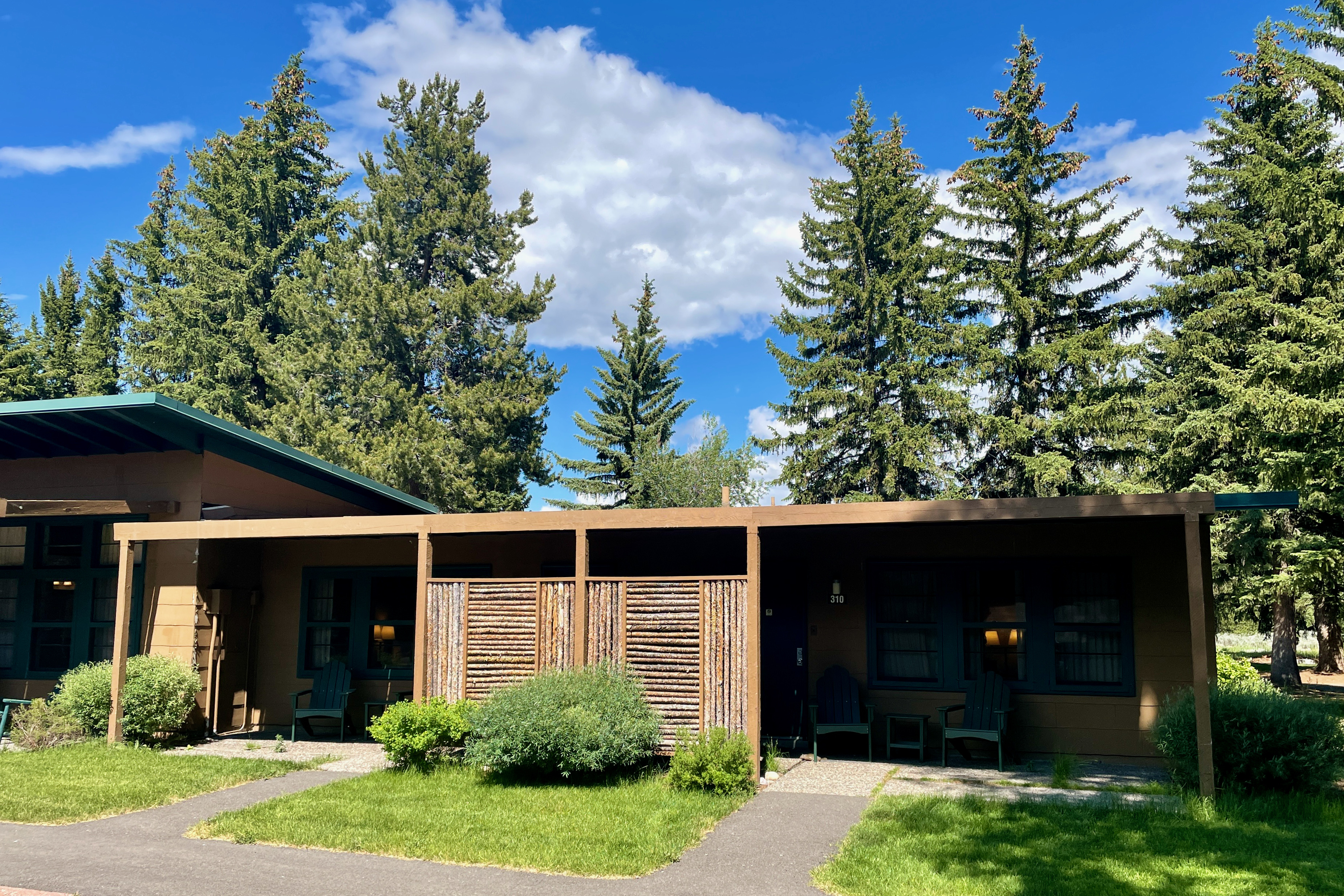
Jackson Lake Lodge
The world's most influential central bankers gather each August in a building that was once dismissed as an eyesore. Jackson Lake Lodge, with its 60-foot picture windows framing the Teton Range, hosts the Federal Reserve's annual economic symposium where decisions affecting global markets are debated over coffee with a view of wandering moose. The contrast is deliberate and quintessentially American: raw wilderness meets high finance, log cabin aesthetics meet modernist concrete, democratic access meets elite discourse.
A Rockefeller's Gamble
In 1950, John D. Rockefeller Jr. hired Gilbert Stanley Underwood with a radical brief: design a lodge that would make national parks accessible to all Americans, not just the wealthy who could afford rustic luxury. Underwood, who had designed the grand lodges at Bryce Canyon and Zion, pivoted from pure rusticism to something new. The result, completed in 1955, shocked traditionalists. Concrete walls were textured to mimic wood grain. The profile stayed low, receding into aspen and pine rather than dominating them. Native plants replaced manicured lawns. The National Park Service called it Mission 66 modernism. Critics called it a concrete bunker. Time would prove Rockefeller right: the building now stands as a National Historic Landmark, celebrated for the very modernism that once scandalized park purists.
Where Moose Meet Markets
Since 1982, the lodge has hosted the Jackson Hole Economic Symposium, organized by the Federal Reserve Bank of Kansas City. The event draws central bank governors, finance ministers, and academic economists from around the world. The setting is intentional: removed from the corridors of power, surrounded by wilderness, participants are meant to think differently. Moose graze the willow flats below the lodge while inside, speeches move markets. Janet Yellen, Mario Draghi, Jerome Powell, and their global counterparts have all stood at podiums here, their words parsed by traders across time zones. The symposium has become so influential that financial journalists now compete for invitations to cover what happens in this remote Wyoming valley.
The View That Defined a Building
Everything at Jackson Lake Lodge is oriented toward one experience: the vista. The main lobby's 60-foot windows frame Mount Moran and the Teton Range across the willow flats of Jackson Lake. At dawn, the peaks catch first light while the valley remains in shadow. At sunset, alpenglow turns granite to amber. Underwood understood that architecture here had to compete with geology and chose not to compete at all. The building becomes a frame for the mountains, its 385 rooms and restaurants arranged to maximize the relationship between interior comfort and exterior spectacle. The effect is cinematic: floor-to-ceiling glass transforms the lodge into a viewing platform for one of North America's most dramatic mountain ranges.
From Tent Cabins to Global Stage
Before Rockefeller's modern lodge, this site held Eugene Amoretti's more modest Jackson Lake Lodge, built in 1922. Amoretti's establishment boasted the first hot and cold running water in the valley, a considerable luxury for its time. Guest cabins and tent cabins served visitors until the Snake River Land Company purchased the property in 1930. The 23 original cabins were demolished in 1953 to make way for Underwood's design. Today, the lodge anchors a National Historic Landmark District encompassing 38 contributing buildings, recognized for significance in architecture, recreation, and conservation. The Grand Teton Lodge Company manages the property along with Jenny Lake Lodge and Colter Bay Village, continuing Rockefeller's vision of accessible wilderness.
The Willow Flats Below
The land east of Jackson Lake, below the dam, remains prime moose habitat. From the lodge's terraces, guests watch these animals browse through willows, seemingly indifferent to human observation. The location was chosen for this adjacency: the drama of large mammals against a backdrop of glaciated peaks. In autumn, bull moose sport full antlers and the willows turn gold. In winter, the lodge closes, the roads fill with snow, and the moose have the flats to themselves. This seasonal rhythm defines Jackson Lake Lodge as much as its architecture does: a place that exists in dialogue with wildness, opening its doors only when the wilderness permits.
From the Air
Located at 43.8775N, 110.5767W near Moran, Wyoming in Grand Teton National Park. Best viewed at 8,000-10,000 feet AGL approaching from the east to capture the lodge against Jackson Lake and the Teton Range backdrop. The lodge's low-profile modernist design blends into the treeline. Jackson Lake and Jackson Lake Dam provide strong visual references. Nearby airports: Jackson Hole Airport (KJAC) 25nm south. Clear morning conditions recommended for best mountain visibility.