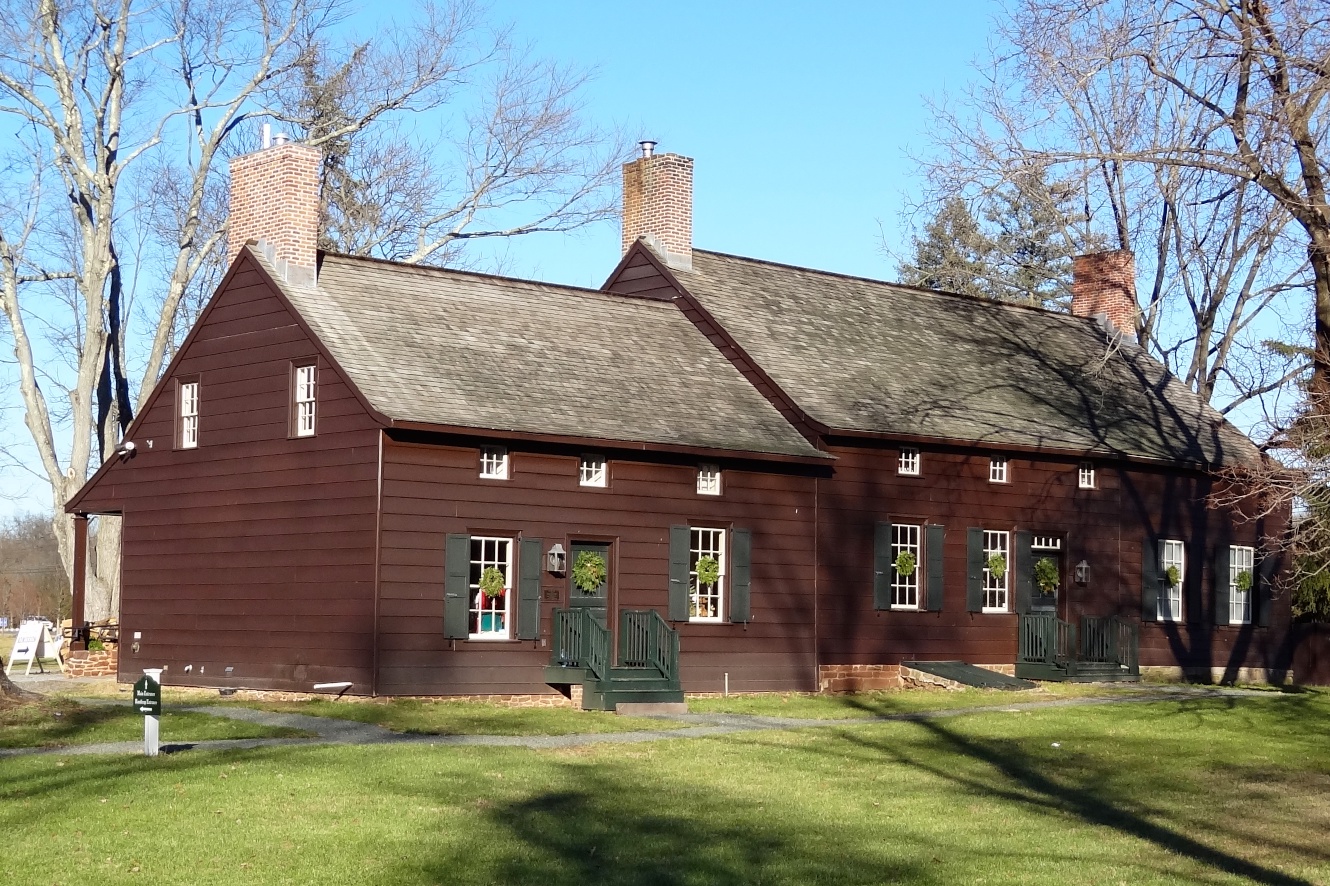
Jacobus Vanderveer House
During the winter of 1778-79, the Continental Army spread its senior officers across the farmhouses of Somerset County, New Jersey. George Washington took the Wallace House in Somerville. Nathanael Greene claimed the Van Veghten House. Lord Stirling settled into the Van Horne House. And Henry Knox, Washington's chief of artillery and the man who had hauled sixty tons of cannon over frozen mountains from Fort Ticonderoga, made his headquarters in a sturdy Dutch-American farmhouse near the village of Pluckemin. That house still stands.
A House Built Between Wars
The Jacobus Vanderveer House was built in the mid-1770s by James Vanderveer, who inherited the property from his father, the elder Jacobus Vanderveer. The timing matters: the house was barely finished when the Revolution arrived at its doorstep. Its Federal-style architecture reflects the Dutch-American building traditions that shaped the Somerset Hills, with proportions and materials suited to the agricultural landscape of the Raritan River valley. The house sits on part of what is now the 218-acre River Road Park, at the junction of US Routes 202 and 206 just north of River Road. It was added to the National Register of Historic Places on September 29, 1995, with the citation noting it as an "excellent example of a Dutch-American house." Today the property is owned by Bedminster Township and operated as a museum by the Friends of the Jacobus Vanderveer House, a nonprofit organization that maintains the structure and interprets its Revolutionary War significance.
Knox at Pluckemin
Henry Knox was one of the Revolution's most remarkable figures. A former Boston bookseller with no formal military training, he had taught himself artillery science from the volumes he sold and became Washington's most trusted ordnance officer. By the winter of 1778-79, Knox was overseeing the Pluckemin Artillery Cantonment, the Continental Army's first military academy for artillery officers. The cantonment, located nearby, represented an innovation in American military education. Knox chose the Vanderveer house as his personal headquarters for the second Middlebrook encampment, a winter camp that stretched across the Watchung Mountains' western slopes. From this farmhouse, he coordinated training, logistics, and the professionalization of an artillery corps that had been improvised from scratch just three years earlier.
A Constellation of Headquarters
What makes the Vanderveer House especially significant is its place within a network of Revolutionary War headquarters that still survive in Somerset County. Washington's Wallace House, Greene's Van Veghten House, Lord Stirling's Van Horne House, and von Steuben's Staats House are all within a few miles. Together, they form a map of how the Continental Army's senior leadership dispersed across civilian homes during winter encampments, relying on the hospitality and the sturdy construction of Dutch-American farmhouses to shelter the command structure of a revolution. The Middlebrook position was strategic: the Watchung ridgeline provided natural defense, and the Somerset Hills offered the supplies and shelter that an army in winter desperately needed.
What Remains
The house today operates as the Vanderveer/Knox House and Museum, interpreting both the domestic life of a Dutch-American farming family and the military history that briefly overtook it. The surrounding River Road Park provides the pastoral context that would have been familiar to Knox as he looked out over the frozen landscape in the winter of 1779. Bedminster Township, now better known for golf courses and corporate campuses, retains this thread of connection to the Revolution. The house is a quiet place, easy to drive past on the busy junction of Routes 202 and 206 without noticing. But for a few critical months, the decisions made inside its walls helped shape the outcome of the war that created the nation.
From the Air
Located at 40.67°N, 74.65°W near Pluckemin, Bedminster Township, Somerset County, New Jersey. The house sits at the junction of US 202 and US 206 north of River Road, within the 218-acre River Road Park. Nearest airports include Somerset Airport (KSMQ, 5 nm SE) and Morristown Municipal Airport (KMMU, 14 nm NE). Best viewed at 1,500-2,500 ft AGL. The house is a small structure within a larger park setting along the North Branch Raritan River corridor.