Jacumba Hot Springs, California
There is a spring in the high desert of San Diego County's eastern backcountry where water rises from the earth at 104 degrees Fahrenheit. The Kumeyaay knew this place. They called it something that later became Jacumba — a word the Spanish transcribed, then anglicized, then built a town around. At 2,829 feet, squeezed between the mountains and the Mexican border, Jacumba Hot Springs has been a destination, a crossing point, a massacre site, and a place that time largely moved on from. The springs are still there.
A Name Older Than the Town
Jacumba sits on Kumeyaay territory that predates any European presence in Alta California by thousands of years. The spring and its surrounding valley were part of the seasonal pattern of Kumeyaay life — the warmth of the water useful for reasons beyond comfort, the valley a corridor between the desert floor below and the mountains above.
The name itself has been read multiple ways: one interpretation suggests it derives from a Kumeyaay phrase meaning 'magic springs.' Whatever the original meaning, the phonetic ghost of the Kumeyaay language remained even after the people who named it were dispossessed of the land. The town that grew up around the spring in the late nineteenth century inherited the name along with everything else.
The Massacre of February 1880
On February 27, 1880, a group of Kumeyaay people were killed near Jacumba. The incident — which left fifteen Kumeyaay dead alongside one white man — arose from allegations of cattle rustling. What happened in the moments that led to the killing is recorded only from the perspective of those who survived with the power to write history down.
The massacre is part of a longer pattern of violence against Kumeyaay people in San Diego County's backcountry in the late nineteenth century, a period when the opening of the Southern Pacific railroad and the expansion of ranching and farming brought sustained pressure on Indigenous communities throughout the region. The spring at Jacumba, the valley around it, the mountains above it — none of these had belonged to the Kumeyaay in any legal sense for decades before 1880. The killing made clear what displacement had not fully finished.
The Hotel and the Bypass
In 1925, Hotel Jacumba opened and transformed the town's identity. The natural hot springs — channeled, heated, managed — became the centerpiece of a resort catering to travelers making the crossing between San Diego and the desert southwest. The hotel sat at 2,829 feet, high enough for cool summer nights even as the Imperial Valley baked below. For nearly six decades it drew visitors to a town that might otherwise have remained simply a border waypoint.
The hotel burned in 1983, destroyed in an arson fire. By then, the larger economic shift had already occurred. When Interstate 8 was built through the mountains east of San Diego, engineers routed it slightly north of the old Highway 80 alignment that ran through Jacumba. The bypass that Interstate 8 created did what bypasses always do — it moved traffic, commerce, and visibility elsewhere. The town that had existed at the junction of the old transcontinental route found itself off the main line.
The border crossing to Jacume, Baja California, closed in 1995, taking with it the cross-border traffic that had added another layer to Jacumba's economy. The combination of the interstate bypass, the hotel fire, and the border closure compressed decades of decline into a generation.
What Remains at 2,829 Feet
Jacumba Hot Springs today is a small community — a few hundred residents, a scattering of businesses, the springs themselves still producing water at 104 degrees. Jacumba Airport, designated L78, operates a 2,500-foot asphalt runway on the edge of town, a facility sized for small aircraft making the approach through desert mountain terrain.
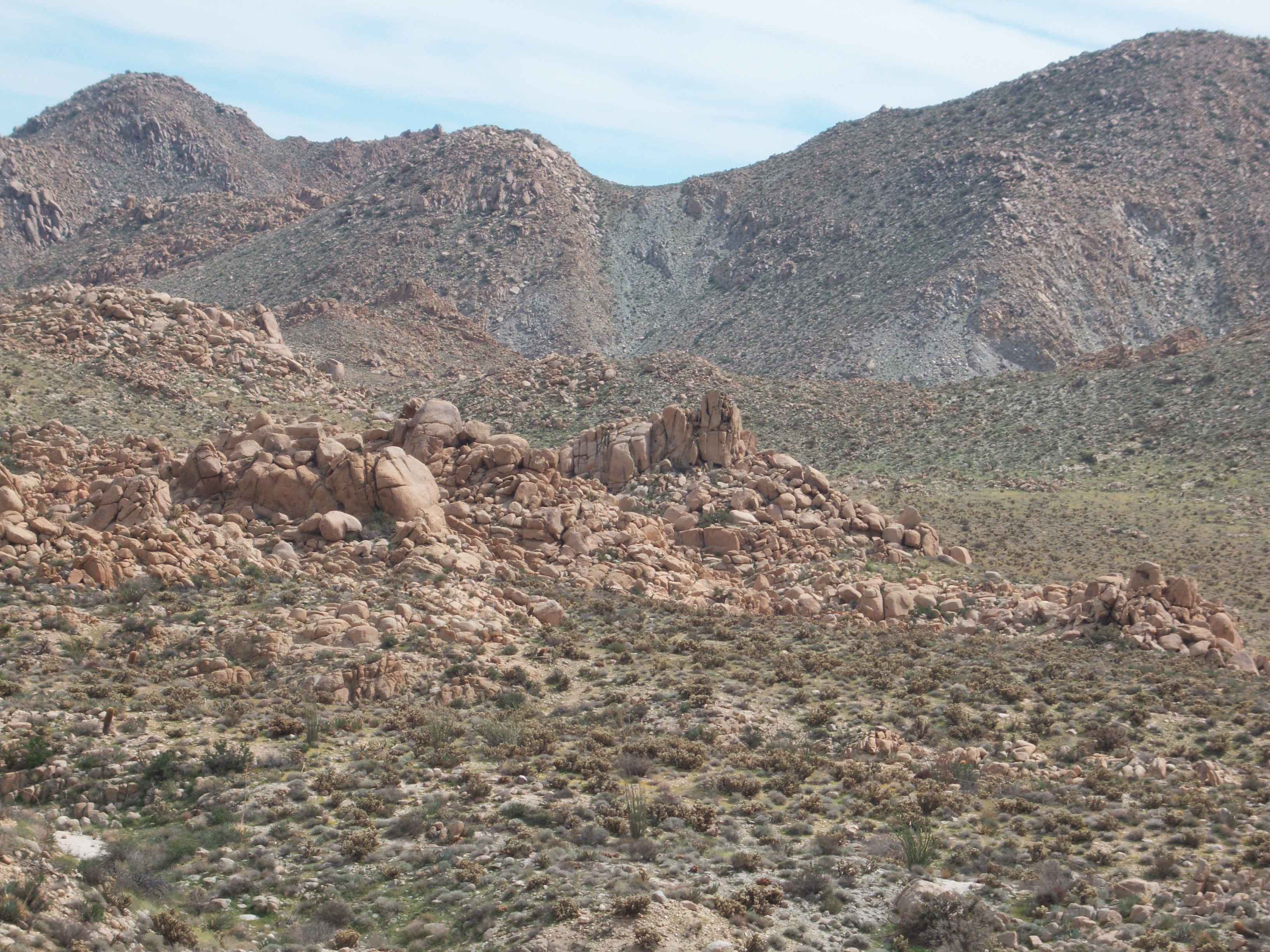
The landscape around the town is the landscape it has always been: the In-Ko-Pah Mountains rising to the north, the Jacumba Mountains forming the border ridge, the desert floor of the Imperial Valley visible far below the grade. The elevation that made Jacumba attractive as a resort destination — cool, clear, removed from the heat of the desert — is unchanged. The springs are unchanged. The old transcontinental crossing that the town grew up serving has simply been reassigned to a newer road running a few miles away, at a speed that makes stopping unnecessary.
From the Air
Jacumba Hot Springs is located at approximately 32.617°N, 116.188°W at 2,829 feet elevation in eastern San Diego County, near the Mexican border. The town is visible from Interstate 8 and identifiable by its position on the high desert bench between the In-Ko-Pah and Jacumba Mountains. Jacumba Airport (L78) has a 2,500-foot asphalt runway. Nearest airports: KSAN (San Diego International, ~55 nm W), KIPL (Imperial, ~35 nm E), KSEE (Gillespie Field, ~40 nm NW).