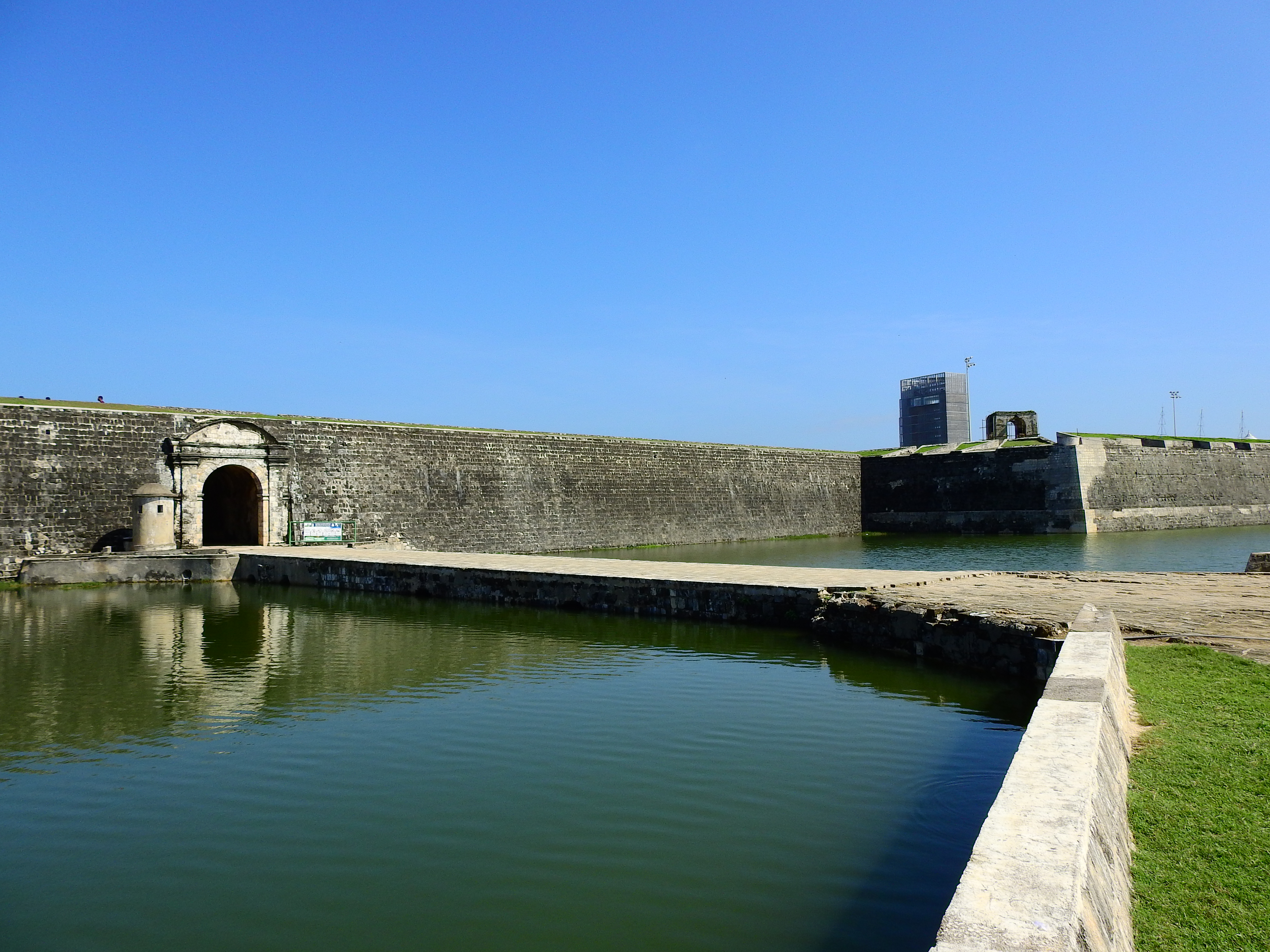
Jaffna Fort
The Portuguese called it the Fortress of Our Lady of Miracles of Jafanapatao, naming it for a statue of the Virgin Mary in a nearby church to which locals attributed supernatural powers. Whatever miracles that statue may have performed, they did not protect the fort from what came next: four centuries of sieges, occupations, demolitions, and reconstructions that turned a simple colonial outpost into one of the most contested pieces of ground in South Asian military history. Jaffna Fort has flown the flags of Portugal, the Netherlands, Britain, Ceylon, Sri Lanka, and the Liberation Tigers of Tamil Eelam. Each left marks on the walls -- and some left no walls at all.
Three Empires, One Peninsula
Phillippe de Oliveira built the original fort in 1618, during the final stages of the Portuguese conquest of the Jaffna Kingdom, which was completed in 1619. It was a conventional four-sided structure, functional rather than elegant, positioned near the coastal village of Gurunagar to control the peninsula's northern approaches. The Portuguese held it for forty years before the Dutch, under Rijcklof van Goens, took it in 1658. The Dutch were not interested in inheriting someone else's architecture. In 1665, they demolished the Portuguese fort entirely and redesigned it as a five-pointed star fortress -- an equal-sided pentagon with bastions at each corner, following the latest European military engineering of the day. The result was one of the finest Dutch fortifications in Asia, geometrically precise and formidable. When the British took control in 1795, they found a fortress that needed little improvement. It remained garrisoned until Sri Lankan independence in 1948.
The Buildings Within
A fort is more than its walls. Inside the star-shaped ramparts, Jaffna Fort contained a small colonial world: the Governor's Residence, known as King's House, where successive rulers administered the peninsula; Queen's House, an elegant companion building; and Kruys Church, a Dutch Reformed church whose name means "cross" in Dutch. The Garrison Parade Ground provided space for drills and ceremonies, while police quarters and Portuguese-era administrative buildings filled the remaining space. Unlike most Sri Lankan forts, Jaffna Fort contained almost exclusively government and military structures -- no civilian homes, no markets, no shops. This unusual purity of purpose made it the only truly dedicated military fort in the country, a place that existed solely for the projection and maintenance of power.
Besieged Again
When the Sri Lankan Civil War intensified in the 1980s, the fort's military significance was revived in ways its colonial builders never imagined. The Liberation Tigers of Tamil Eelam seized the fort in 1985 and held it for a decade. During those years, the LTTE deliberately destroyed several key features to deny the Sri Lanka Army a defensible position -- a grim echo of the Dutch demolishing Portuguese walls three centuries earlier. In 1995, the Sri Lanka Army recaptured the fort after a grueling 50-day siege during Operation Riviresa. The damage was not only military. Civilians scavenged stones and materials from the battered fort to rebuild homes destroyed in the fighting, accelerating the deterioration of structures that had survived centuries of conventional warfare.
Rebuilding What Remains
Today Jaffna Fort stands in a state of partial restoration, garrisoned by a detachment of the Sri Lanka Army with limited public access. The Dutch government has funded renovation efforts, a quiet acknowledgment of the colonial legacy written into every bastion and rampart. Walking the walls -- where access permits -- reveals the fort's layered history: Portuguese foundations beneath Dutch star points beneath British modifications beneath bullet scars from a late twentieth-century civil war. The view from the ramparts looks out over the Jaffna Lagoon toward the islands beyond, the same water that every occupying power watched for approaching enemies. The fort's story is not finished. Restoration continues, and proposals to open it more fully to visitors surface regularly. For now, it remains what it has always been: a place where the past is not a chapter in a textbook but a physical presence, embedded in coral stone and tropical air.
From the Air
Located at 9.662N, 80.008E on the northern coast of the Jaffna Peninsula, near the village of Gurunagar. The five-pointed star shape of the Dutch fortification is clearly visible from the air, especially at altitudes below 5,000 feet. The fort sits on the coast facing the Jaffna Lagoon. Jaffna International Airport (VCCJ/JAF) is approximately 7 nautical miles to the north. Look for the distinctive pentagonal outline surrounded by the moat -- it is one of the most recognizable geometric landmarks on the Sri Lankan coastline.