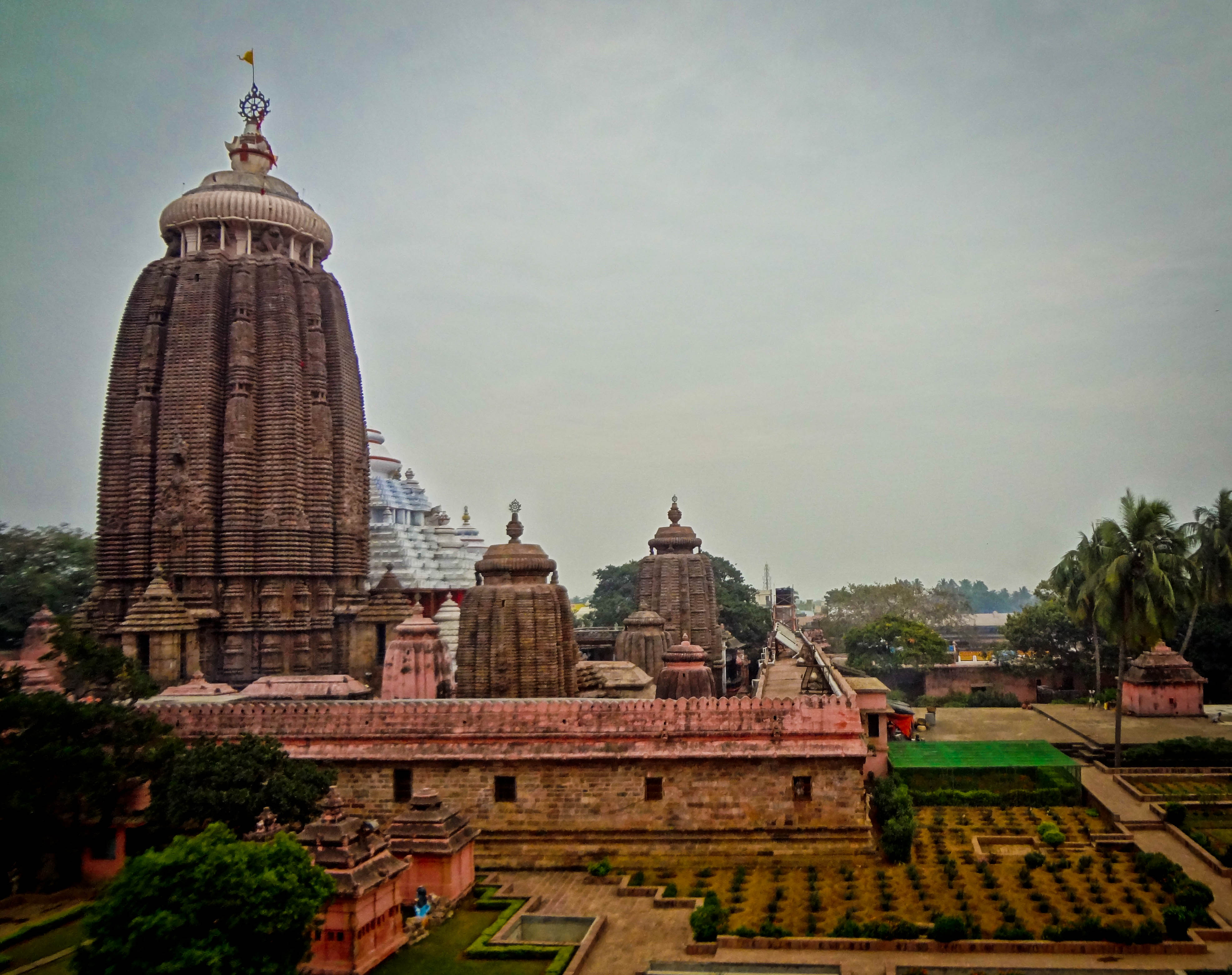
Jagannath Temple, Puri
Every twelve or nineteen years, the god dies and is reborn. The wooden image of Jagannath - Lord of the Universe - begins to decay, as wood inevitably does, and the priests of Puri undertake a month-long ceremony called Nabakalebara to carve an identical replacement from a sacred neem tree found through elaborate ritual divination. Before the old image is retired, something is transferred from its interior to the new one: an object called the Brahma Padartha, so sacred that the priest who handles it is blindfolded, his hands wrapped in cloth. No one knows what it is. Legend holds that it is the heart of Krishna himself, placed inside the original image millennia ago. This mystery sits at the center of a temple that has been continuously worshipped in for nearly a thousand years, rising 65 meters above the flat Odisha coast - the tallest temple in the state and one of the four sacred Char Dham pilgrimage sites that define the spiritual geography of India.
Stone Tower on the Eastern Shore
The Jagannath Temple dominates Puri the way a cathedral dominates a medieval European city - not just physically but psychologically. Its main tower, the vimana, rises 65 meters from a square base of approximately 24 meters per side, its curvilinear spire visible from far out at sea and from considerable distance inland. The present complex dates primarily from the rebuilding initiated by Anantavarman Chodaganga, the first ruler of the Eastern Ganga dynasty, in the 12th century, though temple records attribute the original structure to the legendary King Indradyumna of Avanti. The architecture follows Kalinga style, with four distinct structures arranged in a line: the vimana housing the sanctum sanctorum where the deities rest on the Ratna Mandapa - a platform 16 feet long, 13 feet wide, and 4 feet high - followed by the jagamohan or audience hall, the natamandira or dance hall, and the bhogamandapa or hall of offerings. The entire complex is enclosed by two concentric walls, the inner Kurma Bedha and the outer Meghanada Prachira, creating a compound that functions as a small city within the city of Puri.
Where Tribes and Traditions Meet
Most Hindu temples are served exclusively by Brahmin priests. Jagannath Puri breaks this pattern. The daily worship involves Bhil Sabar tribal priests alongside Brahmins, a practice that traces back to the origins of the Jagannath tradition itself - many of the temple's rituals are rooted in Shabari Tantras, which evolved from tribal religious practices. The daitas, non-Brahmin servitors who claim descent from the tribal Sabara community, have hereditary rights to dress and care for the deities. During the annual Rath Yatra, it is the daitas, not the Brahmins, who carry the images from the inner sanctum to the chariots. This institutional pluralism extends to the theological level. Jagannath has been claimed by Vaishnavites as a form of Vishnu, by Shaivites who note the temple's connections to Shiva worship, and by Buddhist scholars who see in Jagannath's origins a transformation of the Buddha. The great Vaishnava saints - Ramanuja, Madhvacharya, Chaitanya Mahaprabhu - all made pilgrimages here. Adi Shankaracharya established the Govardhan Math nearby, one of the four seats of the Shankaracharya tradition.
The Largest Kitchen in the World
The Jagannath Temple's kitchen is said to be the largest in the world, and the claim is plausible. The Mahaprasad - food first offered to the deity and then distributed to devotees as a sacred blessing - feeds an estimated 100,000 people on ordinary days. During festivals, that number multiplies. The cooking is done in earthen pots stacked one on top of another over wood fires, a method that has not changed in centuries. Rice, dal, vegetables, and sweets are prepared by a hereditary class of temple cooks, the Supakaras, who follow strict ritual procedures. The food is carried to the deities on the heads of the cooks and offered in the sanctum before being distributed in the Ananda Bazar, the marketplace adjacent to the temple where anyone - regardless of caste, wealth, or social standing - can eat. This radical equality of the dining hall has been a deliberate feature of the Jagannath tradition, a theological statement made three times daily in rice and dal: before the Lord of the Universe, every mouth is the same.
Chariots That Move Mountains
The annual Rath Yatra is the Jagannath Temple's most visible expression to the outside world. Three enormous chariots - newly built each year from wood - carry the images of Jagannath, Balabhadra, and Subhadra from the main temple along the Bada Danda to the Gundicha Temple, three kilometers away. The Nandighosha, Jagannath's chariot, stands approximately 13 meters tall and rolls on 16 wheels. Hundreds of thousands of devotees pull the ropes, and the procession can take an entire day. The English word 'juggernaut' derives from this festival - early European observers, watching the massive chariots roll through crowds so thick that fatal crushings occurred, coined the term from 'Jagannath' to describe any unstoppable force. The word's violent connotation misrepresents the festival's spirit, which is one of ecstatic devotion rather than danger, but it preserved the temple's name in an unexpected corner of the English language.
A Living Tradition at India's Edge
Puri sits at the eastern edge of India, where the flat Odisha coast meets the Bay of Bengal. The temple's flag, mounted atop the vimana, is changed daily by a priest who climbs the tower without safety equipment - a feat that draws its own crowds of onlookers. The temple's shadow, according to local belief, never falls on the ground, though this has more to do with the tower's geometry than with miracles. From the top of the temple, the sea is visible in one direction and the green expanse of coastal Odisha stretches to the horizon in every other. The Jagannath Temple is not a museum or a monument. It is a functioning religious institution that feeds, employs, and spiritually sustains the city that has grown around it over nearly a millennium. The wooden gods at its center must be periodically replaced because wood decays - but that necessity has been transformed into theology. The Lord of the Universe is reborn because impermanence is not a flaw but a feature. The body changes. What is carried inside - blindfolded, wrapped in cloth, unknowable - endures.
From the Air
Located at 19.80°N, 85.82°E on the Bay of Bengal coast in the town of Puri, Odisha. The temple's 65-meter vimana tower is the tallest structure in Puri and serves as a recognizable landmark from the air. Biju Patnaik International Airport (VEBS) in Bhubaneswar is approximately 60 km northwest. From altitude, Puri is visible as a coastal town with the prominent temple complex near the shoreline. The Bada Danda (Grand Avenue) extends 3 km north to the Gundicha Temple. The Bay of Bengal coastline and Puri Beach are immediately east of the town. Best visibility October through February; monsoon season June-September brings heavy cloud cover. The temple complex's concentric walls and the large Ananda Bazar marketplace are visible at lower altitudes.